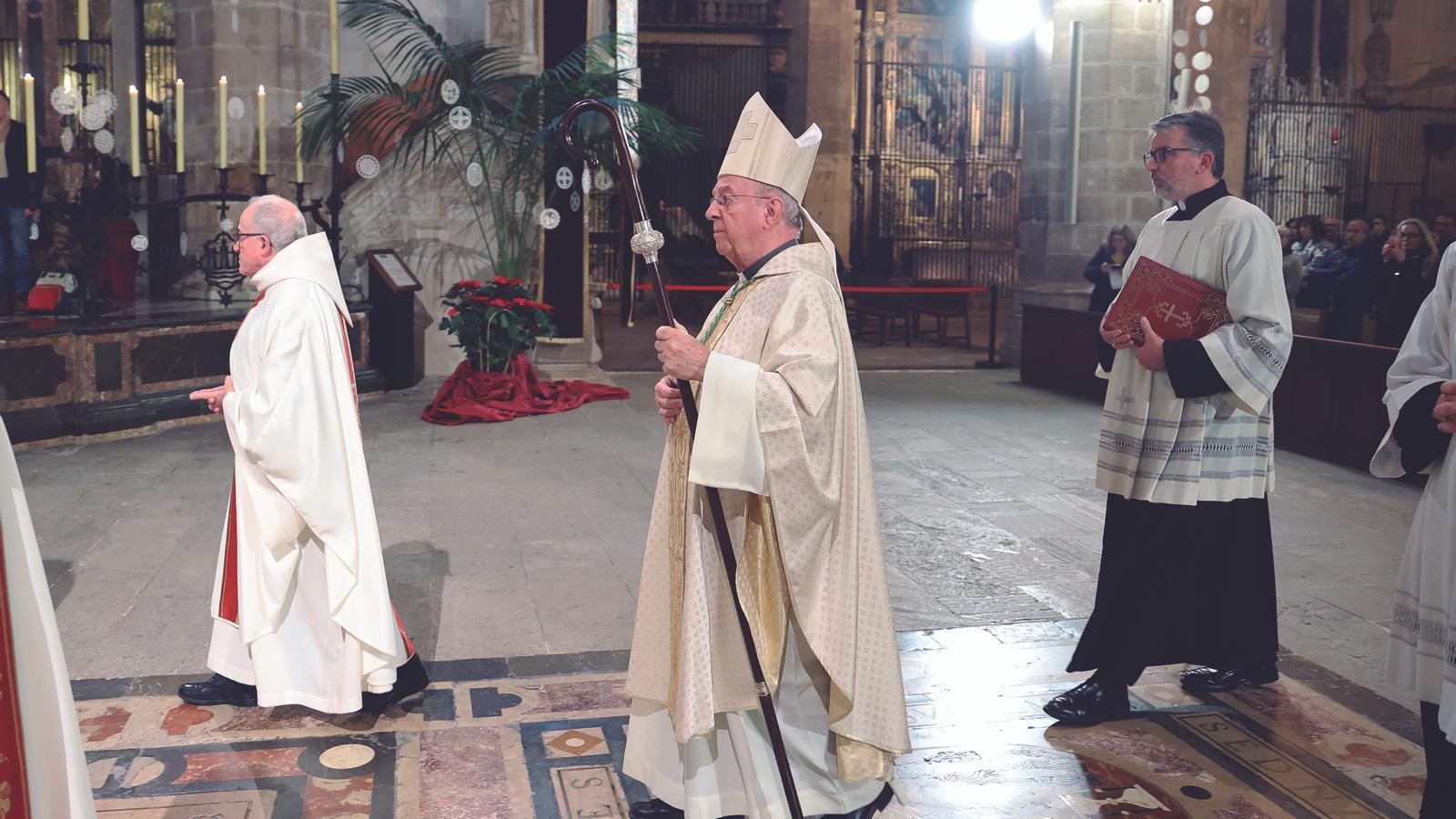
In the middle of the debate about massification, the prelate of Mallorca Sebastià Taltavull vindicates to ARA Balears the pastoral letter in defense of the territory that in 1990, when he was vicar general of Menorca, he helped to draft. Unusually, the document, a whole plea against capitalism, bore the joint signature of the three bishops of the Archipelago
5 min
The bishop of Mallorca at the Cathedral on the evening of Matins.ISAAC BUJ
PalmaIn 1990, the current bishop of Mallorca, Sebastià Taltavull, aged 78 and from Ciutadella, was vicar general of Menorca and a great activist in the environmental movement. "As a delegate for the diocese's youth," he asserts, "I helped organize many demonstrations in defense of the land. I also wrote articles of denunciation for the newspapers. It was clear to me that defending the territory was defending the people, their identity, and their language." At the end of 1973, Menorca led the green struggle in the Archipelago, demanding the protection of the Albufera del Grau, north of Maó, where a mega-urbanization with an exotic name, Shangri-La, had been planned. It was not until 1995, almost two decades later, that the site was declared a Natural Park.
In the rest of the Balearic Islands, in July 1977, the historic occupation of Sa Dragonera (Andratx) took place; and in October, 2,000 people demonstrated in Ibiza with the cry of ‘Save the Salt Flats’. With the restoration of democracy, the well-known toponymic struggles led by GOB, founded in 1973, followed: ‘Save Es Trenc’, ‘Save La Canova’, ‘Save Cala Mondragó’, ‘Save Cabrera’... They were pristine places threatened by the well-known 'balearization'. The term had emerged at the end of the 50s to allude to the unbridled predation of the coast that the Franco regime promoted to ensure good foreign currency after the failure of autarky. The massive arrival of tourists made the construction of motorways necessary, which would end up turning the island into an authentic slot-car track. Little by little, the agricultural past of some Islands that would be further disfigured from 1986 with the integration of Spain into the European Union was forgotten. The measure enabled the free movement of capital and people within the European space.
Pioneering pastoral
In 1990, the Church raised the alarm over the social unrest generated by more than three decades of boom tourism. It was a reality it knew closely. In 1964, the Felanitx priest Bartomeu Bennàssar had written a pioneering doctoral thesis on the consequences that the sun and beach industry would have on the Balearic Islands. It was titled Turismo y pastoral. Síntesis de teologia de las vacaciones. Those years would also see a series of worker-priests like Jaume Santandreu and Francesc Obrador who helped the most vulnerable hospitality workers.
“The worrying evolution of the tourism industry –asserts Taltavull– demanded a response from the Church. It came in the form of a pastoral letter. It was the first joint one in history signed by the representatives of the three dioceses of the Balearic Islands, which are not merged into one provincial one.” At that time, Teodor Úbeda was the bishop of Mallorca; Manuel Ureña, of Ibiza-Formentera; and Antoni Deig served as diocesan administrator of Menorca. “I, as vicar general of Menorca, helped them draft the document based on the opinion of about 800 people surveyed from various professional backgrounds: hotel owners, sector workers, politicians, citizens...”
The Bishop of Mallorca, Sebastià Taltavull M.À. Cañellas (UH)
The pastoral letter was published in April 1990, on Easter Sunday, with the title Ecology and tourism in our Islands. Guidelines for a Christian action. “Today, 36 years later –laments Taltavull–, it is chilling to note its relevance”. The 23-page document began by reclaiming the etymology of the word ‘ecology’, which comes from the Greek ‘oikos’ (‘house’). Thus, it recalled that nature is the ‘house’ of humanity. The reflection referred to a passage in the Bible (Genesis, 1:28) associated with the idea of progress. It is the passage in which God blesses the newly created human being and gives them the following mandate: “Be fruitful and multiply, fill the Earth and subdue it; have dominion over the fish of the sea, the birds of the air, and every living thing that moves on the earth”.
“Throughout the last three decades –denounced the three bishops– there has been a kind of building fever in tourist and urban areas, taking advantage of the lack of territorial and urban planning. Large apartment complexes and hotel establishments have been built in open contradiction with our own style and culture, even without the minimum required taste and quality and without respecting the natural requirements of the landscape. Our cities and many towns have grown in an anarchic and dehumanized way, with merely pragmatic criteria and abusive use of the land, without the corresponding attention to public spaces and, in general, with a regrettable taste”.
The prelates held "man" responsible for the "ecological disaster". They accused him of being moved "by an excessive desire for immediate profit, with a kind of suicidal improvisation that seeks to ignore the future consequences of daily actions". The pastoral letter also listed negative aspects of tourism. It spoke of "the continued erosion of the identity signs of our peoples", of "a considerable decline in certain religious and moral values of a personal and family nature", of "the imposition of purely mercantilist criteria", of the "imbalance in the distribution of benefits between capital and labor", of a working class living in a world "overwhelmed by work and economic limitations", of the "continued growth of materialism, consumerism, and hedonism", and of the "abandonment of economic alternatives to tourism".
Aside from these criticisms, the bishops were also able to highlight the positive side of the well-known goose that lays the golden eggs: "Tourism, as of today, can be said to be the bread of our Islands. It is mandatory to recognize this and to work to safeguard and improve this primary and complex source of income for our society [...]. It has favored contacts of friendship and understanding between our peoples and a great diversity of people and communities. It has been for us a true and privileged means of social communication and opening to the world".
The episcopal x-ray, however, ended with an urgent request: "It would be good if we all began to make a true examination of conscience regarding our ecological faults". These were words that were in harmony with the thinking of the pope at the time, John Paul II. "Modern society – wrote the supreme pontiff – will not find a solution to the ecological problem if it does not seriously revise its lifestyle. This society is inclined towards hedonism and consumerism, but remains indifferent to the damages they produce. If the sense of the value of the person and of human life is missing, indifference towards others and towards the Earth increases. Austerity, temperance, self-discipline, and the spirit of sacrifice must shape everyday life".
Dragonera demonstration in October 1979.BIEL PERELLÓ and EDUARD MIRALLES
Social collapse
“The 1990 pastoral letter –states Taltavull– had a great repercussion both in civil society and in politics. Very soon, however, it fell into oblivion”. In 1991, in the investiture session of his third term as president of the Autonomous Community, the popular Gabriel Cañellas proclaimed: “We want to turn the Balearic Islands into Europe's second home”. In 1993, Menorca protected itself from the new building fever with the declaration of Biosphere Reserve by UNESCO. However, at the beginning of the 21st century the momentum of economic globalization was unstoppable. In 2002 the first Progress Pact of the socialist Francesc Antich tried to mitigate its effects with the ecotax. The pioneering measure had the opposition of the hotel sector and was repealed in 2003 by the new executive of the conservative Jaume Matas, former Minister of Environment under José María Aznar.
Today, the social collapse is added to the ecological collapse denounced 36 years ago by the island bishops. We have gone from receiving 6.3 million tourists in 1990 to 20 million. In the last 25 years, the population in the Archipelago has doubled to exceed 1.2 million inhabitants. There is no region in Europe that has experienced such spectacular demographic growth. Nearly 50% of residents were born abroad. Furthermore, according to data from the National Statistics Institute of 2021, only 27% speak Catalan with their family, while more than half (54%) always use Spanish. Tourism is no longer a source of wealth. Every time there are more working poor who cannot afford decent housing. Immigrants, however, prefer this precariousness to that of their countries of origin. “The capitalist system –points out the priest– must be regulated so that people do not suffer so much”. Since he was appointed Bishop of Mallorca in 2017, Taltavull has become a voice crying out in the wilderness. His convictions are ironclad. “Last June –he says– I had the opportunity to accompany Pope Leo XIV on his trip through Spain. I remember the message he launched during his visit to the Canary Islands. He asked immigrants to make the effort to learn and respect the language of the host land”. The prelate appeals to his parishioners to maintain their identity. He does so by quoting some verses from La Balanguera, the official anthem of Mallorca: “It knows that the trunk climbs higher the deeper it can take root”.
Tourism Pastoral Ministry
In 1964, in the midst of the tourism boom, the first Tourism Pastoral Assembly took place in Malaga. The papers presented there were in tune with the renewing spirit of the Second Vatican Council (1962-1965). They insisted on the need to attend to the most vulnerable sectors of the sun-and-beach industry, particularly the workers. In the Balearic Islands, between 1960 and 1970, nearly 130,000 workers arrived from the most impoverished regions of the Peninsula. Many were illiterate and lived in subhuman conditions in hotel basements, in what were known as 'larriguera' (burrows). Worker-priests like Jaume Santandreu and Francesc Obrador rolled up their sleeves to teach them how to read and write and to offer them legal assistance that would allow them to better defend their rights.
In 1961, three years before the Tourism Pastoral, the Bishop of Mallorca, Jesús Enciso, had promoted the creation of Diocesan Caritas. The parent organization, Cáritas Española, was established in 1947 within the framework of Catholic Action, which was one of the main ideological pillars of Francoism. Various Christian groups that had long been working with the tourism underworld converged around Caritas. One of their pioneering initiatives was the 'Acolliments' (Welcoming) program, which became the cradle of trade unionism in Mallorca. Located in S'Arenal, Magaluf, and Plaça del Progrés in Palma, these were meeting points for hospitality staff. They offered social care services and even daycare centers for the children of working mothers.
Among the Christian groups, a prominent activist was Maena Juan (1932-2019). The daughter of one of the wealthiest families in Mallorca, she began working in hotels at a very young age, alongside the most disadvantaged. She invested a large part of her inheritance in the creation of a cooperative center for hospitality workers in Palma. It was popularly known as Mar 6, named after the street where it was located. Within the Church, Bartomeu Bennàssar from Felanitx also became involved in the new social reality of the Balearic Islands. He was the diocesan delegate for tourism (1971-1976) and a member of the Department of Pastoral and Tourism of the Spanish Episcopal Conference (1971-1974). In 1974, together with Carmel Bonnín, he wrote Guía del trabajador de hostelería (Hospitality Worker's Guide), a true plea against labor exploitation in the sector.
In 1973, Teodor Úbeda assumed the office of Bishop of Mallorca until his death in 2003. One of his priorities was the third sector. That same year, the international oil crisis left thousands of hospitality workers on the street. Some returned to the Peninsula. Others fell into alcohol and drug abuse. In that context, in 1976, Jaume Santandreu inaugurated a shelter for the marginalized at La Sapiència in Palma. In 1978, he set up the Can Gazà rural estate in Secar de la Real; and in 1981, the night hospital at La Misericòrdia. In parallel, in 1979, the bishopric created the Diocesan Delegation for Social Action. Bartomeu Bennàssar was its first director.