When general strikes lasted ten days
The trajectory of total labor strikes in the history of the Islands, now that another one is called for the next November 11th

-
CAT -
CAST -
DE
PalmaConcern among companies? Fear of possible disturbances to public order? Coincidence with an election period? Nothing new. There has been all of that, and more, in the successive general strikes that have taken place in the Islands over time, one of which even lasted not one, but ten days. We recall these episodes as one of these total work stoppages has been called, across the State, for the upcoming November 11th, shortly before the general elections.
Although history registers some precedent, such as when the plebs of ancient Rome crossed their arms until their rights were recognized –more or less like when it is commented, now, what would happen if the immigrants, so maligned, were to stop working one fine day all at the same time–, the truth is that the strike –the general one too– was an essential tool to which the labor movement, which emerged towards the beginning of the 19th century, turned as a reaction to the excesses of capitalism and the precarious situation of the workers.
The first general strike, across the State, was in Catalonia, in 1855, in the textile industry, and it is logical that it was so because back then the Principality was already its economic engine –and still is. In Mallorca, the specialist in the history of the labor movement Pere Gabriel counts, between the end of the 19th century and the 'roaring twenties', five general strikes just in Palma. As for the causes, the most common ones were the demand for improvements in the condition of the working class and, similar to that, the protests against the hardships that the workers suffered –much the same as, now, the pressing problem of housing.
The Tragic Week of Barcelona in 1909 –motivated by the mobilization of reservists for the Morocco war and which led to the fall of the then head of government, the Majorcan Antoni Maura– originated the call for a general strike in Maó: several labor leaders were arrested and the army intervened. Naturally, it was not successful: Menorcan soldiers were also sent to the conflict.
The European labor movement, initially, manifested against the generalized militarism that led to World War I. But it had no choice but to throw in the towel when it broke out in 1914 and the workers were mobilized. Spain declared itself neutral in that conflict. But the supplies that until then supplied the internal demand started to be exported, at a very high price, to the warring countries. This generated a scarcity of basic necessities and a rise in the price of basic products that became an excellent breeding ground for a new wave of conflicts. Between 1914 and 1919 –the year after the end of the war–, there were six general strikes in Mallorca, five just in that 1919: three in Palma, one in Inca and another one in Sóller.
The Republic arrives
The Second Spanish Republic was a period of intense conflict, which was honey for the subsequent Franco regime that used the word 'republic' as a synonym for chaos. The truth, however, is that the political change coincided—precisely!—with the global Great Depression of 1929. One should also add the ambivalence of the left—they were times of radicalism—, which on the one hand, preferred a bourgeois republic to a monarchy, and on the other, wanted to go further, towards a socialist revolution. Only between 1931 and 1936 were seven general strikes called in Palma, two of which in 1932, and three in 1936.

On February 15, 1932, it was the anarchist National Confederation of Labour that called for a general strike, in protest against the deportation to the then-colony of Guinea of a group of militants. The UGT opposed it, yet the strike was a success in Palma. In any case, not without incidents: the strikers overturned a tram in the Plaça de Cort.
The record for general strikes in the island area belongs, most likely, to the one that took place in Palma for ten days: from October 17 to 27, 1933. Just like now, it coincided with the holding of elections to the Cortes. But not only in close dates: the elections were to be held on the 19th of that same month, that is to say, they fell within the dates of that long stoppage.
The reason? To demand a 44-hour work week; now it is forty, but back then, it was many more. It was agreed upon at a general assembly held on the 14th at the Casa del Pueblo –the house gifted by Joan March–, and the curious thing is that the entire labor movement agreed on it: the socialist General Union of Workers union and the communists and the anarchists, despite their differences. The strike would be indefinite. The civil governor considered that call illegal and classified it not as labor-related, but political –a total classic–, since it coincided with the elections.
Pere Gabriel has written a detailed chronicle of that episode. The first day of the strike, October 17, was a complete success: few people worked, except for the railways and the light and gas facilities. That same day, the incidents began: at least fourteen shop windows that had opened were stoned and about thirty people were arrested. The Labor delegate prohibited workers' meetings, unless they were to decide to return to work, and the army went out onto the street: the general commander of the Balearic Islands was Francisco Franco, no joke.
The following days the incidents continued: firecrackers at the tram depots, broken shop windows, and a destroyed coach, which stopped to allow the voting to take place in peace. On the 21st, a demonstration headed towards the civil government and was met with gunfire. The strike committees were arrested. Only the intervention of the mayor, Josep Tomàs, made a minimum agreement possible. On the 27th, almost all the workers were back at work.
The revolt of 1934
The strike had ended in a stalemate, and left-wing organizations—another classic—mutually blamed each other for that failure. The socialists described the result as "catastrophic" and blamed the anarchists. According to them, that means had been abused: the general strike should only have been used for issues of "life or death." By tradition, the socialists had always been reluctant to these calls, while for the anarchists, it constituted one of their essential bases in the struggle against the State.
In October 1934, a revolt broke out, especially in Asturias and Catalonia, against the entry of three ministers from the right into the State government, which the left considered a betrayal, as they doubted their loyalty to republican legality. In Menorca, a new general strike was attempted, but it was repressed forcefully.
In Palma—adds David Ginard—it was the Communist Party that tried, without much success, to carry out the general strike. The newspaper El Día, by Joan March, was attacked, visits were made to factories to call workers to mobilize, an attempt was made to overturn a streetcar, and an explosive device was set off at the pole of another. About thirty arrests were made. The legendary Aurora Picornell collaborated in the protest.
New general elections, in February 1936, unleashed conflict once again. In Ciutadella, on the following April 20th, two workers were wounded by gunfire at a demonstration, which is why another general strike was declared for the next day, throughout Menorca.
On June 4th, two falangists detonated an explosive device at the Casa del Poble in Palma, causing seven injuries. For June 5th, a new general strike was called as a protest. The city was left practically paralyzed. Tempers were very heated and the targets of the strikers' wrath were the headquarters of the right-wing parties and the Catholic Church, which was identified with them: damage was caused to the temples of Santa Fe and Sant Jaume.
The last general strike would be organized as a protest against the coup d'état of July 18th. It had a certain resonance, despite the triumph of the coup plotters in Mallorca, in Palma, sa Pobla, Manacor and Sóller. In Menorca, where the coup failed, the strike left Maó practically paralyzed. In a short time, the total prohibition of strikes would arrive, whatever they might be: the long night of Francoism was beginning.
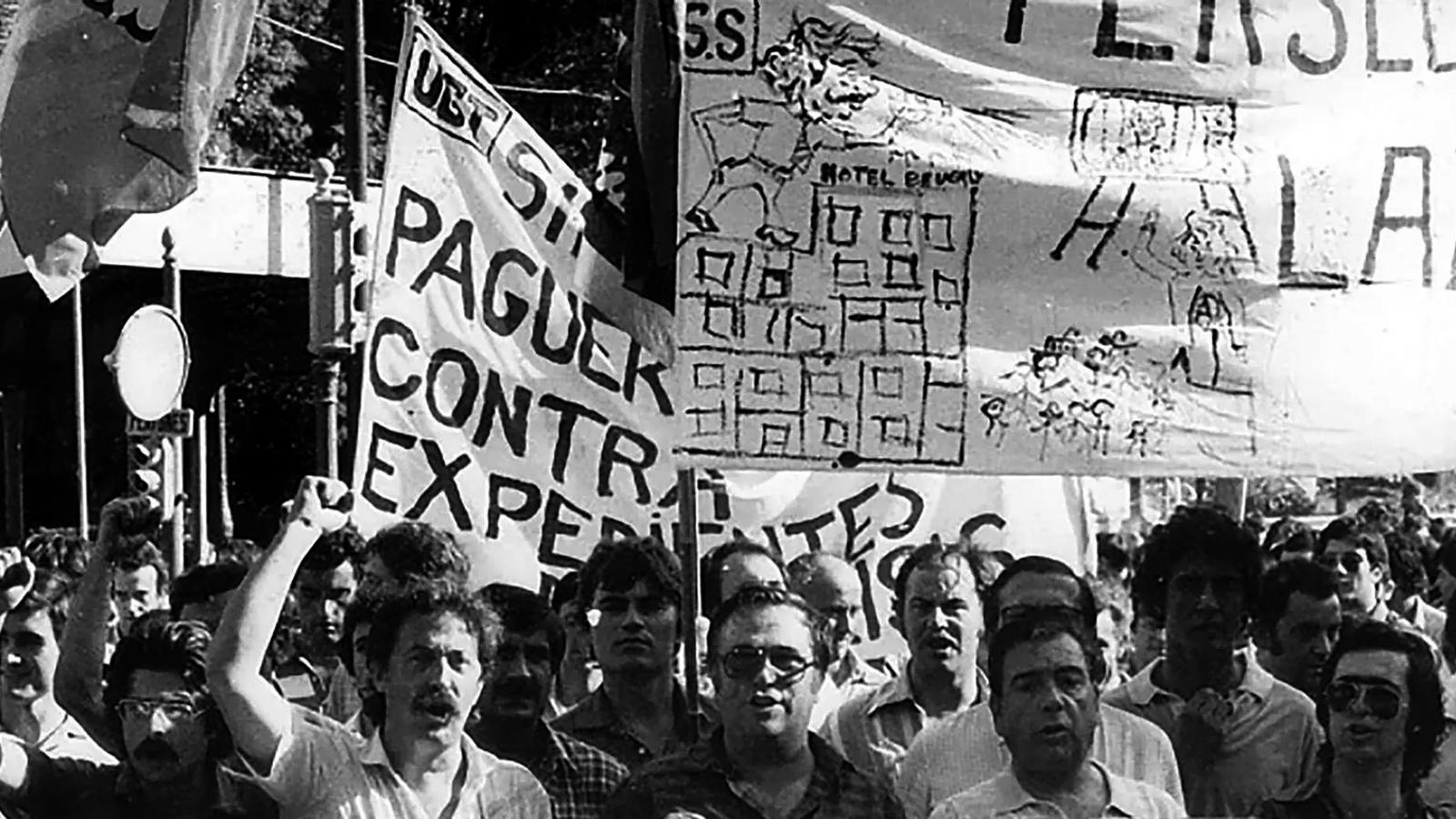
The general strike on November 11th will take place exactly half a century later, with only one day of difference, from the one that took place in the State at the end of the forty years of dictatorship, on November 12, 1976. Another economic crisis was being experienced once again – the arrival of democracy in Spain suffered from colossal bad luck – and the left did not trust that recycled Falangist, Adolfo Suárez, and his political reform very much.
The twenty-four-hour strike was called by the Coordinator of Trade Union Organizations (COS), equivalent to the 'Platajunta' of the democratic opposition, which included the still illegal UGT, Workers' Commissions (CCOO), and Workers' Trade Union (USO). It was against the economic policy of the state government, but also for amnesty and for democracy – it seems that this issue of 'political' general strikes is another classic.
The unions' figures, probably optimistic, stood at 35,000 participants. In Palma, what was still the regime's police – the 'greys' – acted harshly against the protesters, charging against them with batons. Among the nearly forty detainees were two prominent figures of those years: Manolo Cámara, who would soon become general secretary of CCOO in the Archipelago and who was the subject of an astronomical sanction of half a million pesetas at the time, and Josep Vílchez, one of the founders of the union in the Islands, who was arrested three more times that same year.
Since then, we have lived through quite a few calls. The last one of all, a year ago, in solidarity with Palestine, failed in the Islands, according to ARA Balears, although student demonstrations took place on the UIB campus.
Information prepared based on texts by Pere Gabriel, Miquel Àngel Casasnovas, Catalina Martorell Fullana, Antoni Janer Torrens, David Ginard Féron, Bartomeu C. Moragues Jordà, Albert Herranz Hammer and Joana Maria Roque Company, Libertarian Studies Group Els Oblidats, Joan Mas Quetglas, Miquel Rosselló, Col·lectiu Palma XXI, Lucía Rivas Lara and Susana Sueiro Seoane.
