Green Horse: here poetry is sold
50 years ago, in November 1976, Rafel Jaume created the legendary Palma bookstore specialized in this genre

-
CAT -
CAST -
DE
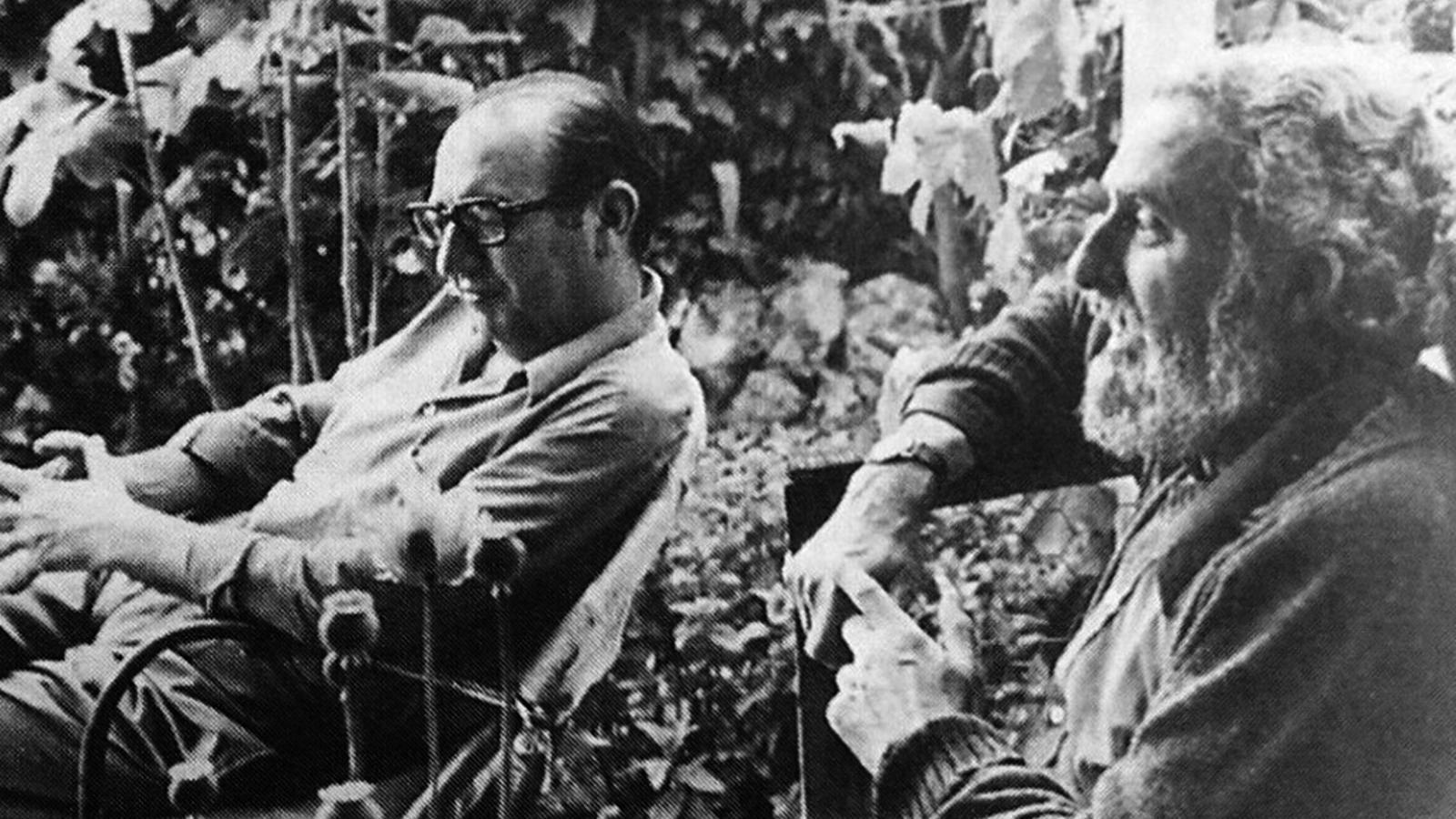
PalmaIt only existed for a few years, but it left a lasting mark to this day: even now, the poetry awards of the Association of Catalan Language Writers (AELC) bear its name, which is certainly curious. The Cavall Verd bookstore, specialized in poetry, was created by the writer Rafel Jaume and was a space for exhibitions, a spearhead for cultural expressions, and a place for gathering for young creators. We remember it as half a century has passed since its opening, around November 1976.
To understand the trajectory of Cavall Verd, one must understand that of its founder: Rafel Jaume was born in 1928, in the Soledat neighborhood, in Palma, and from a very young age, he stood out for his fondness for poetry. Much like Joan Alcover, he first cultivated literature in Spanish, with which he won two Ciutat de Palma awards, and then he turned to Catalan from 1970 onwards.
It was Cèlia Ribas, as recounted by Bartomeu Bauçà, who introduced him to Pere Quetglas Xam, with whom he founded the poetry magazine Dabos, of which sixteen issues were published. And it was Xam who took him to the legendary Moka café in the city, a meeting point for artists with innovative tendencies. Thus was born the no less legendary Tago group (named after the island of Tagomago), of which Rafel Jaume would be president, with an impressive list of creators: Miquel Morell, Francesc Verd Fraver, Miquel Rivera Bagur... The group exhibited at the Estudi General Lul·lià and the Cercle de Belles Arts, of which Jaume was a member.

However, you don't eat art and poetry three times a day –even less so back then–, so Rafel Jaume had to look for a job to earn his keep. In 1952, he began teaching the little ones at the Teatins school, then located on Carrer d'Aragó in the city.
In 1976, half a century ago, Rafel Jaume made his great decision, "the most daring and youthful act with outward projection of his life," as Bauçà puts it. In September, he left his teaching job, and in November, he opened Cavall Verd, a bookstore specializing in poetry, in a small shop at number 19 of Carrer de l'Argenteria, in Palma: the very one that had become famous –'The Street' by antonomasia– for its link to the 'xuetes', the supposed only descendants of the Majorcan Jews, many of whom had their shops, basically jewelry stores, on this public street. Later, it moved to a very nearby location, Plaça d'en Coll, with a little more space –not much more.
Exhibition and discussion stage
Perhaps he didn't quite feel comfortable, as a customer, with the bookstore offerings at the time. In an article published in Última Hora a few months earlier, he commented on how “in a central Palma bookstore” he had found a book that interested him, about “the healing properties of the onion”. But it was too expensive for his pocket, not even “with the ‘extraordinary’ discount of the Book Festival”.
Why this baffling name, ‘Cavall Verd’ (Green Horse)? “As for men, as many as green horses” is a saying attributed to women, as if to say that with what there is, better that there be few, or none. Caballo verde para la poesía was a magazine directed by Pablo Neruda. Miquel Àngel Llauger adds other possible references: the expression “to be rarer than a green horse”; the name of a peak in the Penyal mountain range, in the Marina Alta and the ‘caddos birdes’ (‘green horses’) of Sardinian folklore. A rarity, in any case, not to mention something chimerical or impossible: selling poetry in the mecca of tourism.
It was a “very nice” name, points out literature historian Pere Rosselló Bover, to express “the rarity of poets in such a materialistic land”, where it seemed that only “economic gains” mattered. “We do things because we want to”, and not for economic interest, he adds.
That first premises, on Carrer de l’Argenteria, was “very small, decorated very simply, with some bookshelves, a table and little else”. Even so, exhibitions were held there by artists such as Miquel Brunet, Pep Roig Pepe, Miquel Morell, Joan Lacomba, Cándido Ballester, Andreu Terrades, Ángel Baldovino and Rivera Bagur.
Cavall Verd was also a place for meetings and gatherings of artists and writers, both old and young, such as Josep Albertí, Antoni Serra, Andreu Vidal and Llorenç Moyà, for whom Jaume, who also occasionally acted as an editor, published the book I tanmateix, pallasso... “It was a pleasant place”, adds Rosselló. “You would go there to spend a while and you would always find someone: you would talk and look at the books”.

“I went there practically every afternoon,” recalls the poet Àngel Terron, for whom Jaume’s work of opening up to new initiatives was fundamental. At Cavall Verd, publications and collections such as Blanc d’Ou, La Musa Decapitada, Tafal, Xibau, and Soterrani, among others, were made known. And the most curious thing is that they found readers there, “with a volume of sales that is not usual” for poetry, and even less so during a time of economic crisis like that one.
Xavier Abraham and Sagitari
Rafel Jaume was an inveterate reader of poetry. No matter how strange or exotic the poet might be, he knew them. If he didn't have the desired book at Cavall Verd, he would take charge of getting it. Rosselló remembers that he bought him the Catalan-Valencian-Balearic Dictionary –although this, obviously, is not a book of poetry.
But one cannot make a very good living from selling verses, so Rafel Jaume had to combine his work as a bookseller and cultural promoter with another perhaps more prosaic one: working as a proofreader at Última Hora, with hours from three to six in the morning. “I don't know when he could have slept,” notes Rosselló. He would close Cavall Verd, rest for a few hours, and then join the other job. He also worked as an art critic for the same pages.
The poet-bookseller fell seriously ill in 1982. “Now I know what the corridor that leads to death is like. I was stuck in it for long hours,” he declared, upon recovering, to the newspaper where he was a contributor. But he never fully recovered. He died on October 4, 1983.
Cavall Verd kept its doors open to the public for another three years. Mateu Campomar took over, having until then been Rafel Jaume’s assistant and the man who had saved his life by calling an ambulance when he suffered a heart attack. However, he was not a scholar in the field of poetry, as the founder had been. The poet Miquel Àngel Llauger recounts how, one time, he insisted on “the shipment of a book by Gadafi, which in the end turned out to be by Kavafis.” In 1986, Llauger presented his first poetry collection at Cavall Verd, L’arena de l’amor, in what was most likely one of the last activities the bookstore hosted. A friend and he fantasized about taking over Cavall Verd, but they did not do it.
Another bookstore dedicated exclusively to poetry would still open in Palma in 1994. It was called Sagitari, an initiative of the poet Xavier Abraham, which shared premises, at number 62 Joan Miró street, with the family business: the Picornell hair salon. This coexistence was quite curious: poetry books in friendly neighborhood with hairsprays, shaving soap, and barber’s tools.
It was also consistent with the trajectory and restless personality of Xavier Abraham, who already between 1990 and 1992 had promoted the cycle Poets in Havana, with poetry recitals at the venue of that name in Palma, where legendary names such as Josep Maria Llompart, Miquel Àngel Riera, Bartomeu Fiol, Jaume Pomar, Damià Huguet, Biel Mesquida, and Miquel de Palol passed through. In 1996, he promoted the congress Poetry Traffickers and the exhibition Art i poesia.
At Sagitari, poetry collections were displayed in their original languages, but also with their translations into Catalan or Spanish, to make them more accessible to readers. Just like Rafel Jaume, Xavier Abraham was also willing to obtain whatever title was requested of him. By then, the web had already been invented, which allowed him to receive requests for poetry books even from abroad.
Sagitari, the title of a poetry collection that Xavier Abraham published in 1998, passed the baton in 2012, along with its poetry collection, to a new bookstore located in the same premises, Los Oficios Terrestres, an initiative of Lola Fernández, Joan Miró’s great-granddaughter. Towards the end of the decade, this one also closed its doors. Perhaps some lover of verses will risk, one of these days, opening a new venue in Mallorca where the green horses will ride again.
Joan Perucho, Marià Villangómez, Miquel Bauçà, Ponç Pons, Vicent Andrés Estellés, Susanna Rafart, Antoni Marí, Màrius Sampere, Miquel Desclot, Joan Margarit, Antònia Vicens... All these people, leading figures in Catalan-language literature, have a name in common: Cavall Verd, which are the awards that the Association of Catalan Language Writers has been presenting for 42 years, thus perpetuating the memory of that small bookstore in Ciutat. Mallorca is the setting for the award ceremony every year.
The Cavall Verd award was first granted by the AELC in 1984, the year after the death of Rafel Jaume, and it was awarded to Joan Perucho for Quadern d’Albinyana. Since 1985, there have been two categories: the Josep Maria Llompart award for the best book of poetry and the Rafel Jaume award for the best poetic translation, both regarding titles published the previous year. In 2026, the winners were Sebastià Alzamora for his poetry collection Sala Augusta seguit de Llengua materna and Jordi Fité for the translation of Elizabeth Bishop's Poesia completa.
For the Majorcan writer Sebastià Portell, president of the AELC, “remembering Rafel Jaume and the Cavall Verd bookstore is to recognize the trajectory and contribution of a poet and cultural activist who still has an impact today on the literary life of the Islands and the Catalan Countries. Cavall Verd was a space that catalyzed cultural projects, conversations, and movements that went beyond the obvious”.
Cavall Verd, states Portell, “was a beautiful rarity” that the AELC wants to pay tribute to with the awards that bear its name. He adds: “We hope that this spirit and this inspiration continue to accompany us for many years”.

Information prepared based on texts by Bartomeu Bauçà, José María Gago González, Miquel Àngel Llauger, Andoni Sarriegi, Xavier Abraham, Margalida Melià and Antoni Janer Torrens and the publications El Día del Mundo, Última Hora, Diari de Balears, Diario de Mallorca and L’Avenç.
