Jordi Pujol and us, the islanders
50 years ago the controversy broke out over a supposed landing of the future president of the Generalitat in the Mallorcan magazine ‘Cort’

-
CAT -
CAST -
DE
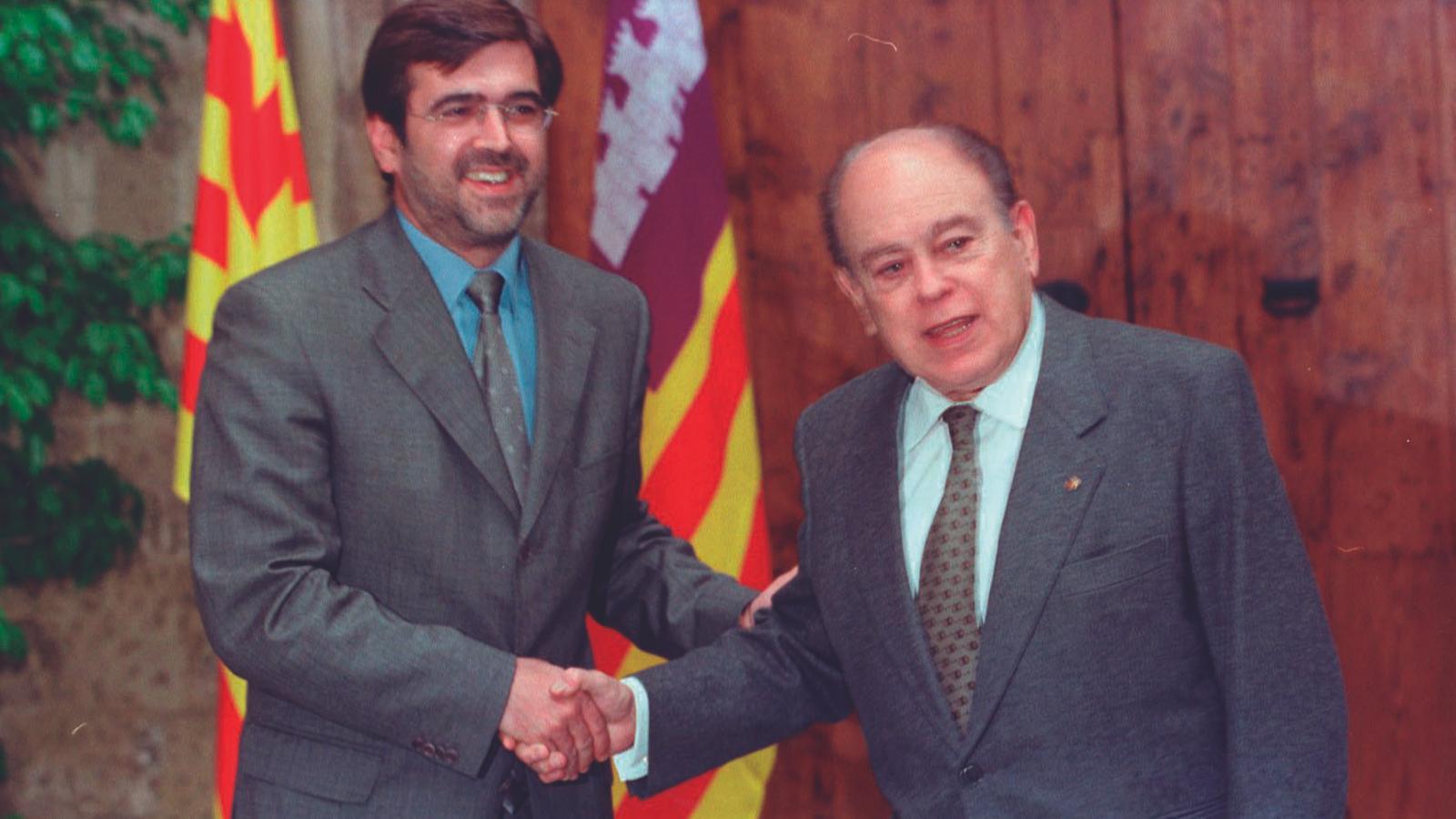
PalmaHe was widely admired, also in the Balearic Islands, until the judicial affair that affected his family broke out and from which he has been excluded due to his delicate health. Before that, Jordi Pujol was, for decades, the benchmark of Catalonia par excellence, with certain ties to the Islands. We remember them as half a century has passed since the controversy generated, in May 1976, by his supposed 'disembarkment' as a shareholder in the Majorcan magazine Cort, in the midst of the political Transition.
Who was that Jordi Pujol i Soley, whose possible presence in a Majorcan magazine generated so much stir? He was born in Barcelona in 1930 and from a very young age had moved in Catalanist and anti-Francoist circles, of course clandestine. That activity would lead him to be subjected to a court-martial in 1960, which was attended by a also very young Baltasar Porcel, to whom a police officer, upon asking for his ID, retorted: “And what the hell are you doing here, if you're Majorcan?”. Of course, Pujol was convicted and sent to prison.
Jordi Pujol had studied Medicine. But, with his obsession to “make the country”, and considering that Catalonia needed an economic instrument, he created Banca Catalana, which managed to establish itself in the Balearic Islands. In 1974 he founded Convergència Democràtica de Catalunya (CDC), a party with which he would become president of the Generalitat in 1980, in coalition with Unió Democràtica, for the following 23 years, a record in itself.
According to David Ginard, the relationship of the future president of the Generalitat with the Islands began in 1950, when a Pujol of only 20 years and Joan Reventós, who three decades later would be his rival at the polls, came into contact with the Majorcan teacher Pau Llabrés, through Francesc de Borja Moll. The objective was to form, in the harshest period of Francoism, a nationalist youth group.

Llabrés showed him the difficulties of that project, at a time like those and in a territory like Mallorca. And Pujol replied with a kilometric letter, in which he demonstrated a surprising knowledge of the island mentality of those times and, in part, of today: "Mallorca doesn't want to hear about Catalanism." In any case, he said, the expression 'Mallorcanism' should be used. The cause was the same, the claim for self-government, but one had to be careful with the term.
Pujol's islanders
Pujol, according to that same letter, tried to find an acceptable expression for everyone: "Countries of Catalan Language" seemed too long to him, and he asked Llabrés if he knew of "a good one", by name. But that project of forming a nationalist group in Mallorca did not take off.
More than a quarter of a century would pass before there was any news of the medical student turned banker. According to Arnau Company, in issue number 82 of Cort, corresponding to the end of May and beginning of June 1976, a letter from José Carlos Llop and Guillem Soler was published, in which they announced their withdrawal as subscribers, having learned, from a news item from the Alfil agency, that "the banker Jordi Pujol is buying the majority of shares in this magazine". This, they understood, meant that an explicitly Mallorcan publication was being "relegated" to an investment plan "from outsiders".
In that same issue, an editorial note clarified that “Mr. Jordi Pujol, despite what the press has aired, has not bought a single share of Cort” and described that rumor as a “hoax.” The truth is that there had been contacts with Pujol by the owners, linked to the Socialist Party of the Balearic Islands, which would later become the Socialist Party of Mallorca (PSM). But they had not reached an agreement.
Pujol had already entered the world of media with the acquisition of the magazine Destino, the direction of which he entrusted to a Majorcan: Baltasar Porcel. The writer, incidentally, had to show Josep Pla the door, because he insisted on writing praises to the Portuguese dictatorship, when the Carnation Revolution of 1974 had already occurred. According to Gregori Mir, Josep Melià also participated in the management of the magazine. Years later, Pujol would call it an “error” to have gotten involved in that mess.
By 1977, Jordi Pujol and Convergence had become the benchmark for Catalan nationalism. At that time, he declared to Baltasar Porcel, in reference to the rest of the Catalan Countries: “We are in favor of autonomy for the Valencians and the Balearics. If afterwards, as would be our wish, they want to link it with that of Catalonia, listen, perfect. If not, nothing, they have the say.” He just lacked adding “they will make soup out of their bread.” Although in 1998 he participated in a Nationalist Gathering in Mallorca and stated that “we are one people,” in his memoirs he reiterates: “The cultural unity of the Catalan Countries does not have, in my opinion, a political translation of an institutional nature.”
Not everyone looked upon Jordi Pujol with sympathy, from within island nationalism. When a proposal for an autonomy statute was presented in March 1977 at the sanctuary of Cura, Josep Maria Llompart wanted to make it very clear that “the Catalan Countries are not a concept invented by Jordi Pujol and the financial oligarchy, because oligarchies have no nationality.” A banker and a patriot? He could never be.
The model of Gabriel Cañellas
But Pujol put money on the table, which was a resounding way of betting on an island nationalism, for the 1977 election campaign of Unió Autonomista (UA), the candidacy led by Josep Melià. And not a little: half a million pesetas at the time, to which a credit of one million more from Banca Catalana had to be added. He did not obtain representation, so that was another failure of a possible convergent extension towards the Islands.
The one who did join CDC in 1978 as a member, and still maintained his militancy around 2008, was the former president of the Obra Cultural Balear, Climent Garau, a frustrated candidate for senator for that autonomist formation. He did so because he trusted, he said, “the civil ethics of Jordi Pujol”. Although he acknowledged that “as a militant of that party, being from the Islands, he could do little”.
When Convergència i Unió won the first Catalan autonomous elections since the Civil War in 1980, against all odds, such a key area as linguistic policy was entrusted to a woman from Menorca: Aina Moll, whom he describes as “very convergent”, that is, close in political position. “Pujol told me: do all you can, but with maximum collaboration with everyone”, she recalled in an interview. A man from Ibiza, Isidor Marí, was appointed head of the Linguistic Advisory Service and would later be, still in the Pujol era, deputy director general of Linguistic Policy.
More than in this area, Isidor Marí's few contacts with Pujol were through the Fundació Acta, a collective of intellectuals. It was assumed that they were to present their opinions to him: “But it was he who wanted to convey his opinions to us”, he recalls now. “He was a well-trained person, with intellectual capacity and leadership. That was his virtue and his problem: it gave him excessive confidence and a certain tendency not to be very self-critical”.
and information from the Municipal Image and Sound Archive of Ibiza (AISME)
According to Gabriel Cañellas, in a long interview with Jaume Sastre, Pujol –the former leader refers to him as ‘don Jordi’– “had great influence” over Jeroni Albertí, who was the leader of Unió de Centre Democràtic (UCD) in the Balearic Islands and president of the pre-autonomy, either by serving as a reference for him or by “having real power over him”.
The Unió Mallorquina created by Albertí accepted in 1986 to join the ‘Operació Roca’, that strange initiative by which Pujol's second-in-command, Miquel Roca, aspired to the presidency of the state government. It was another failure. The cooperation of the convergents with some political force from the Balearic Islands would be carried out successively in perhaps less risky areas, such as the European elections with the Socialist Party of Mallorca and the Nationalist and Ecologist Left of Ibiza.

Not only Albertí, but Cañellas himself recognizes it: “I imitated him a lot”, to ‘don’ Jordi, ‘in his ways of talking and doing politics’”. That is to say, that close, carefree style, with a joke in between. Cañellas also wanted to do like him when handing over to a prominent minister, like Pujol with Artur Mas. Afterwards, for both of them, things got complicated. Both, with their lights and shadows, were essential referents in those autonomies that were just beginning to get underway.
“Why has a hegemonic center force, like Convergència i Unió in Catalonia, not consolidated in the Balearic Islands?”, asks Josep Melià Ques. Obviously, there are many causes. The truth is that the convergent model, even its very name, which expresses the idea of agreement, of understanding, has exerted a powerful attraction on Mallorcan politics practically until our days. As early as March 1976, at the beginning of the Transition, a group of prominent professionals from the Balearic Islands founded Concurrència Democràtica Balear (Codeba): a similarity with Convergència, created only two years earlier, which could not be a coincidence.Several Mallorcan parties have used the term 'convergència' in their name. Convergència Poblera was a pioneer, as early as the municipal elections of 1979. It has been followed by Convergència Alcudienca Independent, Convergència de Manacor, Convergència Porrerenca, Convergència Democràtica Murera, Convergència del Municipi de Santanyí, Convergència Campanera and Unió de Convergències in Manacor, Son Servera and Sant Llorenç. At the autonomous level, there was a Convergència Balear with a short trajectory in the nineties.
Information elaborated from texts by Arnau Company i Matas, David Ginard i Ferón, Antoni Marimon Riutort, Jaume Mateu i Martí, Miquel Payeras, Jaume Sastre, Juan Pedro Bover Sánchez, Gregori Mir, Llorenç Carrió Crespí, Catalina Amer Ballester, Baltasar Porcel, Vicenç Villatoro, Josep Melià Ques and Jordi Pujol himself, in addition to publications in L'hora, Diari de Balears and El Mundo/El Día de Baleares and information from the Municipal Image and Sound Archive of Eivissa (AISME)
