The Mallorca that resists among carts, mules, and bales of hay
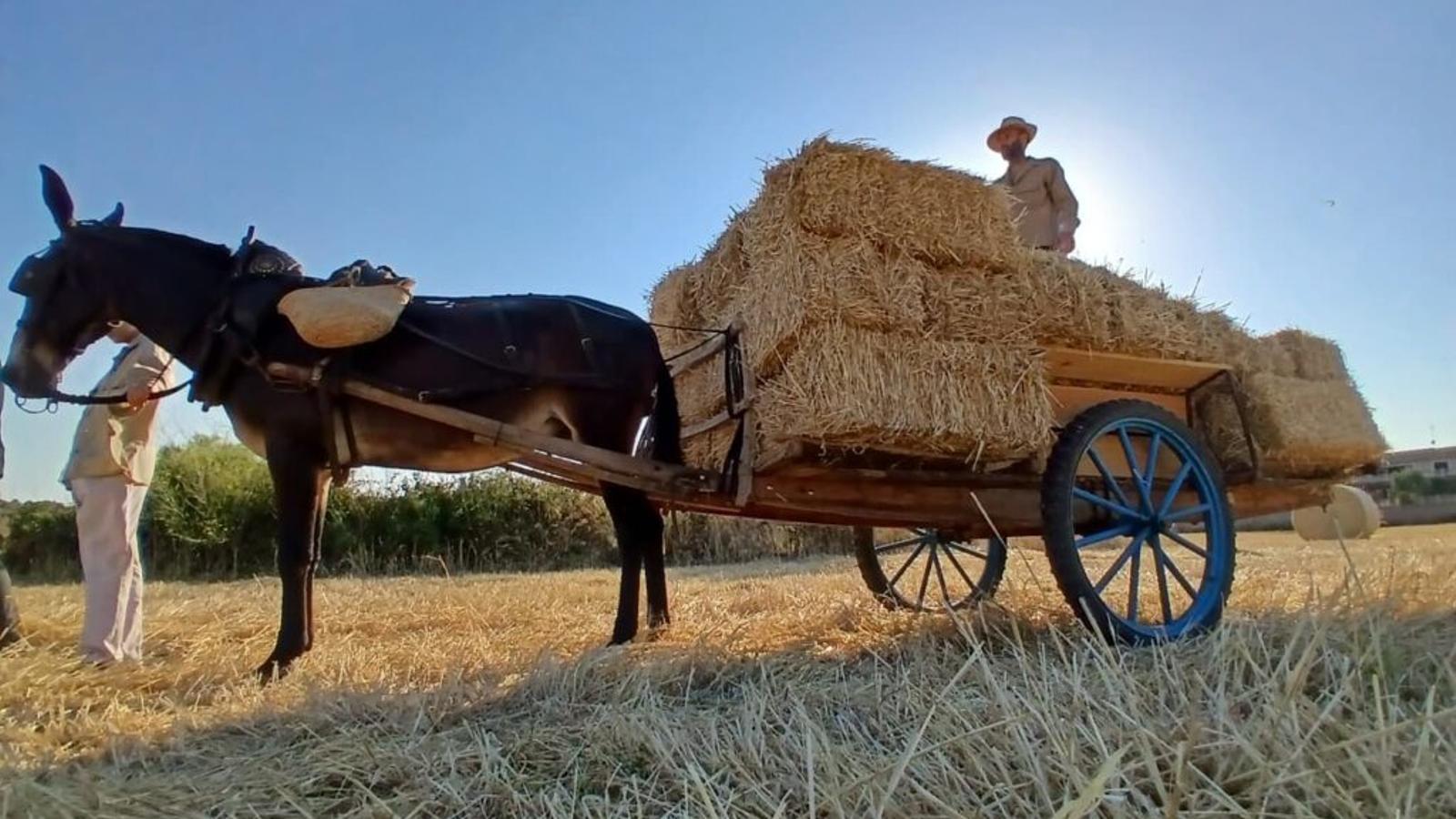
Mateu Fontiroig continues bringing in the hay with a long cart and the mule Blau, a scene that survives in the heart of the Plain and that contrasts with an island marked by massification, haste and tourism
-
CAT -
CAST -
DE
PineappleA few kilometers from the beaches and while we see planes passing every minute overhead, there exists a Mallorca that works in another dimension. It is the Pla. We don't want to say it or shout it from the rooftops either, but we do collect it for you, the people from here, from the land, who live with this same heartbeat. Thus, in the very heart of the Pla, at any point on the road from the field of Pina to Lloret de Vistalegre, there are those who carry the chimera of the old and giant race that Pere Capellà wrote and that Biel Majoral sings.
Here, the calendar is not dictated by tourist seasons, but by the seasons of the land. Now, in an August July, the Pla becomes the scene of a silent battle for the survival of memory. At the rota de la Cova, Mateu Fontiroig, takes out the long cart and Blau, the mule, to go and bring in the bales of straw.

The rest of Mallorca's newspapers open their front pages with visitor numbers, traffic jams and saturated coves. But here we are made of different stuff and on this occasion it is in Lloret, but it could be in any hedge or hollow of Sencelles, Sineu, Sant Joan, Petra and Vilafranca. A farmer, a cart, a mule and infinite patience.
We arrange to meet Mateu, not without having to beg him a little, who tells us he will meet us "when the sun doesn't burn so much", in other words, after the stage of the Tour de France has finished. Blau brushes off the flies and sets off. We leave the farm, going along slowly with the sway of the mule and cart, the whole way to the plot where the barley was and now there is stubble and straw. We hardly see anyone, and the few neighbours who pass by don't pay much attention to seeing the mule and cart.
Once at the plot, we load the bales, "The long cart can hold 40, and two to sit on," says Mateu to Pere Antoni and Tomeu, who help him with the task. The image of the cart with the hay bales becomes more bucolic each time. Seeing a mule pulling a cart loaded with straw while the farmer accompanies it without rushing, is almost an act of poetic rebellion. It is the absolute opposite of the immediacy that dominates us; a job that requires looking at the sky, putting your feet on the ground, respecting the animal's strength and accepting that things take the time they take. Not a minute less. Visualizing the scene, we can't believe we are in Mallorca, it's not the Instagram Mallorca we know, it's the Mallorca we've seen in black and white.

These rural activities that survive sheltered from modernity hold up an uncomfortable mirror to a crowded Mallorca. They remind us of where we come from and, above all, what we are willing to lose. Mass tourism and mass residents consume the territory at a voracious speed, homogenize landscapes, and turn identity into a cardboard cutout backdrop for an Instagram photo. We repeat it, but only for you, for the people here, the Plain maintains authenticity precisely because it resists being a theme park. The sweat of those who carry straw by hand is real; the dust raised by the cart is genuine, and they don't flaunt it, nor do they want to. It's simply their passion, their way of understanding Mallorca and Fora Vila. Animals, tools from other times that are preserved with patience and love.
Nor is it about falling into idealized nostalgia or wanting the peasantry to live in the past for our aesthetic delight. Country life is hard, often thankless, and poorly valued economically. But we must indeed reclaim these last bastions of calm and craft as the island's greatest treasure.
Mateu and Blau are making their way. While Mallorca fills with noise, the Plain offers us silence, broken only by the swaying of a cart and the passage of a mule. There, among bales of straw and golden dust, beats the Mallorca that still knows who it is. Protecting it is not a whim; it is a moral obligation before the freshness, construction, and asphalt end up consuming it all.
