The Manacor magazine that irritated Franco and ended up becoming a historic football team
When Francoism wanted to silence 'Es Forat', without knowing it, it created its legend
-
CAT -
CAST -
GER
ManacorIt was December 1970 when a postal envelope sent from Manacor arrived by motorcycle at the Palacio del Pardo in Madrid. After the mandatory security checks, the envelope, the size of a sheet of paper, ended up on the table of the dictator Francisco Franco. Upon opening it, he discovered what they had already warned him about from Mallorca: inside was a subversive magazine, with articles in Catalan called Es Forat. Founded by Pep Lluís Fuster and Toni Riera, the publication aimed to offer a multidisciplinary view with articles on literature, cinema, and current affairs.
But that was not the main problem. On the fifth page, under the title Letter from an emancipated youth, an article that seemed to start well: “There is no doubt, we are people born amidst stars, grapes, and old gold wheat, ours is a proper homeland, we are admirable folk”, actually hid a denunciation dressed up as irony. The text asked how in such a shining country, such deplorable events could occur as the unpunished death of three workers from Granada at the hands of the Civil Guard, and without any judicial consequence.

The article was signed by Joan Parera, who would later become a professor and director of the Institut Mossèn Alcover in Manacor. It didn't take much to know that something would be punished. And even more so knowing that the one who had sent that beige envelope was not precisely the Mallorcan Francoist administration, but the editors of the new magazine themselves. "We were that innocent, we were 18 years old and we sent it to the regime's high officials like the provincial head of the Movement, Salvador Bauzà, and the mayor of Manacor... everywhere!" recalls Biel Sureda, the first president of the social side of The Hole.
With all the fuss and promotion, it was only a matter of time before special agents from Madrid appeared in the city of pearls: “Trench coat, high collar and cap, just like inspectors. They said in the town they were looking for me. I was working at the central bank distributing letters,” says Sureda, who still remembers being summoned to the headquarters ofIt Hole, a basement of the Bishopric located right in front of the truck stop, in Plaça del Cós, and where on the first floor the nuns made the consecrated hosts for mass.
“They sat me at the other side of my table, turned on the table lamp and shone it in my face… I thought: that’s it!, suspect!”. “However, they apparently saw me a bit young and [smiles] and soon I realized that’s what those who studied at university were looking for. They went through everyone’s files”. Thus, the first reprisals were suffered by Biel Sureda himself, who was reported to the Public Order Tribunal (TOP) and forced to appear and sign every week as proof that that “communist cell” was kept in check.
A The Hole they kept the copy-printer and the desire to occupy a space of cultural resistance in Manacor. “Young people of 18 years old like you shouldn't waste your time on these things… let go of politics and start a football team,” recalls Toni Perelló ‘Confit’ (first sports president) that the agents told them as a forced alternative.
“It was what we did… we had no other option”. It was an unexpected departure that had little to do with what they had initially thought… but it was the only one that would not entail further concessions. Although Joan Parera, author of the article on the Granada crimes, was finally assigned as far as possible from Mallorca to do his military service: he would go to Ferrol, precisely, the land of the Caudillo.
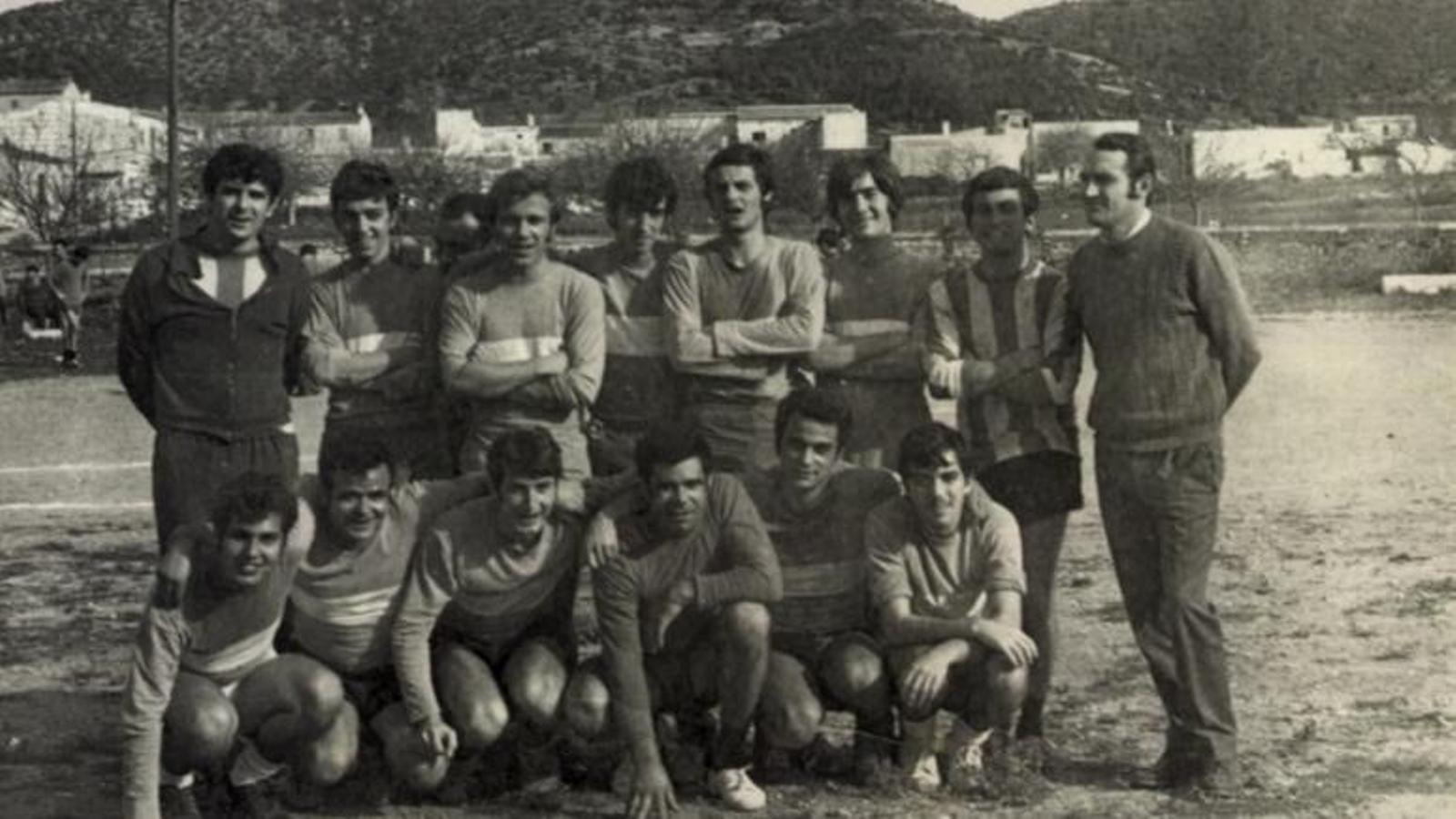
“We were already playing football as amateurs in 1969, but it was the 1971-1972 season that we started competing in the so-called Torneo de Educación y Descanso, a local league organized by the union, where Es Forat never had any problem winning it, because it was a thousand times better than the others, in the years it was there”, recalls Xisco Lladó ‘Frisan’, one of the co-founders of the club. In 1973, they even reached the Spanish championship in Castellón.

Among the teams that competed were Can Tomeu (possibly the great rivals), the Tripolinos (from the mythical Trípoli bar), Can Costa, Sa Volta, and the 1808 Royal Club, a grandiloquent name that represented the bar on the ground floor of Cine Goya. All matches were played at the so-called municipal sports field, at Na Capellera.
But at the end of the 70s, the regime's tournament, with the arrival of the Transition, died of wear and tear. A few years of inactivity that coincided with the beginning of the 80s, when the Lliga de Penyes (League of Clubs) was launched. In 10 years, Es Forat won half of the championships. “We were part of it until the 89-90 season, when we decided to take a step further and register for the business league, which was for teams from all over the Balearic Islands and had a level similar to the preferred league of those times, with many players who had played with Manacor and other third-division teams,” adds Lladó.
From those years, the honorary presidency of Andreu Pasqual ‘Frau’ stands out, who also ceded the land for the dirt field where the club and business tournaments were played for two decades. Speaking of coaches, Es Forat started with Joan Morey ‘Lobé’, then Joan Febrer ‘Randa’, Pedro Sureda ‘Kocsis’, Miquel Reus, Sion Caldentey, and Manolo Riera Guardiola, who had also previously been a great playmaker on the field.
Joan ‘Beió’, the great goalscorer
However, if anyone stood out above the others, it was undoubtedly Joan ‘Beió’, a goal-scoring forward who had played for Atlètic Balears. “With him and Pep Pinya in midfield distributing play, it was very easy to play. Even though we only trained during the week, we had more than enough,” recalls Manuel Parera, part of Es Forat during the 80s and early 90s.
‘Beió’ seemed like the typical forward for whom football was secondary. One of those outsiders more concerned with alternative life than with taking care of himself and building a sports career of a certain level. “He had a lot of talent, and he scored goals until he got tired of it. He alone could hold up the whole team… although many times they had to go look for him if you wanted him to show up,” explains Joan Sebastià Amer ‘Garanya’, who joined the team at just 13 years old and stayed there “they brought me out to run and bother up front,” he jokes.

The team from the last stage, the one that lasted until 2001, has possibly been the most cheerful and competitive. A club, known at that time as Bar Can Miquel-Es Forat, capable of beating CE Manacor in more than one preseason. A group of friends who played for pleasure and, competing in the tough company league football, achieved three championships, always in direct contention with the villagers from Ca Sa Miss Jotul and Ca Na Paulina, the other two dominant teams.
Es Forat even competed in two more Spanish championships: one in Zaragoza in 1994 and one in Valencia in 1999, two years before its definitive disappearance. “There are many experiences and anecdotes. From time to time we had offers from registered teams, but we weren't interested, Es Forat was much more fun. They never scored more than two against us in a game. They never thrashed us,” says Joan Salas, the starting center-back for the last decade.
“One time in Sa Pobla I was insulted… I remember my mother had just died and that really upset me. I punched him and left him sprawled out. Of course, then everyone wanted to beat me up,” recalls Joan Vanrell, the other great goalscorer in the history of Can Miquel-Es Forat. A powerful forward, but precise in his finishing, there wasn't a week he didn't score two, three, or four goals without breaking a sweat. Vanrell ended up signing for Felanitx.
The shield, work of Pere Serra
“All of a sudden we commissioned a shield, a symbol that would define us,” states Biel Sureda, who called his friend, architect Pere Serra, so that he would “make something distinguishable like Nike.” “And what should it be called?” replied Serra. “Es Forat, because the headquarters is, basically, a hole downwards.” “Pere nailed it, he drew the design of a hand forming a hole with its fingers, like an ok… it was perfect!”
