Was Alfonso the Magnanimous so magnanimous?
575 years are fulfilled of the fine for eternity that the governor, with the full powers of the king, imposed on the foreigners for revolting against the injustices they suffered
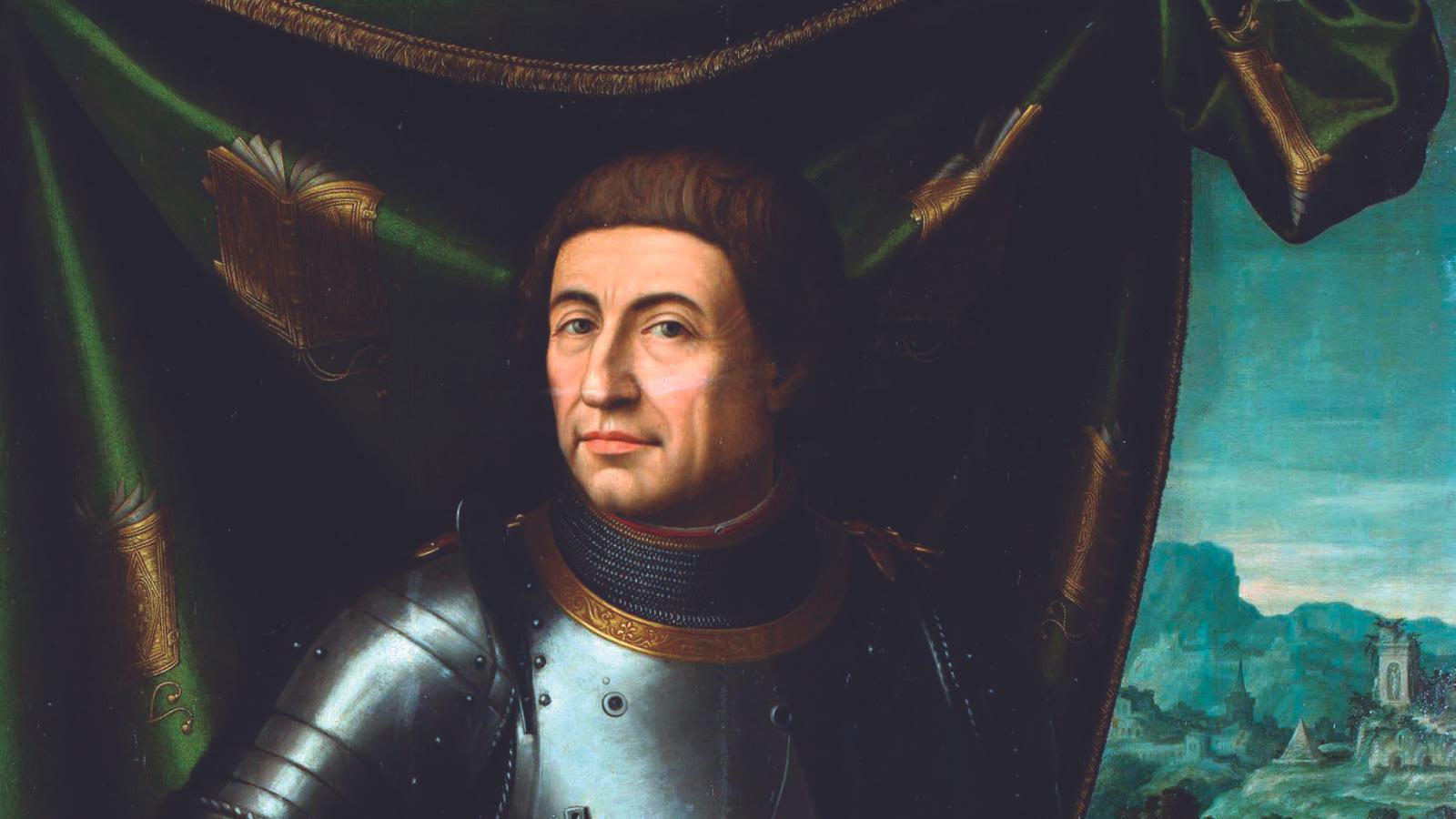

PalmaAlmost all monarchs have had a distinctive nickname –like ‘the Emeritus’, in our times– and Alfonso, sovereign of the Crown of Aragon and, therefore, of the Balearic Islands, between 1416 and 1458, has gone down in history as ‘the Magnanimous’. Was he, really? It is now 575 years since the eternal fine that, with the king’s full powers, the governor of Mallorca imposed on the Part Forana, on April 9, 1451, for revolting against the injustices they suffered. Not much magnanimity there.
Alfonso became monarch by chance. He was a Castilian prince, born in Medina del Campo in 1396, but not the heir to the crown. However, King Martin ‘the Humane’ of Aragon died without descendants. And it turned out that his closest relative was his nephew Ferdinand, Alfonso’s father, son of his sister Eleanor. With the decisive support of Saint Vincent Ferrer, he was elected new sovereign.
Ferdinand died after reigning only four years. So Alfonso, at just twenty, found himself converted into monarch of Aragon, Catalonia, Valencia, Sicily, Sardinia... And, of course, of the Balearic Islands. His beginnings were not very glorious: at the Catalan Courts of 1416, the first of his reign, he could think of nothing more than speaking in Castilian, which, obviously, was not to the liking of the assembly. For the following ones, those of 1419, he had already learned Catalan –that obsession, of speaking in one’s own language in parliament!
Practically from the first moment, Alfonso embarked on warlike enterprises. And this cost a lot of money. Already in 1422, the Gran i General Consell of Mallorca had to approve an extraordinary tax for defense, for the handsome sum of 12,000 pounds. But as this was not enough, it had to be raised to 25,000. He was in Mallorca twice, on both occasions with his corresponding fleet. And, of course, to supply himself with provisions. He expanded the powers of the Consolat de Mar, the court for mercantile matters, under penalty for those who did not comply: another way to earn money.
The bribes of the factions
The Magnanimous' essential objective was to make money, with which to fund external adventures and defend his interests. Queen Joan II of Naples adopted him as heir and he dedicated twenty years of effort and expense to obtain that crown, as if he didn't have enough crowns. With such bad luck that in one of those exploits he fell prisoner. Of course, it was his subjects who paid the ransom price.

The power groups –the lobbies, as we would call them now– that controlled the island institutions exerted pressure on the king to establish one system or another for the election of jurors, equivalent to the councillors of Palma or the councillors of Mallorca, according to their interests. In just two years, the procedure varied four times. Certainly, they used very convincing arguments: in 1437, the powerful Pere Descatlar handed over 2,500 pounds to Alfonso in favor of the system he desired, so the Grand and General Council raised the amount to 2,800 pounds, in favor of the opposite. The monarch kept both donations... –oops, sorry, donations.
In 1425, the Magnanim appointed a new governor of Mallorca, who was to be one of the worst in history: Berenguer d’Oms, a person very close to him. He was from Roussillon, and the island's privileges stipulated that a native of those lands could not hold this office. So Alfonso simply decreed that this privilege was abolished. Many years later, when the monarch wanted the Menorcans to hand over the foreign leader Simó Ballester, who had taken refuge on the island, they alleged that a decree he himself had issued granted him safe conduct. Needless to say, for the Magnanim it was no problem to contradict himself, and Ballester was captured and executed.
It was Alfonso who instigated the revolt of the forans in 1450, by establishing a decree by which titles of land possession had to be exhibited: whoever could not show them would be punished with a fine. Obviously, it was about making money: it was very doubtful that any of those peasants, all illiterate, would have a little piece of paper at home identifying them as owners.
The revolt broke out, and of course, both sides, the forans and the urban oligarchy, tried to win the king's favor. The forans built a galley and sent it to the Magnanim in Naples, so that he could use it in his endless wars: this one, against the Florentines. Giving ships to monarchs, as you can see, is not an invention of our time.
From Naples, the great fear of the ‘Magnanimous’ was that the artisans of the City, who also had reason to complain, would join the foreigners in their revolt. So, as Guillem Morro observes, while he granted the former practically everything they asked for, with the latter he opted for a hard-line policy. That little detail of the galley was of no use. The citizens obtained royal support, by offering him a commission of 33% of what the foreigners had to pay, as compensation for the damage caused by the revolt.
The effects of the wars
On April 9, 1451, Berenguer d’Oms, who had received full powers from the monarch – as if he were “another me,” he had said – pronounced the condemnation: the foreigners had to renounce collecting any debt that was owed to them, for the benefit of Alfons, who thus, once again, made money; and they would have to pay, every year and for eternity, the more than respectable sum of two thousand pounds. That is to say: that even now, if things had not changed, the inhabitants of the Mallorcan villages would be atoning for the sins of their ancestors. Furthermore, two leaders of the revolt, Miquel Renovard and Guillem Nadal, were executed, after being subjected to torture – well, quite an example of magnanimity.
That only served to further inflame tempers. The Magnanimous sent an ambassador to Mallorca, ostensibly to calm tempers and mediate between the two factions. In reality, to keep the foreigners occupied until the punitive expedition arrived. Indeed: death penalties were applied, and La Part Forana was condemned to a collective fine of 150,000 pounds, a truly exorbitant sum – more magnanimity, impossible.
In 1442, Alfonso achieved his dream: the kingdom of Naples, and he spent his last sixteen years of reign there, without showing his face in his original territories. For the Neapolitan court, he hired the Majorcan Guillem Sagrera, the architect of the Llotja de Palma, with the commission to renovate the Castell Nou, where he used stone from Santanyí for the spectacular Sala dels Barons.
Alfonso's wars harmed Majorcan trade – does it sound familiar, this idea of ruining the economy to get involved in a senseless conflict? – but not only trade. The coasts of the Balearics became a likely target for his enemies' attacks, which meant the islanders lived in a state of constant alarm. However, it must be acknowledged that this was not truly new: for some or for others, it had been a continuous ordeal.
Naples, however, was not incorporated into the Crown of Aragon, but was kept by the Magnanimous, as a kind of personal domain. Upon his death, his son Ferdinand succeeded him in this kingdom. He could not inherit the Crown of Aragon because he was illegitimate, but he could inherit his father's property.
Álvaro Santamaría, who is a defender of Alfonso the Magnanimous, acknowledges that in 42 years of reign – which is soon said: longer than Franco's dictatorship, which became eternal – he did not solve a single one of the problems that Mallorca suffered. He only has to add that he created new ones. Why an individual like this has a street in Palma in his name, and one of the longest and most prominent, is one of those enigmas that history sometimes presents us with.
As has been customary practically until our days in royal dynasties –this is how children were produced: that is why they marry commoners lately–, the Magnanimous contracted marriage with a first cousin: Maria of Castile. To her he entrusted the government of his territories, while he dedicated himself to his wars or, in his last years, to enjoying the pleasures of Naples.This meant that there were two governments: Maria's and Alfons's, because the latter did not miss the opportunity to contradict his wife. So foreigners and citizens, in the mid-century conflict, had to spend not on one, but on two embassies: one towards Barcelona and another towards Naples, to see if they could win the benevolence of one or the other. Like children, who if they don't get something from their mother they try with their father, or vice versa.As Álvaro Santamaría observes, the temperament and policies of both were as alike as chalk and cheese. Maria of Castile subordinated everything to what she believed was just. While the Magnanimous was much more willing to negotiate. Like the ‘good cop’ and the ‘bad cop’: a classic. The regent repeatedly showed her good sense, as when she proposed two distinct commissions, one of citizens and another of foreigners, to establish tax quotas; when she ordered that those who engaged in favoritism or did not pay their contributions be excluded from public office; or when she prohibited anyone from being forcibly enrolled in naval warfare.It should also be added that it was Maria who sent two Catalan ambassadors to Mallorca who achieved a truce in the foreign conflict, and it was she who summarily dismissed the nefarious Berenguer d’Oms. While Alfons, Santamaría acknowledges, “used the internal dissensions of Mallorca for his own benefit –or that of his treasury”. That is to say: to make money.Maria and Alfons had no children: it would have been miraculous, as distant as they were, by a thousand kilometers. They died, separated, only two months apart: he, in Naples, in June 1458, and she, in Valencia, the following September.
Information elaborated from texts by Ricard Urgell Hernández, Álvaro Santamaría Arández, Guillem Morro Veny, Pere Xamena Fiol, Miquel Àngel Casasnovas Camps, Jordi Maíz, Maria Barceló, Josep Maria Quadrado, Román Piña Homs and José Luis Martín.
