When the earth shook in Mallorca
It is 175 years since the earthquake of May 15, 1851, the most powerful ever recorded on the island

-
CAT -
CAST -
GER
PalmaNatural phenomena fascinate people: a solar eclipse scheduled for next August has everyone captivated, for months. Others are not so entertaining: an earthquake, in the early morning of May 15, 1851, caused damage to houses and churches in Mallorca and generated panic among the citizens of Palma, who fled to improvised shelters. We recall this episode as the 175th anniversary of the scare is celebrated.
The first documented case of an earthquake in Mallorca dates back to March 18, 1660, in Campos, with aftershocks on the following 19th, 26th, and 28th. According to Archduke Louis Salvador, it was also felt in other places, including Palma: the Cathedral suffered damage for this reason. A report a few years later, from 1679, noted a lean of the facade of about eighty centimeters.
As Miquel Grimalt points out, although no victims were registered, nor damage beyond what was already indicated, the event sensitized the Majorcans to a phenomenon that was certainly unusual for them. Lima and Naples, then belonging to the Spanish Crown, had been destroyed by earthquakes: in 1668, in all the temples of the City, prayers were made not to suffer the same fate.

The Lisbon earthquake of 1755 must have been so powerful that, despite the distance, Mallorca Cathedral once again felt its effects, according to the Archduke. On another occasion, prayers were organized there to avoid suffering similar misfortunes. The following February, Palma declared Saint Francis Borgia patron saint of the city, with the aim that he would deliver Mallorca from that danger. A patronage that, certainly, has gone largely unnoticed since then.
A most unusual case is the one recorded in Santanyí around the same time: the sea reached almost three kilometers inland and left the scrublands full of fish. This is a tsunami. In the following years, earth tremors were felt in Santa Maria, Sencelles, and Inca. Palma had another scare in December 1773: it wasn't a big deal, but the nuns of Saint Jerome were so terrified that they required medical assistance.
Mallorca is corrupt / in vices and moralsTen unforgettable seconds
The worst was yet to come. Around two in the morning on May 15, 1851, 175 years ago, Mallorca suffered the worst phenomenon of its kind ever recorded. It lasted, according to a witness, only ten seconds. But the effects were spectacular: the Seu and Almudaina were seriously affected, damage was caused to churches and convents, and the main buildings of Palma creaked. However, there were no deaths, not even any serious injuries. The night had come laden with electricity, which did not augur well.
Of course, the population of Palma, and also the military garrison, fled immediately and, once again, settled in the outskirts, as best they could. This not only affected the city, but the vast majority of the island's municipalities and, above all, Marratxí, where several buildings collapsed. Only the towns located further east remained free from that disaster.
That same afternoon, the civil governor, José Manso –at that time there was no autonomy of any kind–, made public a decree to "calm the public as much as possible, remedy the evils, and maintain order". In accordance with those provisions, the gates of the City would be open that night and the next, which would allow anyone who wished to leave. The gates were then closed in the evening for security, a measure that would continue for another fourteen years.
The governor also ordered that pairs of the Civil Guard patrol the streets, to prevent disorder, and that the City Council make architects and laborers available to the residents affected by the earthquake. These had to report their damages within twenty-four hours and were prohibited from removing rubble or remains without municipal control.
This was the culmination of a bad climatic spell that Majorcans were suffering: intense droughts, floods, and then the earthquake. Why did the islanders deserve this new misfortune? For the anonymous author of a poem contemporary to those events, the reason was very clear: "Mallorca is corrupted / in vices and manners". This was "a declared warning" from God, so that Majorcans would do penance and good deeds, and not anger him.
The seismic movement, according to the testimony of pilot Antoni Morey, reached Cabrera, but not Menorca. The water tank level in the City and the wells rose, and their contents became cloudy, in addition to the temperature rising at the Campos spa.
The Santa Catalina suburb, Secar de la Real, El Born, La Rambla, and Plaça del Mercat became improvised settlements for residents who had fled their homes and took refuge in tents. They occupied public spaces, walls, and docks. They had to pass the time in the best way possible, as the anonymous poet noted: "Everything was a hubbub", with "guitars, sounds / and without the usual worries / so much sadness was not heard". In other words, drowning their sorrows. It seems that this led to a certain relaxation of customs regarding the prevailing morality of the time.
The mobile rifles of the Almudaina
The effects on the historical heritage were devastating. Part of one of the towers of the Cathedral fell, the most recent construction, and its inclination increased to 130 centimeters, a truly alarming figure. There was no choice but to dismantle the damaged elements and build a new facade, designed by the architect Juan Bautista Peyronnet: the works would last thirty years, until 1884. The facade of Santa Eulàlia was also damaged and a new, neo-Gothic one had to be built, the one that stands today.
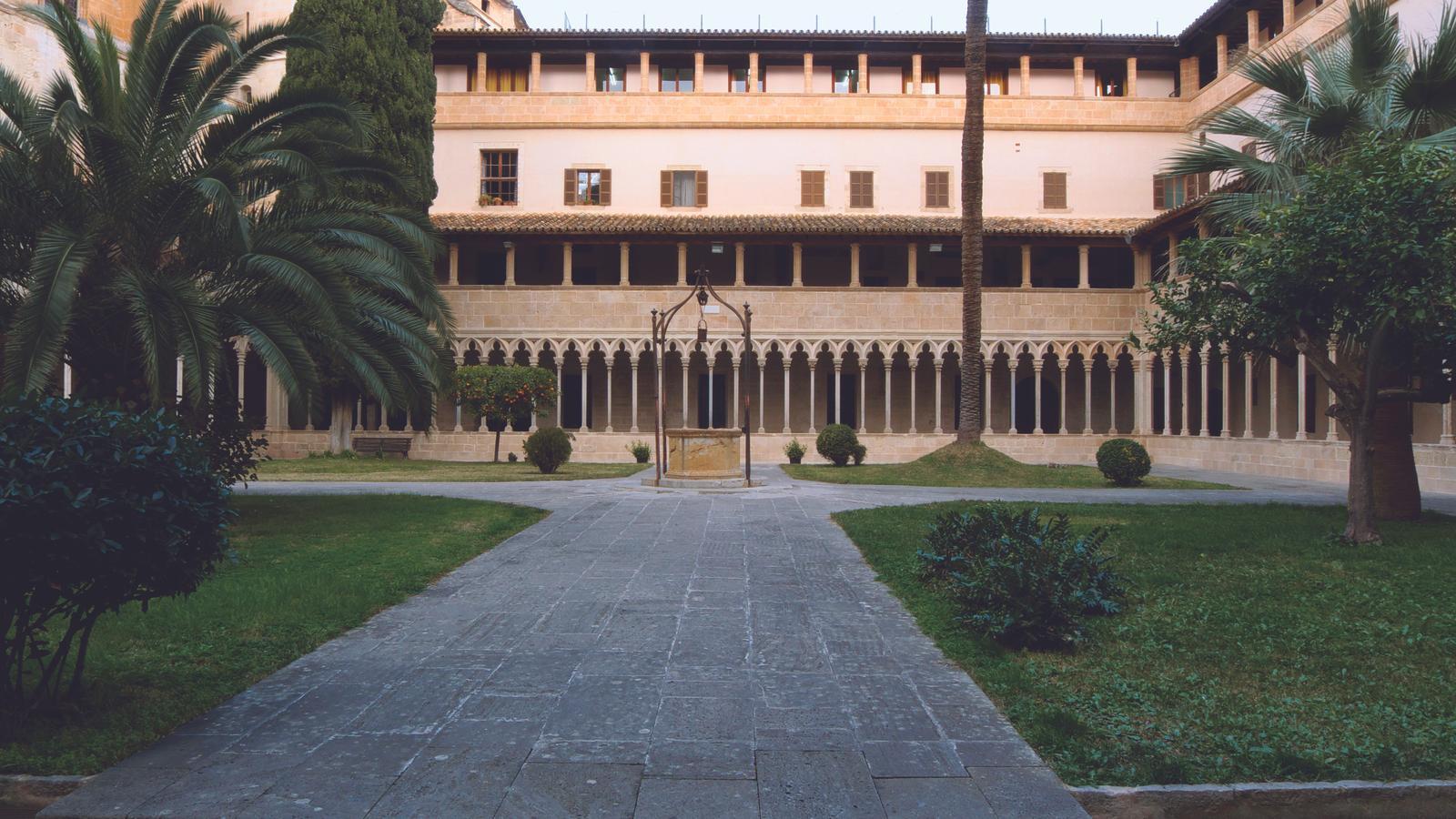
Many more religious buildings in Palma were affected, such as Sant Miquel, Monti-sion, la Concepció, and la Sapiència. The bell tower of El Socors was damaged. The convent of Sant Francesc, which had been expropriated at the time and served as a barracks for the Civil Guard, was one of the most affected: the fall of the bell tower's lantern collapsed what was used as a dwelling for an official and pierced the church vault and one of the tombs. The provincial government offices, which occupied the cloister, had to be evacuated.
The 1851 earthquake also wreaked havoc on the Almudaina Palace. What remained standing of the Torre de l'Àngel fell and the bell tower of the chapel of Santa Anna was affected. There was no choice but to vacate the Court, which was then located in the old royal palace, and move it to the Consolat de Mar building.
According to the report drafted on the effects of the earthquake in this enclosure, the force of the earthquake threw the rifles that were kept in the Almudaina a long distance. One of them would have completed a full turn in the air, so that, upon falling, it made a hole in the stone pavement.
The earthquake also caused damage to the Post Office building and the residence of the Count of San Simón, whose balcony was split in two. One of the damaged buildings had to be demolished. The Casa de les Comèdies was examined and it was concluded that the damage was not significant. It would also be demolished only two years later, to make way for the future Principal Theatre.
The nightmare was not over. Just four days later, the city suffered a second tremor, albeit of lesser intensity. Once again, "Palma became deserted," in the words of Juan Llabrés. A good part of the refugees opted for the ships docked at the port, which could barely contain so many people. More aftershocks would still be registered, but this time the majority of Palma's residents preferred to stay in their homes. "However..." they must have thought. More seismic movements are recorded in 1869, 1870, 1978, 1980, and 1989.
Although they have not gone beyond the realm of curious news, in this decade Mallorca has also experienced, at least, two seismic episodes. In July 2020, it was Pla that perceived "a tremor as if a large truck was passing in front of the house," as ARABalears reported at the time about the earthquake with its epicenter located between Montuïri, Porreres, and Sant Joan. In February 2022, the National Geographic Institute detected two small earthquakes in Deià and Bunyola. The 112 Emergency service, firefighters, and the Local Police of Marratxí registered alerts, and the vibrations were also felt in Santa Maria del Camí and Palma.
As early as 1851, the Mallorcan press lamented that "preventing such phenomena is probably beyond the present and future limits of human capacity." Sciences have advanced to the point where this is absurd, but it is still not possible to predict a phenomenon of this nature with accuracy. It serves as a consolation that the Balearic Islands are a zone of low seismic activity: the repetition of what happened 175 years ago seems unlikely.
One hundred and thirty years after the earthquake of 1851, in May 1981, a supposed apocalyptic prophecy spread through Mallorca: on the 12th of that month, a submarine earthquake would occur that would severely affect it, even its effects would wipe the island off the map. As Miquel Grimalt emphasizes, the environment was conducive to a prediction of this kind: that year, similarly to 1851, Mallorca was experiencing a series of unfavorable climatic circumstances, a drought, snowfalls in February, and floods in April.The fateful date arrived, and, of course, nothing happened. Well, almost nothing. It is true that there was an intense sea storm, but in no way comparable to the predicted catastrophe. Even so, some people sought refuge in the Serra de Tramuntana, just in case the waters overflowed.
Information prepared from texts by Miquel Grimalt i Gelabert, Juan Llabrés Bernal, Catalina Cantarellas, Gaspar Sabater, Lluís Salvador d’Habsburg-Lorena, Àlvar Campaner, the volume Memòria viva and the collective Fotos Antiguas de Mallorca (FAM).
