How was Maria del Mar Bonet, according to her brother: “Maria del Mar is who she is thanks to mother: back then she was already like the women of today”
Joan Ramon, older brother of the singer-songwriter, explains to us the best-kept secrets of her childhood

-
CAT -
CAST -
DE
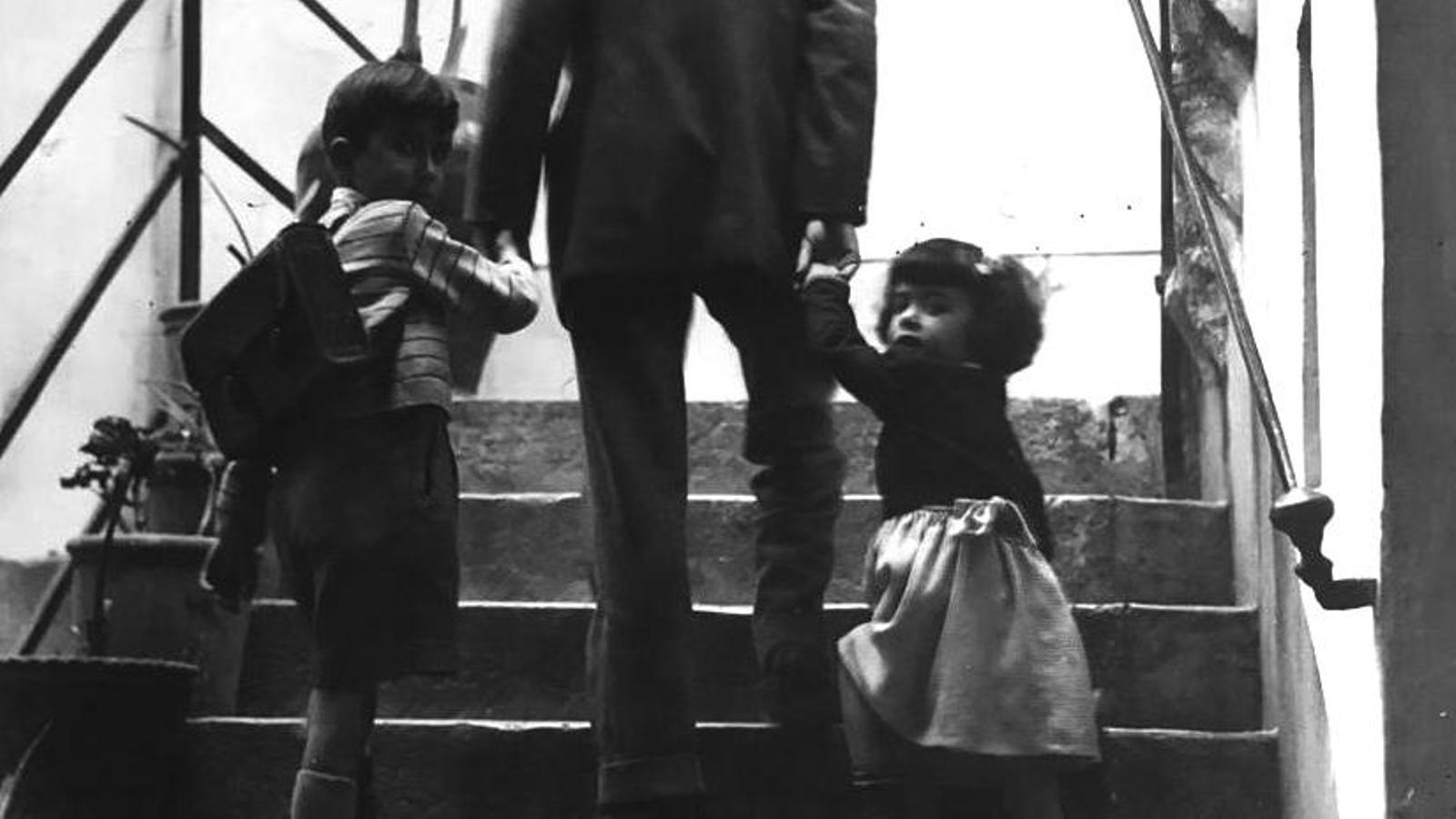
PalmaThe triangle formed in the centre of the city by the streets of Pelleteria, del Sol, and Monti-Sion was her world. The fifties had not yet begun: Palma was a very quiet place, without car traffic. Still. Between these streets was born and raised a key figure in the history of the Catalan Countries and beyond: Maria del Mar Bonet i Verdaguer (Palma, 1947), the lady of Mallorca. Her older brother, Joan Ramon Bonet (1944), offers us a new and highly personal look at the singer-songwriter.
When he was three years old, Joan Ramon was not sure he wanted a little sister; he awaited her with a certain suspicion. A few years later, however, the two siblings enjoyed a full childhood, surrounded by culture: "We went to the circus practically every day. Maria del Mar loved it! We also went to the theatre and to symphonic concerts," he recalls. Very soon, their parents got them a music theory teacher. "I played the violin and Maria del Mar sang in the choir. We normalised doing music theory; for us, it was like a grammar class. We had a fabulous education."
The father of the Bonet i Verdaguer siblings was the journalist Joan Bonet Gelabert, who worked at Baleares; their mother, Mercè Verdaguer, from Sant Sadurní d'Anoia, also had a column there. Maria del Mar is who she is thanks to her: “My mother had a very advanced way of thinking: she talked about feminism, caregiving, and the role of women. At home, there was no discrimination. We were raised with great freedom and independence.” The singer-songwriter’s character stood out early on: “Maria del Mar was very sweet, but also very independent. Even then, she was like the women of today, and she learned that from her mother, who gave her drive and courage.”
At home, wherever you looked there were books. Her father accumulated so many that, from time to time, they would donate them to the Palma City Council. He remembers that Maria del Mar had a sensitivity for poetry from a very young age. The father gave a guitar to Joan Ramon, and music began to be a part of family life. When her brother had already left for Barcelona, Maria del Mar Bonet began to create her first compositions. Her first concert, together with Joan Ramon, was at a lecture by her father about the French chanson of the fifties and sixties, which they illustrated musically.
At eighteen, Maria del Mar went to Barcelona, where her brother was already part of the Setze Jutges. “She left Palma, which at that time was a quiet city, to land in Barcelona, all bustle, all color. There was movement, the feeling of change. There, she was able to display her radiant personality.” The singer-songwriter integrated into the cultural environment and befriended artists such as Joan Manuel Serrat, Guillermina Motta, and Pi de la Serra. “We went to the theater, to photography exhibitions… The education we received allowed us to have a great interest in these things,” her brother states. Soon she became part of the Setze Jutges. The rest is history.
“Maria del Mar is sweet and hardworking. She does not improvise: she dedicates many hours of work to her voice and to the music. Things do not just happen on their own. She takes great care of herself. She reads, she talks to people.” Today she lives peacefully in the Migjorn of Mallorca, with the serenity of someone who knows she has made her mark and the energy to continue doing so. Over the decades, she has set poets to music, written songs, and rescued folk melodies, turning her voice into a bridge to take Catalan culture far beyond our borders. Thank you.
