Museums and archives of the Islands, still pending from the State
The Ministry of Culture has not set in motion the great majority of reform interventions announced in February 2022

-
CAT -
CAST
PalmaIt is not just the airports, those gateways to the Balearic Islands, which cannot be controlled from the Islands themselves because they belong to the State. The main museums, libraries, and archives, at this moment, after 43 years of self-government, are still state-owned, no matter how much their management was transferred to the Government, or from the Government to the island councils. This means that, in some cases, they have been waiting for years for Madrid to provide the funds and for the relevant procedures to be carried out to implement the necessary interventions, which the Spanish government is responsible for paying.
The Museum of Mallorca, in Palma, and its ethnology section, in Muro; the Archive of the Kingdom of Mallorca and the Can Sales Library, also in the city; the Archaeological Museum of Ibiza and Formentera, with its two locations in the Ibizan capital, in Dalt Vila and at Puig des Molins; the Museum of Menorca and the Library and Archive of Mahón are essential cultural infrastructures of the Islands, the ownership of which is maintained by the Ministry of Culture, even though, depending on the case, they are managed by the Autonomous Community or the Island Council, or both. Almost all of them need essential interventions, most of which have not yet been able to be carried out.
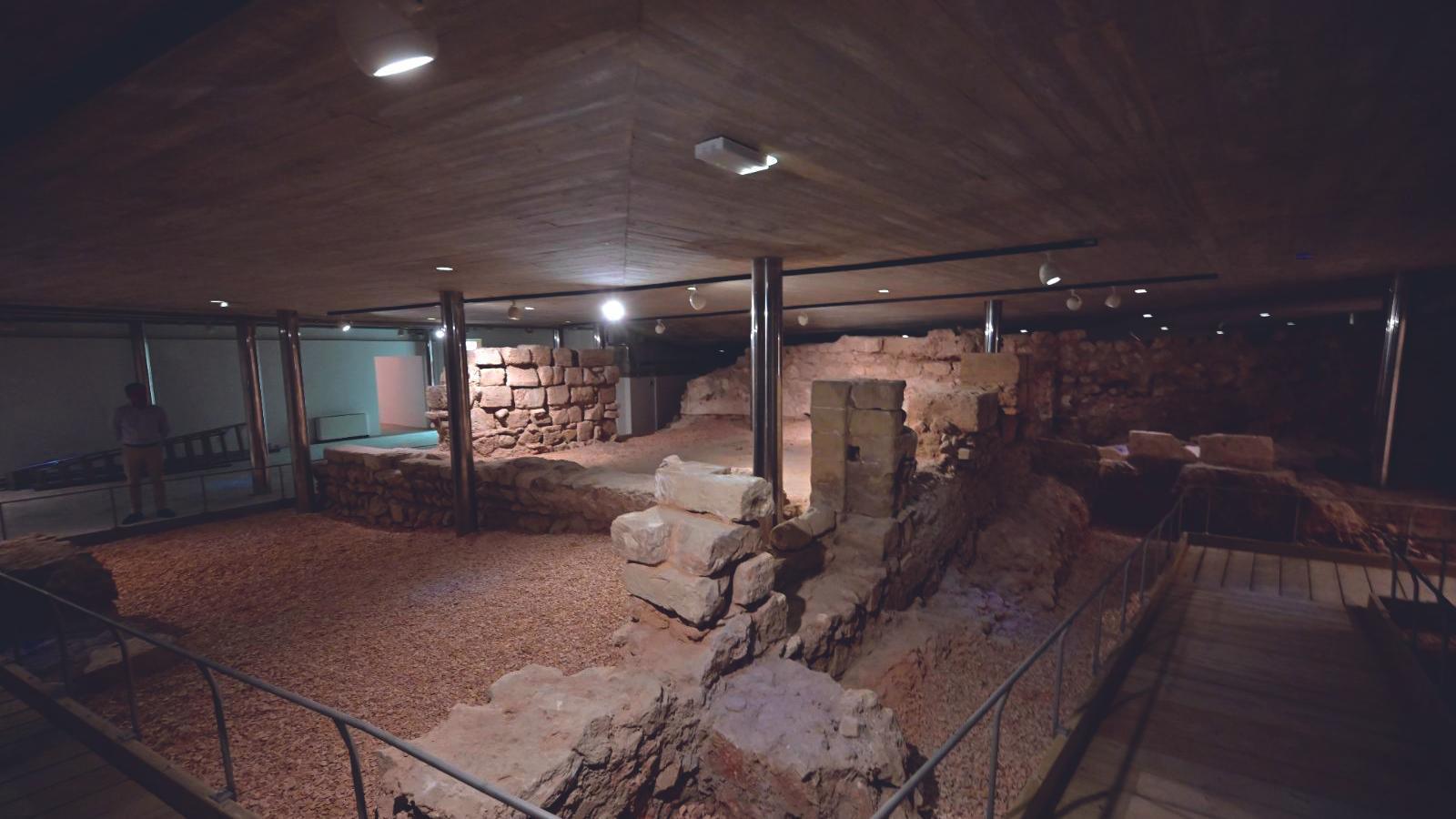
The most egregious case is that of the Archaeological Museum of Ibiza and Formentera (MAEF), created in 1907, a true jewel representing one of the benchmark Punic collections in the world. The responsibility for this facility is shared by three administrations: the State, owner of the museum; the Government, responsible for its management; and the Ibiza City Council, owner of the buildings at the Dalt Vila headquarters: the former headquarters of the University—the governing institution—, the Chapel of the Savior, and the Santa Tecla bastion.
The Dalt Vila headquarters has been closed for 16 years, since 2010, in need of restoration, although it has hosted the temporary exhibition When the walls speak to us. To this issue, another need has been added: the renovations that must be carried out at the Puig des Molins headquarters, located at the archaeological site of the same name.
The City Council of Ibiza has requested to recover the spaces it owns: "We have demanded that they be returned to us," note sources from the City Council, "but we continue without a response" from the state government. "We are willing to take them on to open them to the public, but they do not respond to us." The Council of Ibiza does not participate in the management of the MAEF, but it is responsible for giving technical approval to construction projects, in its case, through the Insular Commission for Land Management, Urban Planning, and Historical and Artistic Heritage. This entity also has "the greatest interest in these works progressing and finishing as soon as possible," the Council indicates.
Four years of delay
The Government's Director General of Culture, Llorenç Perelló, describes the situation in which the MAEF finds itself as “very sad.” Perelló himself and the Minister of Culture and Tourism, Jaume Bauzà, met in June in Madrid with the Secretary of State for Culture, Jordi Martí Grau, and the Director General of Heritage and Fine Arts, Ángeles Albert, to insist, once again, that the necessary works at the two locations of this facility be accelerated. The Government showed its willingness to take on the restoration of the Dalt Vila location, but without the drafting of the works project by the Ministry of Culture, it is not feasible to take this step.
The Ministry of Culture announced in February 2022, as reported at the time by ARA Balears, a set of investments earmarked for interventions in State infrastructures in the Islands, including 1,200,000 euros for the MAEF, 249,000 for the renovation of the archaeology rooms of the Museum of Mallorca, and 228,000 for the drafting of the rehabilitation project for the ethnological section of Muro.

Four years later and with elections in between, in addition to a change of political color in the Islands –which perhaps is not anecdotal–, none of these three interventions have been carried out. The renovation works at Can Sales, valued at 1.6 million euros, were indeed put into practice. The team led by Carolina Guayta went to great lengths to avoid having to temporarily close the library, and they maintained service to users until the intervention was completed in July 2025.
Both Can Sales and the Archive of the Kingdom of Mallorca, based on Ramon Llull Street in Palma, are managed by the Autonomous Community. The management of the Museum of Mallorca and the ethnological section of Muro corresponds to the Council of Mallorca. Much like the Museum of Menorca and the Library and Archive of Mahón with the Council of Menorca.
At the Museum of Mallorca, work was also carried out in 2023 in the building's courtyard to waterproof it and prevent water ingress, as explained by the director, Maria Gràcia Salvà. On the other hand, the archaeology rooms have remained closed since 2009, pending air conditioning and the awarding of the corresponding museum plan. The museum has already had, for four years now, the museum program for these rooms, that is to say, the narrative: how the pieces should be organized to be shown to the public. What is missing, however, is the awarding of the museographic project. This includes, among other things, the form of exhibition and the material supports: display cases, lighting, signs, and all other necessary elements. It is planned that in January 2027 the air conditioning works for the archaeology rooms will be awarded, charged to the State. This intervention will also make it possible for the spaces on the first floor of the same museum to have proper air conditioning.
Regarding the ethnological section of Muro, the comprehensive rehabilitation of the building is pending, an old 1670 manor house that the architect Gabriel Alomar Esteve once donated to the State's National Heritage and which incorporates agricultural tools, kitchen utensils, and furniture from rural culture. To make this action possible, the Council of Mallorca acquired, in May 2024, the house annexed to the museum, with the aim that it could serve to store the entire collection while the intervention was taking place, estimated to last about two years.
This August, the Council of Mallorca issued two separate complaints to the Ministry of Culture, demanding that both actions be launched once and for all: the Museum of Mallorca and the Muro section. The Vice President of the Council and Minister of Culture and Heritage, Antònia Roca, stated: “Mallorca cannot keep waiting. We have archaeology rooms [at the Museum of Mallorca] closed and citizens who cannot enjoy an essential part of their heritage because the government of Spain is not moving forward on a project that is their responsibility.” In reference to the Muro section, she denounced the “two years of paralysis.”
At the June meeting with the Ministry of Culture, the representatives of the Balearic Islands requested the corresponding procedures for the air conditioning of the Archive of the Kingdom of Mallorca, as well as new necessary financial allocations for Can Sales: waterproofing of the courtyards and restoration workshop. The latest news received by Llorenç Perelló indicates that the Ministry of Culture has awarded the drafting of the project for the air conditioning of the Archive.
The castle of Alaró and the bulls of Costitx
At that same meeting, Llorenç Perelló, who is also the mayor of Alaró, requested the collaboration of the State for the protection of the municipality's castle, for whose lands the Council of Mallorca has initiated the compulsory expropriation proceedings, as announced on Thursday, November 12. The Council had requested the transfer of the fortress, of which the state government claimed to hold ownership in 2022, in response to a question asked by the then-deputy in Congress Marga Prohens.
Another cultural dispute between the Islands and the Ministry of Culture is the three prehistoric bull heads found in Costitx in 1894, which left Mallorca destined for the National Archaeological Museum (MAN) in Madrid, because no one on the island could pay the price requested by the owner. It was the State that shelled out the 3,500 pesetas requested.
As early as 1979, the then-mayor of Costitx, Maria Antònia Munar, requested that the bulls be deposited at the Museum of Mallorca. As recently as March of this year, Madrid denied the request from the Council of Mallorca to, at the very least, loan the pieces temporarily and exhibit them at the same museum, which led the president of the institution, Llorenç Galmés, to state that "the Ministry of Culture is laughing at the Mallorcans".
The plenary session of the Council of Mallorca this October approved, unanimously despite the heated discussion, the creation of a joint commission: the Council, the Spanish government, the National Archaeological Museum, the Government, the City Council of Costitx, and the Museum of Mallorca. The objective is to study the state of conservation of the bulls and request a conservation plan from the MAN that would make their permanent transfer to the Mallorcan museum possible. The fact that both are state-owned is supposed to facilitate things, because the ownership would not be modified.
In Menorca, neither the Museum of Menorca nor the Library and Archive of Mahón present, in principle, deficiencies as serious as those that are indeed recorded in facilities that are still owned by the State, both in the Pityusic Islands and in Mallorca. The Library shares a headquarters with the Archive, and this certainly implies a lack of space. It is the same thing that happened, at the time, with the House of Culture of Palma, which was shared by the Archive of the Kingdom of Mallorca and the Library, until it was moved to the current headquarters of Can Sales in 2004.
Bartomeu Colom, Doctor of Law, Professor of Administrative Law at the University of the Balearic Islands and one of the leading experts in the legal framework of autonomy, considers that each competence should be the responsibility of one administration, and “not of three or four”. If there are several institutions “that act on a competence, to whom do we attribute the laurels?”, he asks, thinking about when there is a success.
“In matters of culture”, adds Colom, “there is really a mess”. If different institutions—state, regional, island, local—share competences on the same issue, “in the end you don't know who is responsible and to whom you should attribute good administration. It is very complicated to manage all this”.
