Joan Melià: “My exemplary lives are not very exemplary”
Sociolinguist and writer

-
CAT -
CAST -
DE
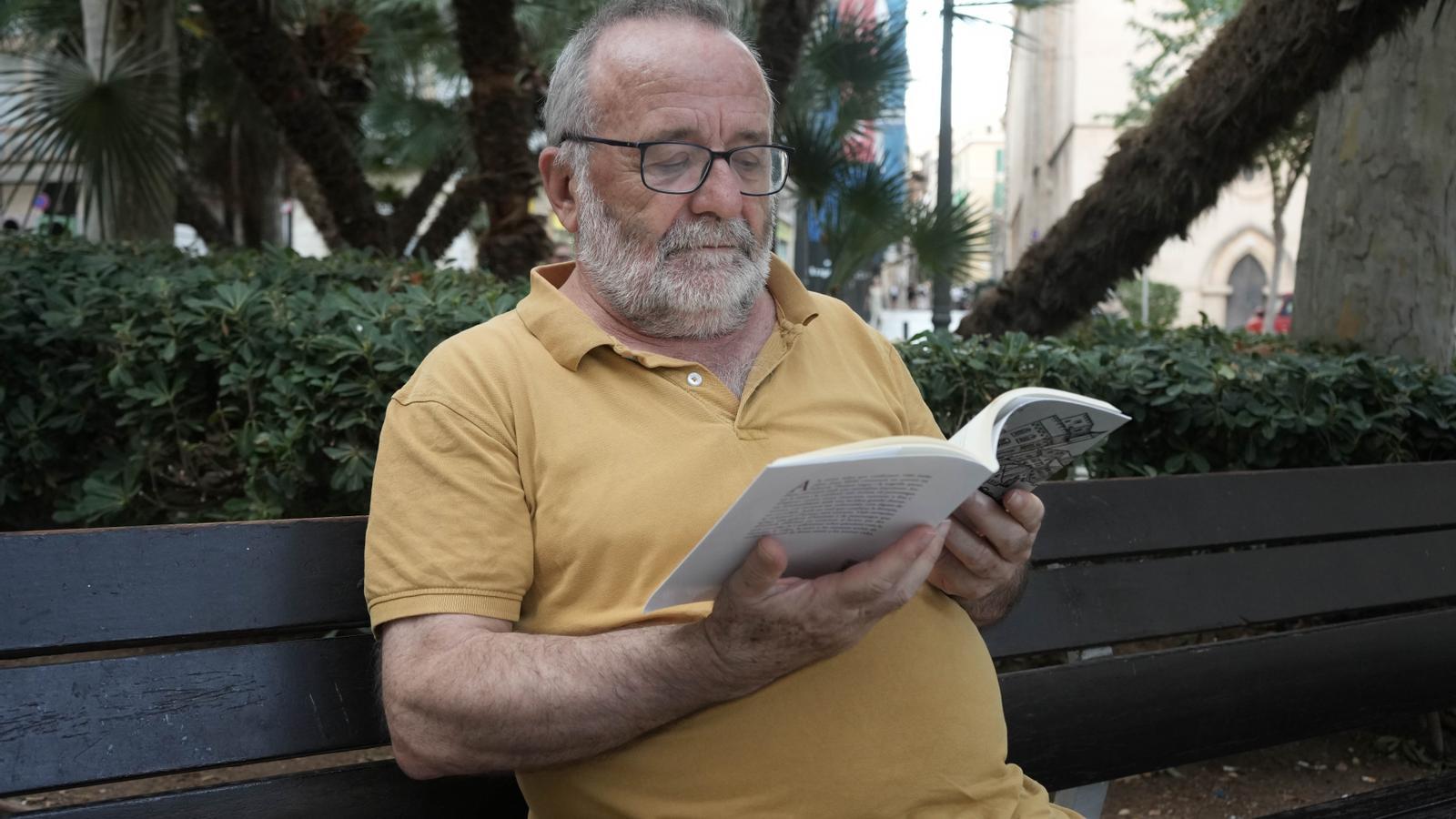
PalmaHe is a benchmark for the Catalan language in the Balearic Islands. An expert in sociolinguistics and language models, before retiring Joan Melià Garí (Porreres, 1954) was a teacher at secondary schools and at the University of the Balearic Islands, where he held the positions of associate vice-rector for Linguistic Normalization and director of the Linguistic Service. He has also been the director general of Linguistic Policy for the Government of the Balearic Islands. In 2023, he published with the publisher Lleonard Muntaner Smiling with grammar, and now he brings to light, under the same imprint, Exemplary lives, his first foray into fiction literature, a collection of thirteen stories. He acknowledges the influence of authors such as Quim Monzó and, above all, Pere Calders, to whom he pays tribute in one of the stories. On Saturday, October 17th, at 7:30 PM, he will present the book at the Cultural Association of Porreres, accompanied by Cesca Roig and Maria Muntaner.
Why launch into publishing fiction now?
— The first story, ‘Justice is blindfolded’, was requested by ARA Balears for Sant Jordi in 2016. I wrote the rest after retiring; they are unpublished. Perhaps now, with age, I am not as afraid to publish them.
Exemplary lives. Or perhaps they are not so exemplary?
— When I was seven or eight years old, there was a collection of saints' lives that was called that, which were comics, with a certain epic quality, and we kids liked them. The title of the book can be misleading: no, they are not very exemplary, they are examples of themselves.
“Nobody believes me when I say that I am me”. That is how the first story begins. It seems that you have taken special care with the beginnings.
— Yes. It is intentional. Also when I was writing the articles for ARA Balears it was important to capture the readers' attention with a surprising beginning.
Some of the protagonists in the stories are people who want to write. Like you.
— Some have an autobiographical basis. But exaggerated, out of context. Some reflections are the ones you make when you write. But these are characters with a special coherence, not politically correct.
There are also assassins.
— But they do not kill out of hatred, but because of the circumstances. For example: they may have the impression that life is a suffering, and want to avoid that suffering.
And a good handful are people who are retiring.
— I felt more comfortable with people who were going through the same phase as me. People who already look at the world with a certain distance.
Does life change much with retirement?
— Yes. Suddenly you have that feeling that, if I don't do that, I'll do it tomorrow. Sometimes, you find a certain emptiness, because you are used to a powerful work rhythm. You have to adapt to it, look for other ways to fill the time.
A pandemic appears in the book.
— But it is not that one from a few years ago. This is another one.
How did you experience the pandemic a few years ago?
— I was still teaching classes. That accelerated the use of computer tools, through the internet. It caught me in Porreres, at my home, in a village house, which must not have been as hard as being locked up in an apartment. I had animals in the countryside and I had to go there every day to feed them. It was not that distressing.
Germans who buy a property and urban speculation also appear on these pages. That sounds familiar to me.
— Exactly. They are winks, to seek the reader's complicity.
And the teachers' work: very burdensome.
— Not so much because of the teaching, but because of everything that administrative work and paperwork entails. From my own experience and what I have heard from colleagues, it is the part that teachers dislike the most. They have to do a lot of work for which they do not see the result.
You have dedicated your career to the language. How do you see Catalan in the Islands now?
— It is in a very difficult, complicated situation. I believe it is still reversible if there is will on the part of the public administrations. But also from the population. We probably need to be more consistent in our daily behavior. Everyone, with our daily actions, can be active agents in favor of the Catalan language, in the way we establish communities, and not renounce our language.
Does the fact that many people have come from abroad have an influence?
— It is very difficult to manage this growth. But it is not the culprit. Immigration, when it finds a social context that favors linguistic integration, usually integrates into it. The problem is that the social context is not favorable to them. The people they interact with do not maintain a coherent attitude: it is not necessary to change languages. They often understand you. The problem is that we change languages before knowing if they understand us. Now, those of us who have Catalan as our first language are a minority. Among young people, school has ensured that there is, at the very least, comprehension and usage, even if it is very basic. But knowledge is not enough.
And the University of the Balearic Islands (UIB), how do you see it?
— The UIB is somewhat a reflection of society. In the early 80s, teaching in high schools was mostly in Spanish, whereas at the UIB more than 50% of classes were taught in Catalan. Now the opposite is happening. The UIB has reduced Catalan as a teaching tool, while in secondary education its presence has increased.
Is it possible to reverse this situation?
— Yes, it is possible with the joint will of society, of individuals, of collectives, who must see that the administrations are by their side. This does not only happen in our case: all medium-sized linguistic communities have received the effect of globalization. They have become more permeable.
