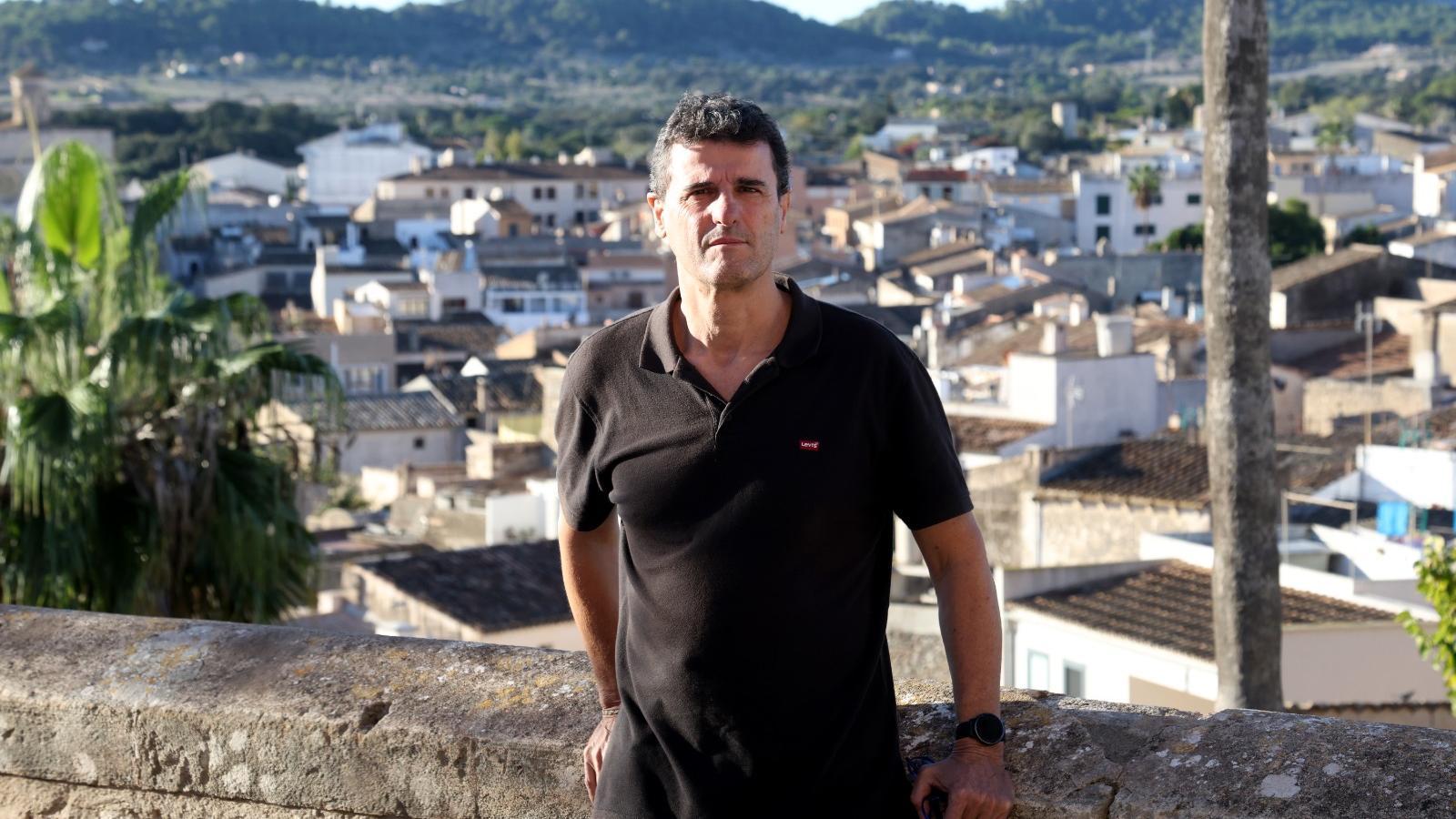
Manolo Galán: "Artà does not want any more tourist places, the social situation cannot be sustained"
Mayor of Artà
-
CAT -
CAST -
DE
ArtàThe plenary session of Artà approved at the end of September an initial modification of the Subsidiary Rules that limits tourist places in the municipality and restricts tourist rentals in multi-family homes, listed buildings, and the old town. The agreement, approved with the votes of the PSIB-PSOE and El Pi and the abstention of UIA-MÉS and the PP, suspends incompatible applications for two years and has now been opened for public information for 45 working days.
Artà is the first municipality to approve a measure to reduce tourist places. How was this reached? What made the City Council take this step before the supra-municipal institutions, such as the Government and the Council of Mallorca?
— We arrive here after an analysis of what is happening, not only in Artà, but in all of Mallorca, and after listening a lot to the citizens, who say and manifest that they are not against tourism, but against massification and the lack of control that exists. If to all this you add a trend, in which there is a lot of legal supply, but there is also a lot of illegal supply, we consider what we can do. It has been a somewhat long process, because we started it a year and a half ago. The question we posed to our technicians was what powers we had and how we could regulate the issue of tourist places.
How did you decide to take this step, what margin did you have?
— The question we asked ourselves was what we could do and what powers we had. The technicians, after talking among themselves, found that the way was through the Intervention Plan in Tourist Areas (PIAT). The PIAT was approved in 2020 and set a four-year period during which the town councils had to adapt to it, but no town council had done so. The Urban Planning services and the legal team proposed that the appropriate thing was to do it via a modification of the Subsidiary Norms, since that is where we establish the uses of dwellings and uses that the different properties can have. From there, they concluded that the most suitable thing was to carry out this study, which we commissioned from an external company. By the month of March we already had the first resolutions and in July we already had a proposal for modification. From there, we began to talk with the political parties until reaching the plenary session, in which the proposal was approved without a single vote against.
How many tourist places does Artà have?
— Artà currently has 4,400 tourist places, more or less. If we take into account that we have a population of about 8,000 people, you realize that they represent half of the population of the entire municipality. If you walk through Artà in the month of August or July, there can easily be 12,000 people in the municipality. All this, counting only the legal offer.
The measure has been approved without any opposing votes. Does this make you think that it will endure regardless of the government team in place?
— For us it is important, because no political force has expressed discontent or voted against this modification. This suggests that it will be a measure that will be maintained. Perhaps there will be some nuance, but it will endure, because the social situation we have is unsustainable. I believe that now it is unlikely that any political force will backtrack on a containment measure and, in this case, one that would mean reopening the door to more tourist places. I believe that not even the Government will dare to increase the tourist places.
What exactly does the modification of the Subsidiary Norms that you have initially approved consist of?
— What we have done with this modification is basically say that Artà does not want any more places, that there will not be a single new one. We start from the base that there were 4,336 tourist places, of which 2,117 were on urban land and 2,229 on rustic land; the PIAT, however, only refers to places and densities of urban land and not to the places that are on rustic land. In the first studies we carried out, we applied the zoning that the PIAT told us, of the residential urban core and the more touristy urban cores. If we applied the six places per hectare that the PIAT marks on urban land, of the 744 places we have within the core of Artà, we saw that there were 156 too many. Afterwards, the debate with the different political forces; being clear that the message was that we did not want any more places, we had to know what we were doing with the other cores.
— In the coastal centers of Colònia de Sant Pere, Montferrutx, l'Estanyol, Betlem and Sant Pere, the PIAT states that the density can be between 6 and 12 places per hectare. If we applied 12, there was obviously no reduction and in some places, it was even possible to increase hundreds of places. Therefore, in this way we did not achieve our goal. Thus, we looked for a density that would allow all centers to have surplus places, and that density is 7.
With a density of six places per hectare in the urban center of Artà and seven in the coastal areas, how many tourist places will remain?
— From the 2,117 places that existed initially, we would go to 1,456: we are reducing it by 661. What does this mean? That the Artà City Council will eliminate 661 places? No, because we do not have the authority to do so. What we have done is set a ceiling of 1,456 in urban land. We know that there are about 29 dwellings which account for 100 places in multi-family buildings and which must be renewed every five years. And this is where we can act: we will not renew them, because the Artà City Council opts for there to be no tourist rentals within multi-family buildings. This means that these 100 places will be amortized as the certificate is requested from the City Council. This is a 31% reduction in urban land and 9.87% in rustic land. In total, 20% between both. This is the work that the Council of Mallorca entrusted to us six years ago that no one has done and that we indeed have done. Could we have been more restrictive? Yes, probably yes. But well, there is not much margin left with the parameters set by the PIAT.
Are multi-family buildings where the measure will be seen first?
— This Thursday we are to meet with the island Councilor for Tourism, Guillem Ginard, and we will explain to him what our objective is. First, we want to ask him for the inspections to be more solid and for there to be more of them, because we have information that says this number could be somewhat inflated, because there are people who bought them when they were free and did not end up commercializing them, because, for example, the son has nowhere to go to live and they really have the use of a dwelling or others that are long-term rentals. We understand that these places could be fewer if there were more inspection and then regulation to deregister them.
And what will happen with tourist accommodation places on rustic land?
— The PIAT does not set any density of tourist places on rustic land. Since we had 2,200, we reached an agreement to set the cap at 2,000 places, and they would be reduced in the same way: people who do not market them or people who, in the meantime, no longer comply with the regulations.
How is it explained that a municipality like Artà has 2,200 tourist places on rustic land?
— This accounts for almost 20% of all dwellings on rustic land. In other words, one in five has tourist accommodation. Although here we would say that there is a bit of everything: there are people who have their country house to rent because they cannot make ends meet or to have an extra income; and there are others who buy houses in the countryside or who already build them with the aim of marketing them, which are the majority.
In what timeframe do you think this reduction of places in Artà will be able to materialize, taking into account that it is a measure that will be applied very gradually?
— The horizon is this Thursday the meeting with the Council, and we will raise these questions, because we want to know how many people have been inspected in Artà and how many places there really are. Probably, those dwellings that someone has rented out as ETH, and has a child, or two or three, and needs this dwelling, are released from holiday rental to become a dwelling for the children, basically. Knowing that land in Artà is very expensive and that dwellings are highly valued, well, probably, if I have a child and I have a dwelling rented out as ETH, well, all the time I have to release it is fine, but probably this dwelling will return to the market and will not be able to consolidate it. What time? It is very hard to say. Unless the Council of Mallorca takes a further step and reduces the places as it said it would and has not done... But what must be taken into account is that the regulation does not depend on the City Council.
What powers does the City Council have in this matter and what room for maneuver does it have?
— In multi-family communities, we depend on whether we issue a certificate for a suitable or unsuitable zone. Now, what I said before: we will not grant any more places. Now, if the Council were to open places again and people wanted to opt for them, the certificate that we would have to provide would be negative. Therefore, it would not be possible to issue new licenses. It has already been stated: this is as far as it goes, there will be no more. We issue the certificate to declare a zone suitable or unsuitable, and if this certificate is not requested, the town councils have no way of doing so. How long this will be the case, I do not know, because the Council could modify it. Therefore, the requirements for a person to be able to market their places until now had been, especially in ETH, that they needed one of the town councils to declare the zone suitable or unsuitable, as established by the PIAT.
The Council said that it would effectively reduce the ceiling of places through the PIAT and now they say that the processing is too long and that there will be no time.
— That the Council says it is a long process is true, but it must be started at some point. That it is a long one should not deprive you of starting at some point, right? Perhaps you do not start with 100% of the objectives, as it could be here, but we have a minimum.
At what stage is the processing?
— It is now under public exhibition and there will likely be allegations that we will have to resolve. We have done a job that we understand is not the best, not 100% of what we would have politically wanted, but it is a minimum that we have agreed upon among all, some with an abstention and some with a favorable vote. At the time of negotiating there were more radical positions, there were some not so radical, but we did not have a single vote against and that is good.
What is the housing situation in Artà? Has the municipality been declared a stressed residential market zone?
— In Artà we have a problem, like everyone else, with housing and we understand that there are many of these homes that are marketed as tourist accommodation: at the end of the day, the only thing they do is take away housing for the people of Artà. We do not say that they are the exclusive cause, because there are other things, but it is certainly a fact that has left its mark and we must take it into account. We asked the Council of Mallorca and the Government for the municipality to be declared a stressed residential area, but they told us no. We carried out a study through the UIB like the one Manacor did and we obviously meet the requirements by far.
Which housing-related problem do you encounter most often: young people who cannot become independent, second homes becoming primary residences, substandard housing...?
— It is no longer the case that those who cannot access housing are the ones going to Social Services. That has not been the case for a long time. Young people cannot access housing. Many second homes have become primary residences for children. Faced with this, all we have left is to buy plots of land to cede them to Ibavi. We now have a tender for a block of 12 homes that Ibavi will build.
Have you received any pressure regarding the measure?
— Before approving the measure, I already met with the business association. They agree to regulate this a little. The pressures I have received are for clarification. We are dealing with a diverse set of circumstances, where there are people who had bought places, but who do not yet have them marketed. We have to see at the planning department how many people from Artà have bought places and do not have them marketed, because it is a piece of data that I am interested in knowing.
Ten years from now, how would you like Artà to have changed?
— For me, Artà should be able to maintain the quality of life we have there. Like the cliché of the essence of the town. That is what I would like it to maintain. What should change? The housing situation is key. The people of Artà should not have to go to other towns to be able to find a home. Many people from Mallorca have to go to the Peninsula and we must do something about it. I believe we must find the balance between consuming territory and optimizing all the housing we have. Now, regarding the census, we will work to see how many empty homes we have; it is a piece of data that I am interested in knowing. Faced with this serious problem, political forces must reach an agreement. It is essential that in housing policies, four, five, or six measures can be agreed upon and not touched for ten years, to see if they will bear fruit. I believe that stability is necessary to first know how the market responds, which is what builders always say, that they have legal certainty and time for these policies to bear fruit. We need high-mindedness.
