Pilar Aymerich and Paula Artés: two committed photographers
The Toni Catany International Photography Centre has just opened two exhibitions that question reality from two different generations
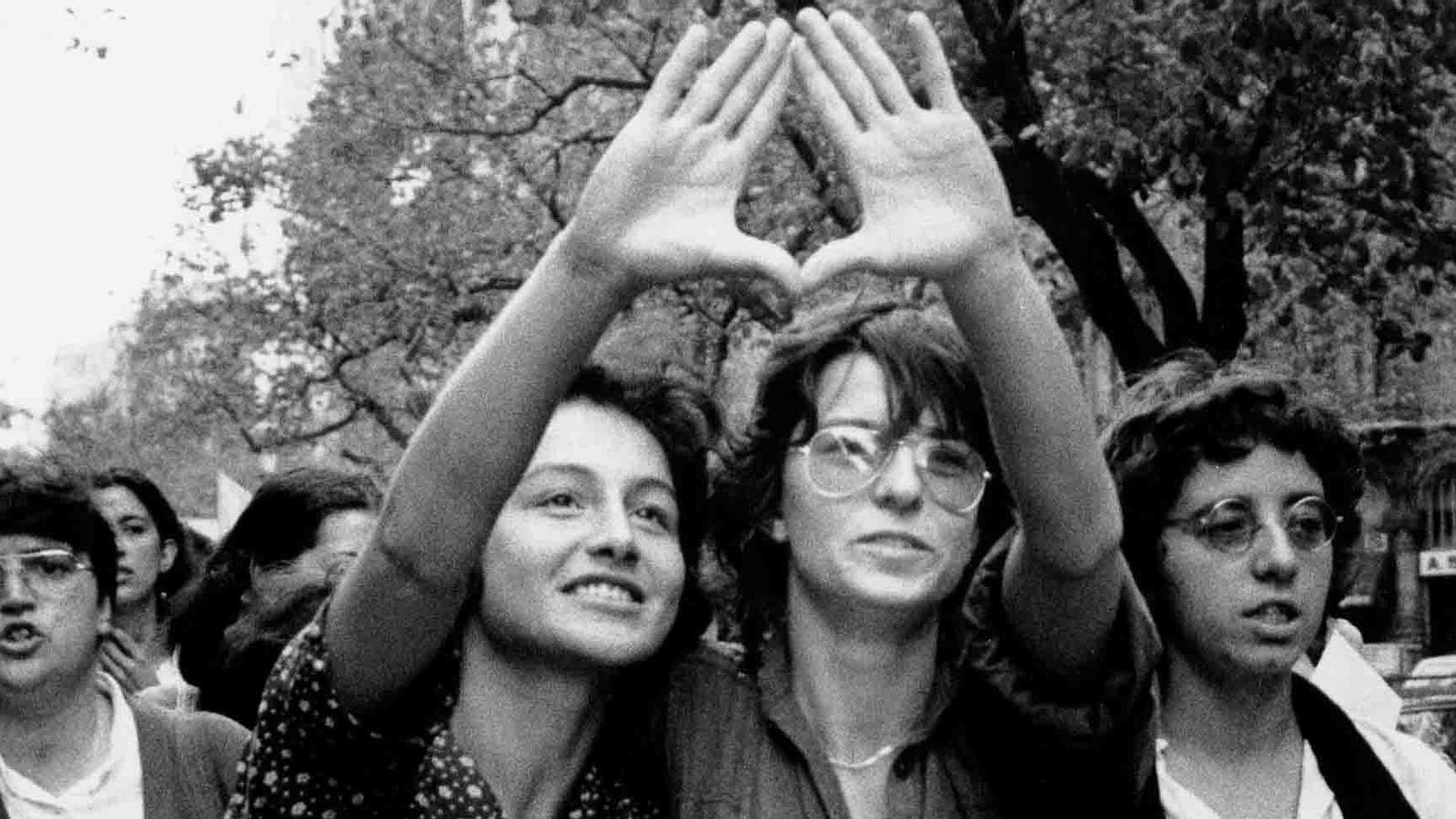
PalmThere are looks that not only document the world, but shake it. This is what we find at the Toni Catany International Photography Centre in Llucmajor, which this Friday, March 27, opened two exhibitions that fully align with this tradition: The insolent revolution of bodies, by Pilar Aymerich –curated by Laura Terré– and Honorary box, by Paula Artés. Two proposals that are part of the cycle Committed female photographers and which, from different times, contexts, and languages, share the desire to make visible that which often remains out of frame or dissolves into normality. From two very different generations and also from two diverse ways of expressing themselves through photography, both Aymerich and Artés understand photography not as a solitary gesture, but as a practice permeated by the relationship with others and with the surrounding context.
Testimony and active part
In the case of Pilar Aymerich (Barcelona, 1943), winner of the National Photography Prize 2021, the camera becomes a tool of resistance and, at the same time, of listening. Her work, forged in the convulsed years of the end of Francoism and the Transition, captures the moment when bodies begin to disobey imposed norms. It is not just about documenting historical events, but about recording a profound transformation that is inscribed in everyday gestures, in gazes, in the way of inhabiting public space. “I photographed the first feminist demonstrations in the streets of Barcelona. Those days I was present with two hats: that of a photographer and that of a demonstrator,” she recalls.

Her career, which began in theatre and developed in publications such as Serra d’Or, Triunfo, and El País, is marked by this dual condition: witness and active participant. She collaborated with Vindicación Feminista and, together with Montserrat Roig, helped to construct a visual and textual memory of cultural resistance. As Laura Terré points out, her images reveal “the insolent revolution of bodies”, an insurrection that manifests in the details: a posture, clothing, an expression. “Joy is revolutionary,” states Aymerich, and in this joy – full of tension and awareness – the spirit of an era in which everything seemed possible and urgent is condensed.
But if Aymerich focuses on the body that erupts and becomes visible, Paula Artés (Molins de Rei, 1996) directs her gaze towards the mechanisms that organize the visible and determine what remains hidden. In Palco de honor (2023-2025), the artist investigates the presidential box of the Santiago Bernabéu stadium as a space for the representation of power. There, amidst sporting euphoria and under the gaze of millions of spectators, a network of political, economic, and business relationships is concentrated that is rarely questioned.
Access to restricted areas
Artés's practice stems from exhaustive research and a desire to access restricted spaces to challenge them. Previous projects such as Fuerzas y cuerpos and Energia submergida already traced this cartography of diffuse power, but in Palco de honor the gesture is especially revealing: it is not about going to a hidden place, but about looking carefully at what is openly displayed. As critic Carles Guerra points out, his work “amounts to a continuous, in-depth cross-section, to make visible the strata of a diffuse power”.

The diptych that structures Honor Box proposes a play of mirrors between the masses and the elite, between the choreography of the stands and the apparent stillness of the box. The faces of power, captured from television broadcasts and presented pixelated, become unstable, almost abstract images that point to the mutable nature of capital. The image of the empty box does not function as an absence, but as a latent presence: that of a system that reproduces itself even when it is not seen.
Aymerich and Artés's work is a dialogue between two generations of photographers that is part of a broader program. On April 16 and 17, the Toni Catany Foundation, in collaboration with the CRIMIC laboratory at Sorbonne Université in Paris, is organizing the international symposium Committed Photographers during the Transition (1975-1982). The event will revisit the careers of Aymerich, Colita, Marta Sentís, and Anna Turbau.
Taken together, the project traces a path from the rebelling body to the self-staging system, from the emergence of a collective subjectivity to the persistence of a power that constantly reinvents itself. The two exhibitions that have just opened not only invite us to look, but to take a stand.
