The new town square is digital
An emerging generation from the Islands creates content in Catalan on social networks and, beyond entertaining, builds language, references, community, and new shared imaginaries
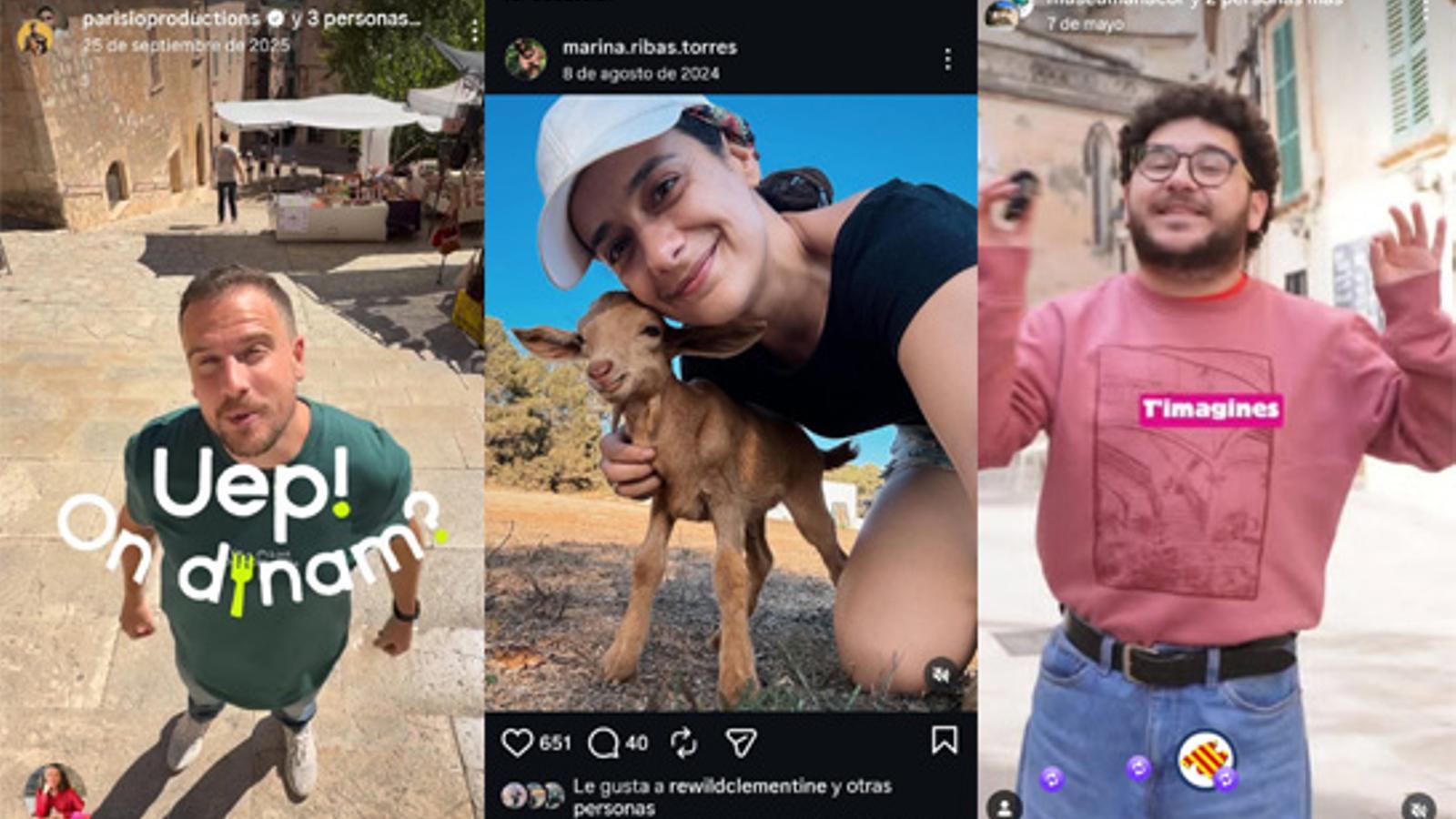
Manacor“Everyone who comes to Mallorca and wants to take a typical souvenir: let them take a cyclist, there are many... To a whore's house, the bicycle!”. This is how Lluc Aparicio (@parisioproductions) ironically states in an Instagram video that has over 26,700 likes and nearly 10,000 shares. The publication accumulates hundreds of comments, some very harsh. “There are always people who get angry, but I don't want to pay attention to them. They criticize me if I talk about tourist saturation and also if I speak Catalan, but they are people who don't understand that I'm doing humor,” he explains.
Aparicio (Sineu, 1992) is one of the best-known voices in the digital landscape of the Balearic Islands. During confinement, he began dubbing a travel video for which he had not recorded the sound. It is only one of many examples that place the lack of physical socialization imposed by COVID-19 as the context that gave rise to a whole series of content creators in Catalan in the Balearic Islands.
On the @parlars_mallorquins account, a meme surpasses tens of thousands of views, criticizing the media mirage of therians: “What if we stop stigmatizing and harassing 16-year-old kids who are experimenting with their identity and start getting outraged by the housing crisis, linguistic substitution, the touristification, and war crimes?”. Another example of how a new generation uses the codes of social networks to generate public conversation, build community, and intervene in cultural debate.
From isolated profiles to the ecosystem
Despite the relentless law of the algorithm, which favors Spanish and English, a diverse ecosystem of content creators has emerged in the Balearic Islands who explain the territory and society, make humor, disseminate information, or simply share daily life from their own perspective. They do so in Catalan, naturally. Viewed individually, they are different profiles; observed as a whole, they draw a new digital cultural sphere that contributes to creating discourse, references, collective imagination, and a sense of belonging.
- 1,200 active projects
- 440 publications per day
- 2.8 billion views
- +101.6% views per publication in 2025
- +71% audience compared to 2024
These are profiles that participate with different registers in the public conversation on issues as diverse as the economic model, language, the housing crisis, tourist saturation, and identity. Hundreds of thousands of views demonstrate that there is an audience that wants to consume content in Catalan on the internet. It is a new scenario that replicates or even replaces the function that other socialization spaces such as public spaces, local media, and cafes have exercised until recently.
“There are many creators who today are already first-rate cultural interlocutors. They speak of shared concerns, generate communities around certain interests, and contribute to building new cultural spaces,” assures digital culture expert Albert Lloreta. From Accent Obert, the foundation that promotes Catalan in the digital environment, and La Llista, the benchmark observatory for the creation of content in Catalan on social networks, Lloreta understands them as “a heterogeneous collective with a great capacity to generate cultural value”.
At what point does one go from being a personal profile to being a community promoter? “I suppose the first sign is when people stop you on the street and tell you they've seen your videos. Until then, everything happens behind a screen, but suddenly you discover that there are real people who recognize you and follow you,” explains Joan S. Moñino (Manacor, 1997), known as @parlars_mallorquins. “My growth has always been very gradual. Simply, there were more and more comments, more messages, and more people with whom I shared experiences”.
Towards a cultural industry
Until recently, it was difficult to measure the real scope of content creation in Catalan. Well-known names were known, but not the overall picture. This is precisely the gap that La Llista has filled, which has X-rayed the digital landscape in Catalan for the first time.
In 2025, the Balearic Islands registered the most spectacular increase among Catalan-speaking territories: total views soared by 249.8% compared to 2024. Maintaining practically the same level of impact after that explosion now means, according to Lloreta, "that the audience no longer responds to a specific viral phenomenon, but has consolidated". In other words: growth no longer depends on one or two viral videos, but on the constant appearance of new creators, formats, and communities. It is the clearest sign that the Balearic Islands have stopped having isolated creators and are beginning to build a true digital cultural ecosystem.

Last year, audiences grew by 71% compared to 2024, a progression rarely seen in other cultural fields. “It is not common for there to be 70% more viewers in cinema or theater from one year to the next,” he points out. For this reason, he considers that digital creation in Catalan is still “on a growth ramp typical of the beginnings of a cultural industry”.
Data from the first months of 2026 in the Balearic Islands indicate that there are approximately 1,200 active projects and about 440 daily publications, with “a trend towards maturity”.
Who explains the Islands today
“We live surrounded by a lot of information and it's getting harder and harder for us to process it. Short videos may seem superficial, but they can also be an entry point. If you manage to get someone interested in the history of a neighborhood, a building, or a tradition, you've already taken an important step,” says Constança Ramis (Palma, 1995), @co.torrita, who also started creating content during confinement.
“At first, I made videos recommending cafes and over time I started to question what model I was promoting. I asked myself if, unintentionally, I was contributing to a certain industry or a specific way of understanding Mallorca. I decided I wanted to be more coherent with my values. Creating content is also a political decision: each video explains a way of looking at the world,” she explains.
Marina Ribas (Eivissa, 1989) started writing a blog about cooking in 2012. She defines herself as a 'dietitian, teacher, and oil-dipped bread peasant who writes' and is one of the most followed Eivissa voices in Catalan on the internet. Her case is symptomatic: “We are the island where Catalan is spoken the least; the language is in decline, but there are people who write to me to say they are studying Catalan to be able to follow me.” Ribas explains how, after the initial success, she gave in to commercial pressures to create content in Spanish. Despite everything, she decided to return to Catalan. To the surprise of many, she has not stopped growing in followers and feels she is in a more coherent position. “We have the biggest loudspeaker in history. Here we have to break ground, because perhaps it is the best tool we could have to continue normalizing the use of Catalan,” she states.
Building a network from networks
For Ribas, networks “fulfill a compensatory function” in the face of the loss of real physical spaces and the rise of individualization. “That's why communities online can also generate this sense of belonging and foster the creation of communities that can often transcend the screen,” she assures. In her case, digital content has opened doors for her to publish books and she opts for a more relaxed style.
@parisioproductions is an example of how digital media has fostered connections in physical space. He is one of the regulars in collaborations with other creators such as @cas.horrach, @mar.xosa, @angelaguilop and @toniguiscafre. And he himself has promoted shared initiatives such as ‘Uep, on dinam’.

Moñino and Ramis, the creators of Ramona Divulga, are also clear on this, a network of nine disseminators who want to establish themselves as an association to have a stable structure, share resources, and contribute to professionalization. “We have a great need to network. Probably because we are a minority culture and we need to say that we exist, that we have our own perspective on the world, and that we want to explain it,” concludes Moñino. For them, Catalan is not a limitation of audience, and their challenge is twofold: to return to physical space and rebuild community there, and to aspire to professionalization.

When L’Aferrada held its first edition in 2023, the content creation sector in Catalan in the Balearic Islands was still very nascent. Three years later, the landscape has changed radically. “The creation of content in Catalan probably has the best health it has ever had,” assures the project director, Laia Carrera, who highlights both the increase in creators and the diversification of content.L’Aferrada was born thanks to the Obra Cultural Balear with the aim of promoting the use of Catalan in the digital sphere, fostering the professionalization of creators, and becoming a meeting point for the entire ecosystem. The project took over from La Troca, the first meeting of creators organized in 2022 by the governments of the Balearic Islands, Catalonia, and the Valencian Community, which did not continue. “It was already perceived that it was an emerging sector with great potential and that it could play an important role in the future of the language,” she recalls.Beyond the conferences, L’Aferrada has played an essential role as a networking space. “Many Majorcan creators met in person for the first time at L’Aferrada,” explains Carrera. These meetings have led to collaborations and new projects, while creators from the Islands have gained visibility among companies, institutions, and professionals from other Catalan-speaking territories.Growth has also been reflected in the relationship with brands. A few years ago, it was the creators who had to convince companies of their potential; today, the situation is beginning to reverse. “More and more brands are directly seeking out creators because they know the value of the communities they have built,” she states.For Carrera, the creators' main asset is the trust they generate with their audience. “They offer proximity, naturalness, and especially effective communication.” She also highlights authenticity as one of the distinguishing features of creators from the Islands.Despite all these advances, professionalization remains the major challenge. “We still need more institutional support, more involvement from companies, and more job and training opportunities,” she argues. Her vision is clear: that anyone can find quality content in Catalan on any topic in the digital environment and that creators “can earn a living under the conditions they deserve.” These, she concludes, are the goals that have guided L’Aferrada from the first day and will be discussed at the upcoming fourth edition.
