'A voice full of nests': seven paths to enter the universe of Blai Bonet
The word of the Santanyí poet rises to the stage in the central centenary show, which is part of La Lluna en Vers and will take place in Palma and Santanyí, on July 18 and 19

-
CAT -
CAST -
DE
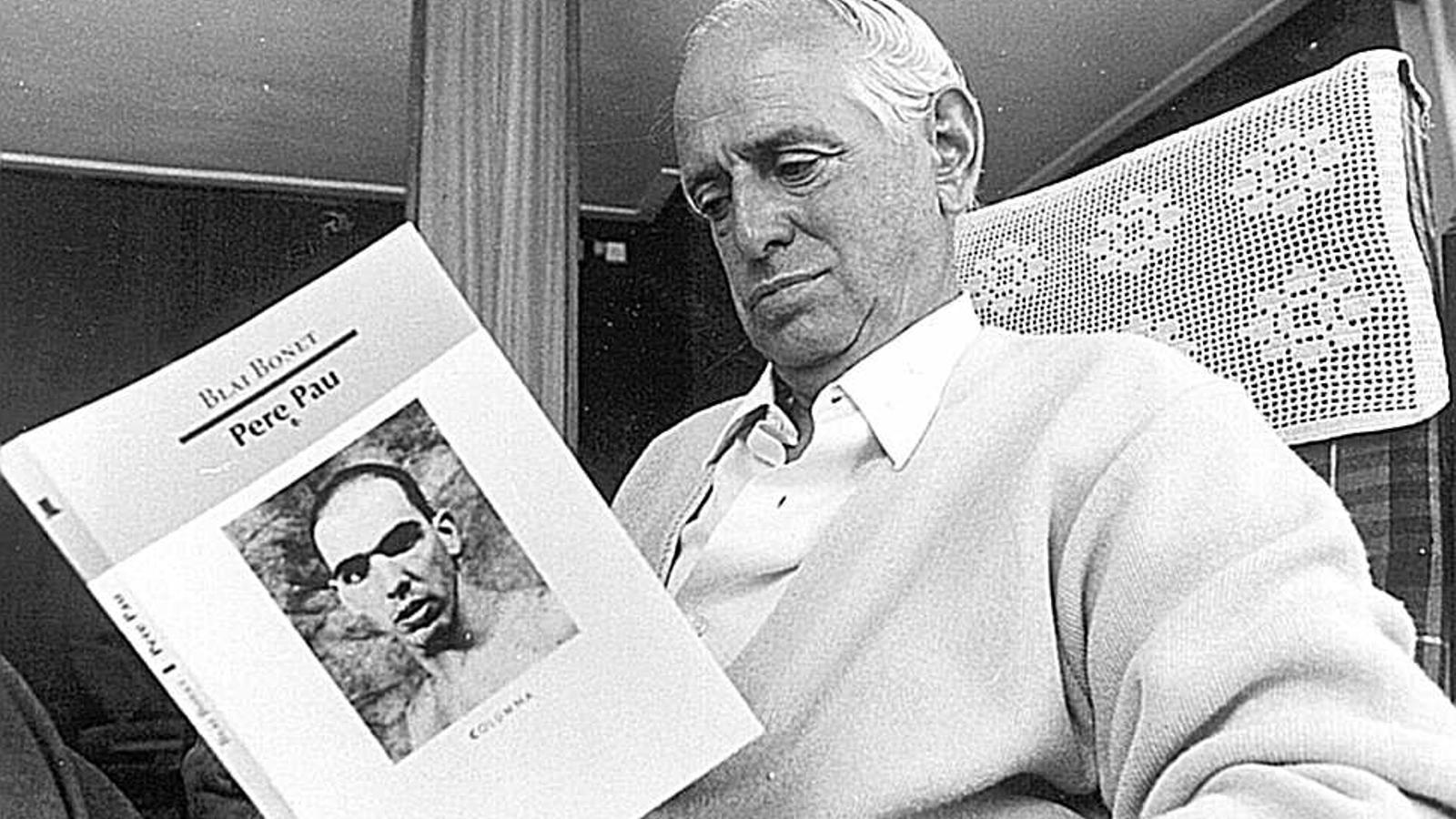
Palma“When you bit me, God left saliva / inside the wound and the coolness of his great lip. / And the saliva flooded my blood. / And a voice full of nests was born in me”. The set of verses is from the poem ‘Soledat oberta’ (Open Solitude), included in the book Entre el coral i l’espiga (Between the Coral and the Ear of Corn) published in 1952. The author is Blai Bonet, of whom this year marks the centenary of his birth – and a voice, indeed full of nests, which still spreads everywhere. The last verse of this stanza gives its name to what will be the central spectacle of the Blai Bonet Year, a production by the Fundació Mallorca Literària that aims to vindicate the relevance of one of the most unique voices in Catalan literature and invite the public to rediscover it through a journey along the paths of his great themes.
The show will bring Mercè Sampietro, Sílvia Bel, Toni Gomila, and Jaume Madaula to the stage, while Mar Grimalt and Carles Medina will provide an original soundtrack created from Bonet’s own words. The dramaturgy is by Joan Tomàs Martínez. It will premiere within the framework of the summer festival La Lluna en Vers: on July 18th it will be in the Dones courtyard of the Centre Cultural La Misericòrdia in Palma; the following day, the 19th, it will be held in the courtyard of the Col·legi Bisbe Verger in Santanyí. Towards autumn, Una veu plena de nius (A Voice Full of Nests) will begin a tour that will include performances in Catalonia, coinciding with various poetry festivals, with the aim of continuing to bring Blai Bonet’s voice to new audiences.
The proposal is simple and aims to give prominence to the writer’s poetry. “We wanted Blai Bonet’s word to shine like the treasure it is,” explains the director of the Fundació Mallorca Literària, Carme Castells. According to her, the author’s strength lies precisely in his ability to communicate without the need for great artifice. “It is a very powerful word, which requires no other artifice than to be heard,” she affirms.
A less obvious Blai Bonet
Castells explains that the objective was not only to return to the best-known poems, but to offer a broader view of the author's universe. For this reason, the dramaturgy was commissioned to Joan Tomàs Martínez Grimalt, a connoisseur of Bonet's work, with the intention of creating a "distillation" of the texts that would allow other facets of the poet to be discovered. "We wanted the audience to leave with new quotes from Blai, with less obvious, but equally powerful verses," he summarizes.
The show is structured into seven major thematic paths that explore some of the fundamental axes of the Santanyí author's writing. There is a first approach to the figure of Blai Bonet, a section dedicated to correspondence and human relationships, another focused on the male body and the transformation of Mallorca during the tourist boom, a block dedicated to the sea and the connection with the land, a journey through Bonet's different views on freedom, a space reserved for desire, and a final section that brings together various essential concepts of his poetic thought.
The playwright Joan Tomàs Martínez explains that the proposal stems mainly from Bonet's poetry, although it also incorporates some prose fragments. His task has been to select those texts that best represent the concerns and themes of the Santanyí author's work that continue to challenge the current reader, while avoiding limiting himself to the best-known poems. "I have tried to gather the most current and representative ideas of Blai Bonet without falling into clichés," he points out.
Martínez explains that the poems appear whole in some cases and, in others, they dialogue with each other through a "little interventionist" dramaturgy, constructed so that Bonet's own word guides the spectator. Among the main axes of the staging are desire and freedom, two recurring concepts in the poet's work that articulate a large part of the scenic journey, as do the other blocks mentioned previously.
The musical dimension also plays a prominent role in the scenic proposal. Mar Grimalt and Carles Medina have created original compositions inspired by Bonet's texts. Castells highlights that they sought music "tuned to the tone" of the show, but that the musicians were given creative freedom to contribute a new reading of the verses. The director also recalls Grimalt's career in setting authors like Miquel Bauçà and Damià Huguet to music, a background she considers a guarantee for approaching Blai Bonet's universe now.
Regarding the cast, the intention was to bring together performers from different generations with diverse ways of delivering poetic language. Therefore, Toni Gomila, who has already performed Bonet's texts on other occasions, is joined by Mercè Sampietro, Sílvia Bel, and Jaume Madaula, who form a quartet that, according to Castells, responds to the desire to offer complementary perspectives on his work.
The Santanyí preview
On July 19, in Santanyí, before the performance of A Voice Full of Nests, an installation by Cabosanroque will be inaugurated at Casa Blai Bonet. Cabosanroque is a duo formed by Laia Torrents Carulla and Roger Aixut Sampietro, who work with sound art, technology, space, and objects. They will present Where the Bad Roads Get Lost, a production that delves into the poetic universe of Blai Bonet, approaching it from the perspective of the concept of freedom, an idea always present in the writer's work, which becomes a collective, vitalistic song, and a reflection that admits no middle ground or tepid expressions.
According to the Fundació Mallorca Literària, Cabosanroque's interventions question the exhibition space, formats, and the spectator's experience of inhabiting this space: physical, temporal, and conceptual, sonic, and visual. Their academic training in music, industrial engineering, and architecture has led them to use technology in all their works, always understood as a tool, a medium, and not as an aesthetic, in a continuous process of research. The installation at Casa Blai Bonet can be seen until September 19.
