The ‘Swede’ who wanted to be buried in Mallorca
Ernest Dethorey, chronicler of culture and incipient tourism in the Balearic Islands, was born in Barcelona 125 years ago now
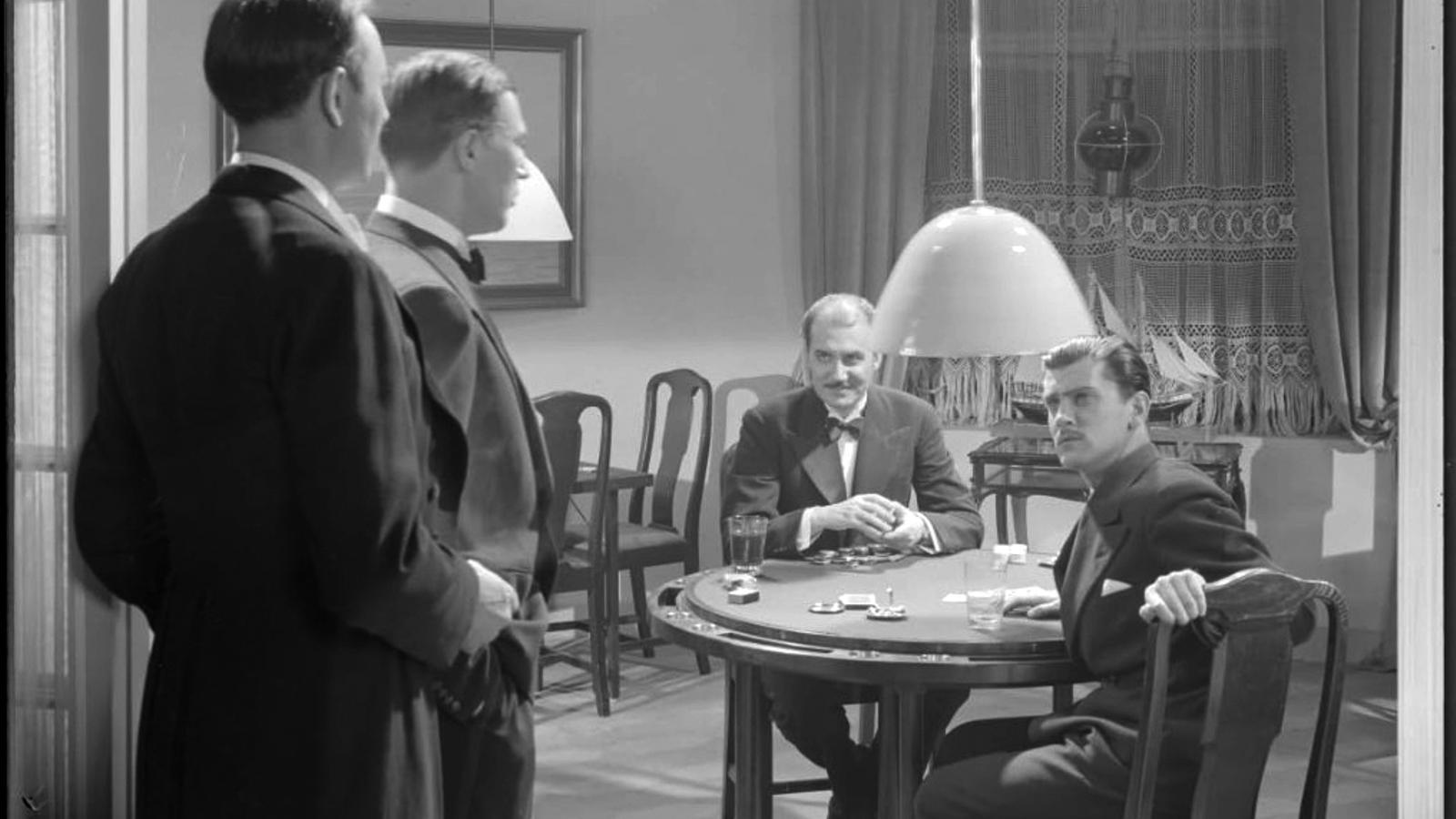

PalmaHe was born in Barcelona, of French and Cuban origin, raised in the Philippines, emigrated to Sweden, acquired Swedish nationality, and, by his own wish, was buried in Mallorca. Ernest Dethorey was, in the Balearic Islands a century ago, the chronicler of culture and also of the then-incipient tourism. We remember him as 125 years have passed since his birth, on September 13, 1901.
Dethorey was a restless character, a socialist, a mason, with a strong critical spirit, interested in the latest creative trends and open to everything that was being cooked up in the world. And, at the same time, he was deeply rooted in his adopted land, Mallorca, even though he only resided there for nine years. The bond between Dethorey and the island was love at first sight. He was an admirer of Joan Alcover and declared himself a disciple of Gabriel Alomar: in 1930, when he was already living in Sweden, he sent his contribution, the article 'Spiritual Debt', to a tribute held for the politician and writer.
He came from a diverse and nomadic background: the Barcelona of his birth and youth, eleven years of childhood in the Philippines, and a few months in Liberia. He arrived in Mallorca at the beginning of 1920 and the following year, at only twenty years old, he became part of the editorial staff of El Día, the newspaper that the financier Joan March had just created. There was a truly luxurious list of collaborators: Bartomeu Rosselló-Pòrcel, Josep Pla, Miquel Àngel Colomar, Eugeni Xammar, Miquel Ferrà, Llorenç Riber, Llorenç Villalonga, and Jacobo Sureda, in addition to Gabriel Alomar himself and his son Joan. The latter, together with Sureda, Fortunio Bonanova, and Jorge Luis Borges, then a resident of Mallorca, had signed that same year of 1921 the legendary 'Manifiesto del Ultra' in the magazine Baleares.
With some of those young men, such as Colomar, Alomar the son, Villalonga, and Sureda, Dethorey established a good friendship. In the weekly Sa Veu de Sòller he published two very combative articles, defending Colomar's performance “in the calm waters of Mallorcan poetry,” which raised the cries of the “retrograde papers.” With Villalonga, they maintained a correspondence when Dethorey was already residing in Sweden. The Mallorcan writer sent him a copy of Mort de dama: two years later, his friend still had not replied—it is quite clear that he had become a Mallorcan from head to toe, with that lack of hurry that characterizes the islanders.
He was also a friend of the Catalan painter Joan Junyer, a resident of Llucalcari, who tried to get Picasso to visit that corner of Mallorca. In the summer of 1929, Jacobo Sureda, in a letter to Dethorey, took for granted that the man from Malaga would come with his family. But Junyer himself announced the change of plans to him: “It is their doctor”, referring to the painter and his son, “who advises them against the trip to Mallorca due to the contrasts of heat and humidity in the proximity of the Mediterranean. He prescribes the temperate zones of Brittany for them”. Even in 1933, already in Sweden, he dedicated an article to Junyer.

10,000 tourists per season!
In the twenties, in El Día and also in La Nostra Terra, Dethorey acted as a chronicler of cultural life in Mallorca. He dedicated reviews to artists such as Sven R. Westman and Tito Cittadini and spoke out in favor of Dalí when one of his works caused quite a scandal, upon being exhibited in 1929 at the Costa galleries in Palma: “Dalí acts as Providence. He stirs the lethargic stillness, the pictorial slump, and interrupts the constant yawning of the academic crocodiles”.
Dethorey broke the exclusive news of the 1925 visit to Mallorca by the Mexican writer José Vasconcelos, invited by their mutual friend Gabriel Alomar, and of how they both walked through the city “without noticing anything around them”, talking about their own affairs. He also reported on the stay of D. H. Lawrence, who, at the time, no one probably knew who he was, and of whom a novel with the curious title Lady Chatterley's Lover had just been published. In another article, in 1923, the figure of the patron Joan de Saridakis and his wife appears, who “on land in Cala Major are building –thanks to the refined taste and architectural knowledge of Guillem Forteza– a superb small palace”. Yes, the very one you are thinking of: Marivent.
The Barcelona native raised in the Philippines introduced Mallorcan readers, practically as a scoop, to what was happening beyond the sea. That year, 1929, in El Día, he published the chronicle of a trip to Paris. He had attended the screening of Un Chien Andalou, by Buñuel and Dalí, in the company of Joan Miró and Tristan Tzara, another illustrious visitor to the island. It was a film that marked a turning point and which “perhaps they will never see in Mallorca”, he lamented.
Following the line of Miquel dels Sants Oliver, who had already intuited the enormous possibilities of the ‘tourist industry’ –though without imagining to what extent–, Dethorey also made a diagnosis of Mallorca's shortcomings in hosting visitors. It was autumn. A time of “preparations”, he noted, “for the winter season, the only one that is truly fruitful, commercially speaking, for those dedicated to the tourism business”. That is to say: a century ago winter was the high season –and at the rate we are going, with climate change, it will be again soon.
Back then, as noted in his article, campaigns were already being carried out in favor of tourism, "never intense enough," for his taste: "Everyone speaks" of needs such as "good roads and good hotels" but "they neglect the main thing, the means of getting there, that is, the port." At a time when the staggering figure of 10,000 (!) foreign tourists per season was being recorded, the journalist lamented "the inconveniences of disembarkation, the dust, the filth, the cargo scattered along the docks." A master's touch was needed to resolve that situation.
The Ibiza of 1927
Dethorey also acted as a tourist himself in the Islands and, of course, published the corresponding chronicle in La Libertad of Madrid, in 1927. He approached Ibiza. He narrated how Vila, at that time, had seven thousand inhabitants –today, a century later, there are more than fifty thousand– and only two inns, where asking for modern “comfort” was a pipe dream. He admired the old city but, on the other hand, spoke ill of the Vara de Rey promenade, ‘s’Alamera’, “with modern constructions of terrible taste, worthy of being among the works of the municipal architect of Palma”; who, obviously, was not his favorite person.
In Mallorca, Ernest Dethorey resided first in Fornalutx and then in the Terreno neighborhood in Palma, the artists' colony par excellence. The image he offered, in 1923, of the later legendary Gomila square, in Palma, is curious, with “some scrawny pines that provide neither shade nor character” and “some stone benches that were somewhat dilapidated”. Back then, it served as a stage for the strolls of young women, “waiting for something that might never arrive”.
In that Gomila square, while waiting for the tram –recounts Llorenç Capellà–, he met a Swedish girl, Gertie, daughter of a bookseller –letters call to letters– who was spending a season on the island. At that time, there must have been seven Swedes in all of Mallorca: the era of the legendary Swedish women, with their bikinis, had not yet arrived. Mallorca was so unknown to the Nordics that the family's maid, upon finding out that Gertie was getting married and going to live on an island, asked if there were other white people there.
In 1929, it was he who took the step of moving to live in Sweden. They organized a farewell for him at the Hotel Victoria in Palma, with the presence, among others, of Gabriel Alomar and Jacobo Sureda, and the support of Villalonga, Junyer, Guillem Forteza, and Andreu Crespí. It was supposed to be a temporary stay: the young couple planned to return to Mallorca. But, in the meantime, the Civil War, World War II, and the Franco regime would arrive. And Dethorey decided not to return while the dictatorship continued.
He worked as a correspondent in Sweden for El Día de Palma and other media outlets: El Socialista, La Vanguardia,La Libertad and Nueva España, directed by Antonio Espina, the governor of the Balearic Islands at the outbreak of the 1936 coup d'état. And he maintained his loyalty to the Republic: he was appointed chancellor of its embassy in Stockholm. Later, he stopped collaborating with the Spanish press, so as not to feel influenced by censorship. He gave Spanish lessons, worked as a translator, and even as a film actor, participating in 1938 in the film Dollar, by Gustaf Molander, starring Ingrid Bergman, in the role of an Argentine poker player. In 1944 he acquired Swedish nationality.
At the end of the dictatorship, Ernest Dethorey returned to Mallorca for a visit. “I had never seen him so nervous or moved,” asserted Gertie in an interview with Brisas. In 1989 he was awarded the Creu de Sant Jordi. He died in his adopted country on October 24, 1994, at the age of ninety-three. Fulfilling his wishes, his ashes were deposited in the family pantheon at the Palma cemetery. Certainly, he had not been born in Mallorca, but he had carried it in his heart. Even if it was from very, very far away.
-
From the Sweden that would be neutral in the imminent World War II, Ernest Dethorey was a voice that warned of the danger of fascism –yes, the one that now seems to be showing its claws again. In a 1933 article, published in Madrid by La Libertad, he commented on a telegram “that has passed through three or four hands”, according to which that year's Nobel Peace Prize would be awarded to the Italian dictator Benito Mussolini. Well, in current times Trump has believed himself deserving of it, so any nonsense is possible.
Dethorey ironically asked himself why, while they were at it, not propose Adolf Hitler for this award, who had barely been in power for a few months: “All the Nazis would enthusiastically chorus the request. ‘Hitler, the peacemaker of Germany’. Yes, the peace of the sepulchers”. “Wolves disguise themselves as sheep to be able to wreak more havoc on the flock”, the journalist warned about these two sinister characters.
Regarding another Nobel Prize, that of literature, as revealed by his widow, Gertie, in the interview with Brisas, it was Dethorey who proposed to the Swedish Academy the awards granted to Juan Ramón Jiménez –he maintained an important correspondence with his wife, Zenobia Camprubí– and to Miguel Ángel Asturias. In the case of Camilo José Cela, a resident of Mallorca for three decades, “it was not necessary”, he said. “The Academy itself had an enormous interest in Cela”.
Information compiled from texts by Carlos Meneses, Emilio Quintana Pareja, Antoni Ribas Tur, Matías Vallés, Josep Miquel Garcia, Damià Pons and Ernest Dethorey himself, the Gran Enciclopèdia de Mallorca, the publications Brisas, Última Hora, Diario de Mallorca and HT 77 Palabras al Aire and Ràdio Escolar de Suècia.
