Growing up in Catalan in Switzerland: "It is the language that comes from my heart"
Heritage languages are maintained and transformed throughout the years in contact with school, friendships, and the society that surrounds children.
-
CAT -
CAST -
DE
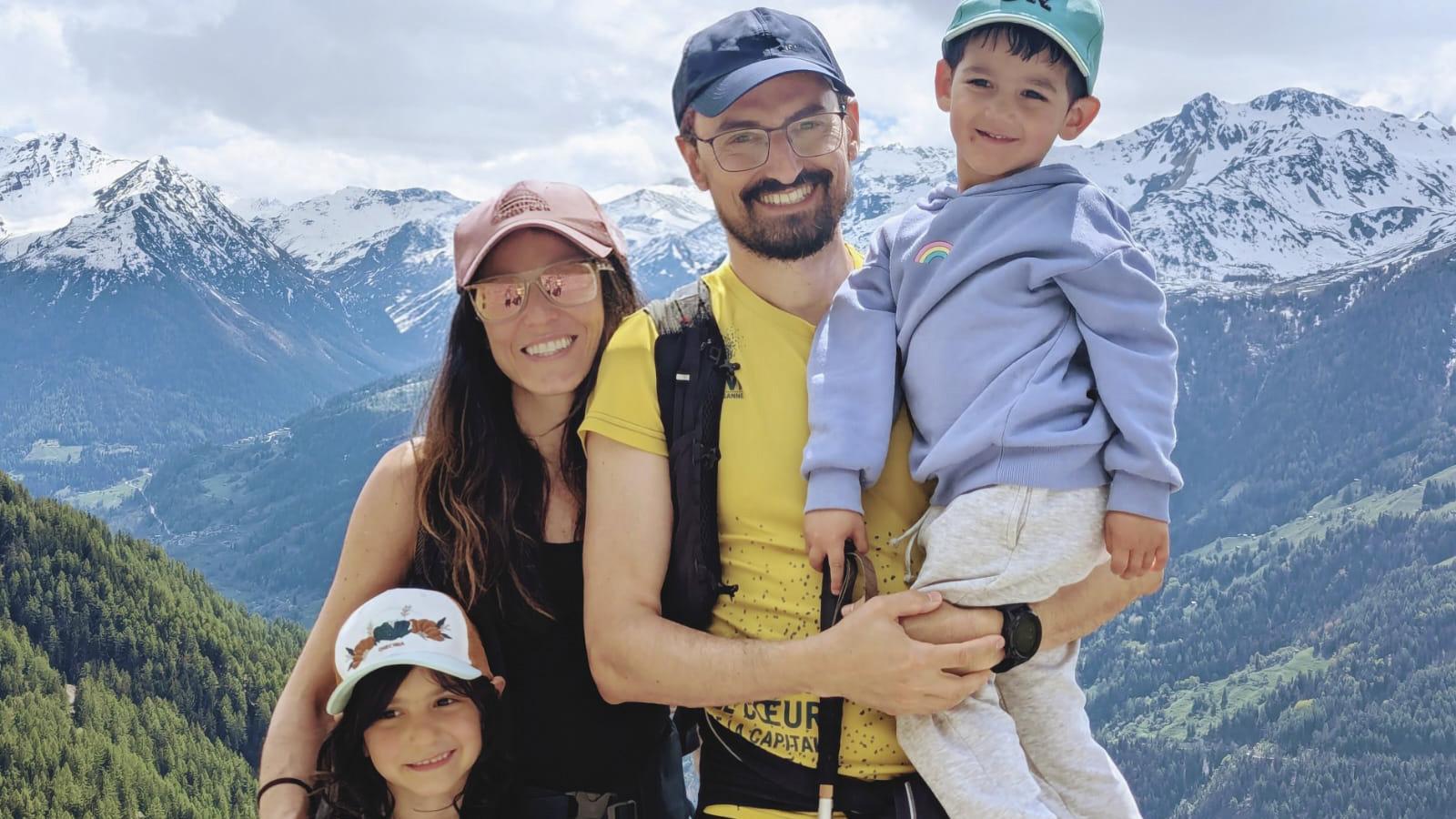
PalmaJúlia is seven years old, she was born in Lausanne and speaks Catalan, French and Spanish. Her parents are Mallorcan and, when she was born, at home they continued speaking Catalan, naturally. “The mother tongue of my partner and mine is Catalan. It is the one we have always spoken at our home and that our whole family speaks, so for me there was no other option: it is the language that comes from my heart and most naturally”, explains her mother, Cristina Oliver.
Heritage language is the language spoken at home, when it is not the majority language of society. It is the one spoken by people who have emigrated and who use it with family or with their community, while in other areas the language of the environment predominates. “It is enough that there is at least one person at home with whom the child speaks it”, explain Mariia Pronina, doctor and researcher of Linguistics at the UIB, and Maria del Mar Vanrell, professor of the Department of Catalan Philology and General Linguistics at the same university.

In the case of mixed families, a child can also grow up acquiring the heritage language of only one parent. The trajectories, however, are diverse. Some children use it a lot; others, less. There are those who only understand it, while others speak and comprehend it. Likewise, it can also end up being lost, often after a process of linguistic erosion, that is, a gradual loss of proficiency.
Siblings in Catalan, environment in French
Júlia has a little brother, Leo, who is three and a half years old. Both are schooled in French, the language of the society where they live, but they currently speak Catalan among themselves. “It is the language spoken at home and for now they maintain it,” says Cristina. However, the mother believes that, as they grow up and spend more time with friends, school, and activities, French could gain weight.
In their case, the start of schooling did not present significant difficulties, although at first they could have vocabulary differences compared to other French-speaking children. At home, on the other hand, Catalan remains present. “For now it has not lost presence,” she explains. She considers that Júlia speaks it very well and that she knows expressions and words typical of Mallorca; Leo also speaks it, with the vocabulary expected for his age.
In this family’s case, the uses change according to the context. With friends from school and activities, the family usually speaks French; with Spanish friends, Spanish; and with Catalan speakers, Catalan. And the children move from one language to the other with naturalness.
Xavier Peña, the father, explains that before Júlia’s birth he considered speaking Spanish to her so she would also learn it. Finally, he discarded it: it was easier for him to express himself in Catalan and he trusted that Spanish would reach them through other channels, as it has ended up happening.
The family reinforces Catalan with stories, music, video calls with their grandparents, and, above all, stays in Mallorca, where they spend two months a year. Xavier considers this contact to be decisive for the children to perceive that Catalan is a living and useful language, not just the parents' language. He also speaks to them in Catalan in front of other people most of the time, although he sometimes switches to French if it is important that everyone understands the conversation.
Cristina says she has not felt uncomfortable speaking Catalan in Lausanne. She sees it as important that the children feel Mallorcan, in addition to Swiss, and that they can communicate with their extended family; her concern is that one day they might stop speaking it. For Xavier, maintaining Catalan is also a way for the children to feel at home, both in Lausanne and in Mallorca, while he considers that they might learn to write it later on at the Catalan Center of Lausanne.
Language contact
Pronina and Vanrell explain what happens when the language spoken at home is a minority language within the social environment. Their research studies Russian-speaking children living in the Balearic Islands and Catalonia. In this case, they point out that using a minority family language can restrict the vocabulary of the heritage language to familiar situations and leave less room for abstract and specialized registers.
The study has also observed that some Russian-speaking children incorporate features of Catalan intonation when speaking Russian. Contact between languages can leave a mark on pronunciation, but also on morphology and syntax. Furthermore, an accent can influence children's confidence. A language learned at home can sound "foreign" to some native speakers, even if it is a family language for the child. This is when teasing and unpleasant comments can cause them to become inhibited when speaking it. For this reason, the researchers recommend not constantly correcting children: it is better to offer them correct models in a natural way, without making them feel judged. They also ask that teachers and speech therapists have training in multilingualism, so that the differences inherent in a bilingual trajectory are not confused with deficiencies.
The Babylonic Balearics
The Balearic Islands have 1.26 million inhabitants, of whom nearly 279,400 (22%) hold foreign nationality, and more than 376,000 (29.7%) were born outside of Spain. Both are the highest percentages in the State.
Added to this reality are the children born in the Islands to migrant families who have a family language other than Catalan. In 2024, the mother of one in every three children born in the Islands was of foreign nationality. This data does not reveal what language they speak at home nor does it include all children with parents of foreign origin, but it indicates that a significant part of the new generations is growing up with other family languages.
Ela is seven years old, she was born in Argentina, and in March it will be two years since she has lived in Mallorca. She goes to a public school where Catalan is the vehicular language, and her mother, Cecilia Nori, began to accustom her ears with Duolingo and songs. “The first month was hard, at school, but two months later I already heard her speaking it in the square: it was extremely fast,” she explains. Now she is the translator for the house and plays in Catalan with her friends and, sometimes, she speaks it with her little brother, who was a year and a half old when they arrived. It was starting nursery school and not speaking anymore, until now, “that she has loosened up as much in Catalan as in Spanish.”
The coexistence of many languages in Mallorca adds to the situation of linguistic minoritization of Catalan with respect to Spanish. According to Pronina and Vanrell, this situation may cause Spanish to become the default shared language among people of diverse linguistic backgrounds. The accommodation practices of Catalan speakers can also contribute to this, when they switch languages according to the imagined origin of the interlocutor and reduce the opportunities for newcomers to learn and use Catalan.
At the same time, the researchers speak of a possible "mirror effect": finding themselves in a society with a minoritized language can lead newcomer families to reflect on the value of their own languages and on the importance of passing them on. Promoting Catalan as a language of school, cohesion, and social participation, they add, should not imply giving up family languages. "Promoting Catalan and valuing languages of origin are not contradictory objectives," but rather they can be complementary. For Catalan to move from the classroom to daily life, however, children must have opportunities to use it and spaces where it is a living language, without prejudice to families, in turn, maintaining their heritage language.
