Marta Ferré: "There is a long way to go in the musical field, in dance, or in other types of younger theater"
Manager of the Theater and Auditorium of Manacor
-
CAT -
CAST -
GER
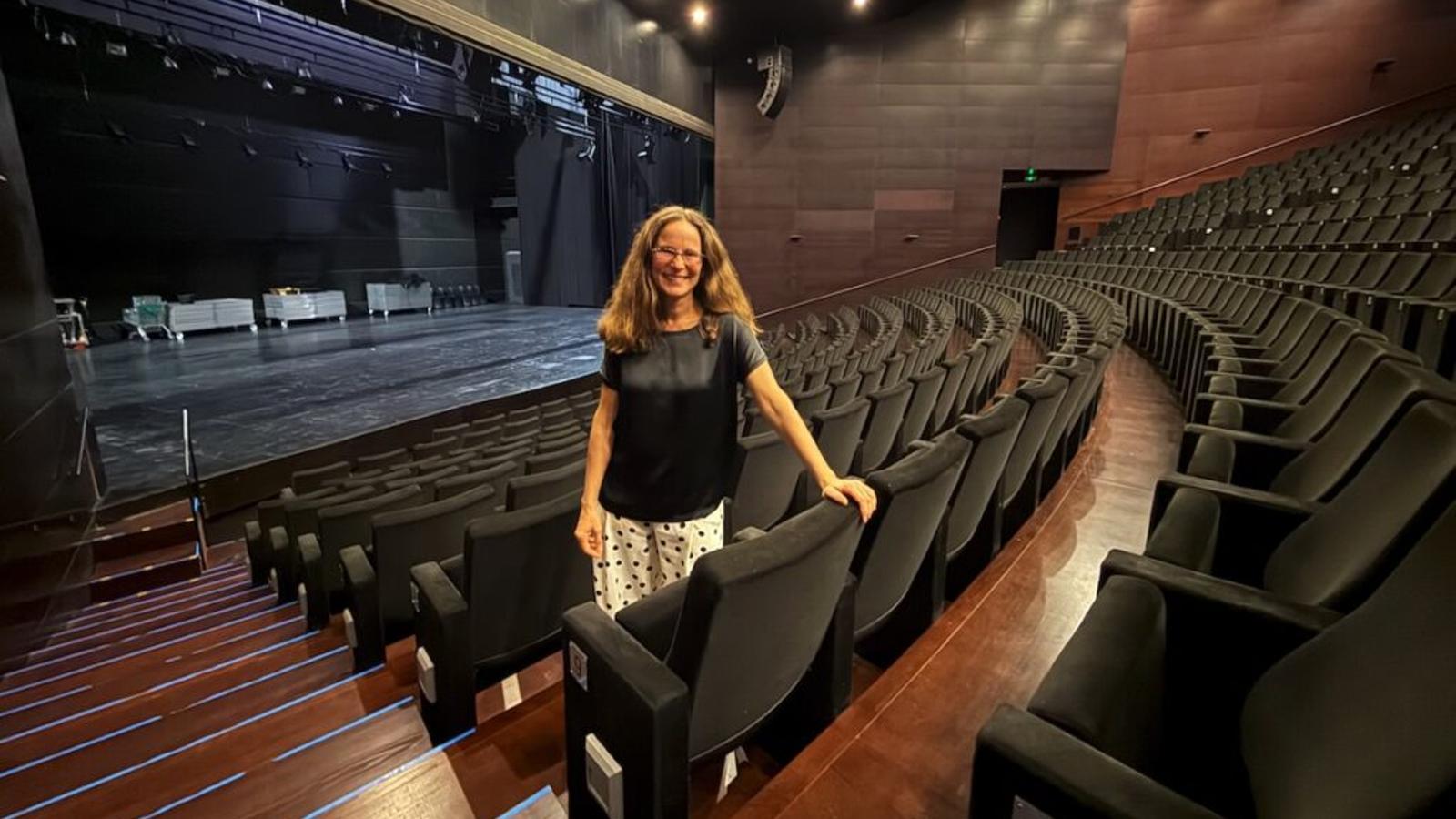
ManacorMarta Ferré Freitas-Morna (Lisbon, 1978) is already serving as the new manager of the Manacor Theatre and Auditorium. A transition that comes after four decades of Tomeu Amengual at the helm and that opens a new period of illusions and challenges to expand the impact and proposals that go beyond text-based theatre.
How do you feel now that the season is about to begin?
— I feel great joy, with an incredible responsibility and also a little bit of fear... It will be a huge experience because Manacor is a benchmark, and not only in Mallorca.
What was your first impression when you found out the position was vacant?
— In a conversation someone said: Listen, this has come up... all of a sudden I thought that I had to apply for it. Although the truth is that I didn't imagine that this moment would arrive... I believe that everyone who has dedicated themselves to cultural management and the management of performing arts spaces in Mallorca sees Manacor as such an interesting, such an emblematic and such a powerful space, that it is very tempting. It is an important place within a professional career.
How does Marta Ferré start to make a place for herself in cultural management?
— I arrived in Mallorca in 1996 to start working at Grup Serra, where I met Guillem Frontera. I went back and forth to Barcelona several times during those years. In Barcelona, I worked as a documentalist and translator. I had always organized events or helped to organize them. But it wasn't until I returned definitively that Guillem proposed I join a new project called Balears XXI, a Government foundation that blended tourism and culture and was created in 2001. He proposed that I join as head of cultural activities and projects. This was my first major experience in cultural management.
How do you manage something that works or that in theory works so well?
— Every project is different; it has good things, bad things, things that must be maintained, and things that need to be redirected. Manacor has done an incredible job, mainly in the field of text-based theater in Catalan. In this sense, it is an example of a space that works. There are also other areas that, if in 30 years we manage to get them to the level of text-based theater, would be wonderful. Because there is a long way to go in many other fields. In the musical field, in the field of dance, in other types of younger theater... We must also take into account that the world is changing very quickly. There are hybrid formats, there are many young people who are experimenting with other languages that it would also be interesting to incorporate. Basically, it is about trying to maintain what Tomeu [Amengual] has looked after for so many years, which is the text-based theater in Catalan or the school theater exhibition, which is an incredible breeding ground. And on the other hand, being able to start doing this work in other fields, going to seek other audiences, making contact, and networking between spaces as well... I believe there is a lot of potential in this path.
The world of dance, for example, is not very well represented. There is also a film club here in Manacor that has to go on a pilgrimage to the multiplexes when perhaps it could have a stable program at the theater. How should it be done to satisfy everyone?
— It is very difficult; you never manage to make everyone happy and I don't think that's the idea either. You have to try to do things following a logic, following a plan and so that there are fruits now and for many years to come. These are municipal spaces and that is something we must keep very much in mind. A municipal space must have these two sides. The most spectacular one, of proposals that directly appeal to an audience and that are professional shows within a seasonal program. But then, as I was saying, these spaces are municipal and therefore belong to the community. And the community must be able to use them, obviously, for certain things and at certain times. And one must make, if possible, always a rational use of the spaces, because we do not have infinite workers or infinite resources. The most important thing is to determine which days of the year can be dedicated to each thing. Working with clear regulations, so that you already know from the start that you can attend to them. How many hours we can leave you in the room or what we can offer you. This work has already begun and the City Council is helping me a lot with this; to create all this basis of paperwork, which is important in terms of administrative security. Knowing that you are adhering to foundations that are clear and fair... and we are in this phase, on one hand, looking at how and how many days we can dedicate to each part of this project, and on the other hand resolving all the administrative part to be able to do it well.

Cultural events are also economic
— Yes, without money obviously things cannot be done. But they are not only economic... I believe the great challenge, more than economic, is to organize space, time, personnel and resources in the most effective and efficient way possible.
There is a lack of staff, that is evident
— There is a lack of staff, but that is the case here and everywhere. You were telling me earlier that dance is poorly represented. Dance is poorly represented everywhere... We work in a field that is complicated. But it is true that here, in Manacor, there is little staff for the infrastructure we have, and it is a miracle that things work so well. And it is because this staff pours their soul into it. I have encountered wonderful people who dedicate many hours and their lives to this. That is why it works, because this staff is truly dedicated to the theater.
Will there be news in the short term?
— Luckily, Tomeu has left me a good part of the season programmed, because otherwise it would be impossible to arrive here and have to program everything from scratch. The structure, to begin with, will be very similar to what has been done so far. The only thing is that now we will have two subscriptions: one for three to six shows, and another for seven or more. They include all the Auditorium programming, all the theatrical programming, and also the Symphony Orchestra. Therefore, we are expanding the subscription to all shows. This season we will also start some project, a little bit towards the end, which I cannot announce yet. But basically, I believe that the people who come to Manacor and are used to coming to the Theater will find exactly the same high-quality theater and this very familiar atmosphere. Looking ahead to next season, we will indeed try to start a couple of new lines, which we will start working on right away.
What it's like to have to organize so many spaces
— Many of these spaces, which are in the theatre building, have already been occupied since October for rehearsals for the school theatre showcase. I believe that people from outside Manacor are not aware of this, and many imagine that they are the end-of-year performances of children who do theatre... and that is not it. The school theatre showcase is an incredible project that has yielded all these fruits that we have today. If it had not been for the showcase, I doubt that Manacor would have consolidated itself not only in Mallorca, but throughout the Catalan-speaking scene. Manacor is the benchmark. There is no other place that has done this work. The theatre is occupied by these young people from the month of October until the end of the school year. In all the rooms, which are many, every afternoon there are students rehearsing. This is a marvel and we are not aware of it.
How do we then make these rooms coexist also with the programming?
— It is extremely complicated, it is a Tetris. But it is possible. Of course, it is many hours of work during the week and then weekends with programming for the public. But it can be achieved. And then we have the Auditorium, which is a very versatile and impressive space, with 800 seats. Which does not mean that it should also be able to be used, even if it is not full, for shows with less capacity. Aside from that, this space and its acoustics are a gift.
You have been to the Principal and the Municipal in Palma and in Inca. Does each theatre operate in a very different way?
— Every space is different. I have two very distinct profiles. I have a more artistic direction side, where what I can contribute most is networking and relationship-building, connecting projects and building bridges, and therefore, always offering programming where you can play with cycles or paths. And then I have another profile which is management. And I love this one... I know it's a very rare thing, but I love the economic, legal, judicial, or bureaucratic part. It is a challenge to make the administration more agile and at the same time ensure it remains a guarantor.

A wish for this path that begins?
— In the long term, I would love for the success that Manacor has achieved in the field of text-based theater to also expand to others such as dance, for example. Because it is always the poor sibling of the performing arts. Theoretically, it is a more difficult, more complicated language, and that is not true. Dance is the most universal. Just like music, they are languages that enter through the skin. On the other hand, I would also like the Manacor Theater Fair to return to being the benchmark it was a few years ago. The Manacor Fair as the place where you would see text-based theater in Catalan and discover all these companies that came here, and it would be filled with programmers. This has gradually diluted in favor of Fira B!, for example. Even so, the programmers, in their imagination, perfectly remember Manacor as a meeting point.
Manacor is a large municipality with other population centers. How is it done to bring theater to Portocristo, Son Macià, or s'Illot?
— It is always complicated. The Department of Culture of the City Council does part of this work, that of bringing proposals to other centers. On the other hand, for example, the city council makes every possible effort so that all the children come to see the plays when they are performed as school theater, making buses available. Obviously, the physical location cannot be moved, we cannot keep moving the auditorium. Therefore, we must ensure that people move and the distances are not that long either.
And with street theater?
— I am a huge advocate for street activities. When I have had to work indoors, I have always missed being able to go outside, and when you only work in the street, you always miss having a venue to showcase more complex projects that require more complex technical elements. The ideal thing is to do both. But yes, the street is the easiest way to reach the public, always.
