Manacor Jazz Festival: The world inside a Manacor square
The third edition of the Manacor Jazz Festival turns the Rector Rubí square into an open space for music, improvisation and the meeting between audiences
-
CAT -
CAST -
DE
ManacorRhythm is born in Africa. It is worth starting here before asking ourselves what jazz is. Because there are still those who imagine it as music of dark clubs, expensive drinks, and a certain cultural liturgy reserved for the initiated.
But jazz was born from mixing, from the African diaspora and the African American traditions that took shape in the United States. Spirituals, work songs, blues, ragtime, and the music of New Orleans. Music related to memory, for the community, for racial and social inequality, reminiscences of slavery, colonization, and the need to turn experience into rhythm.
That is why it is paradoxical that music with such deeply popular and African American roots has ended up being associated, in some spaces, with a certain idea of elitism. And perhaps that is why a jazz festival in a square has something so fitting about it. Without doors to select, without dress codes, and without the need to know how to distinguish a diminished chord from an augmented one to be able to sit, listen, and enjoy. Jazz can also be a square, a summer night, people who know a lot about music, and people who were just passing by and decide to stop for a while. That is what was breathed last Saturday in Manacor.
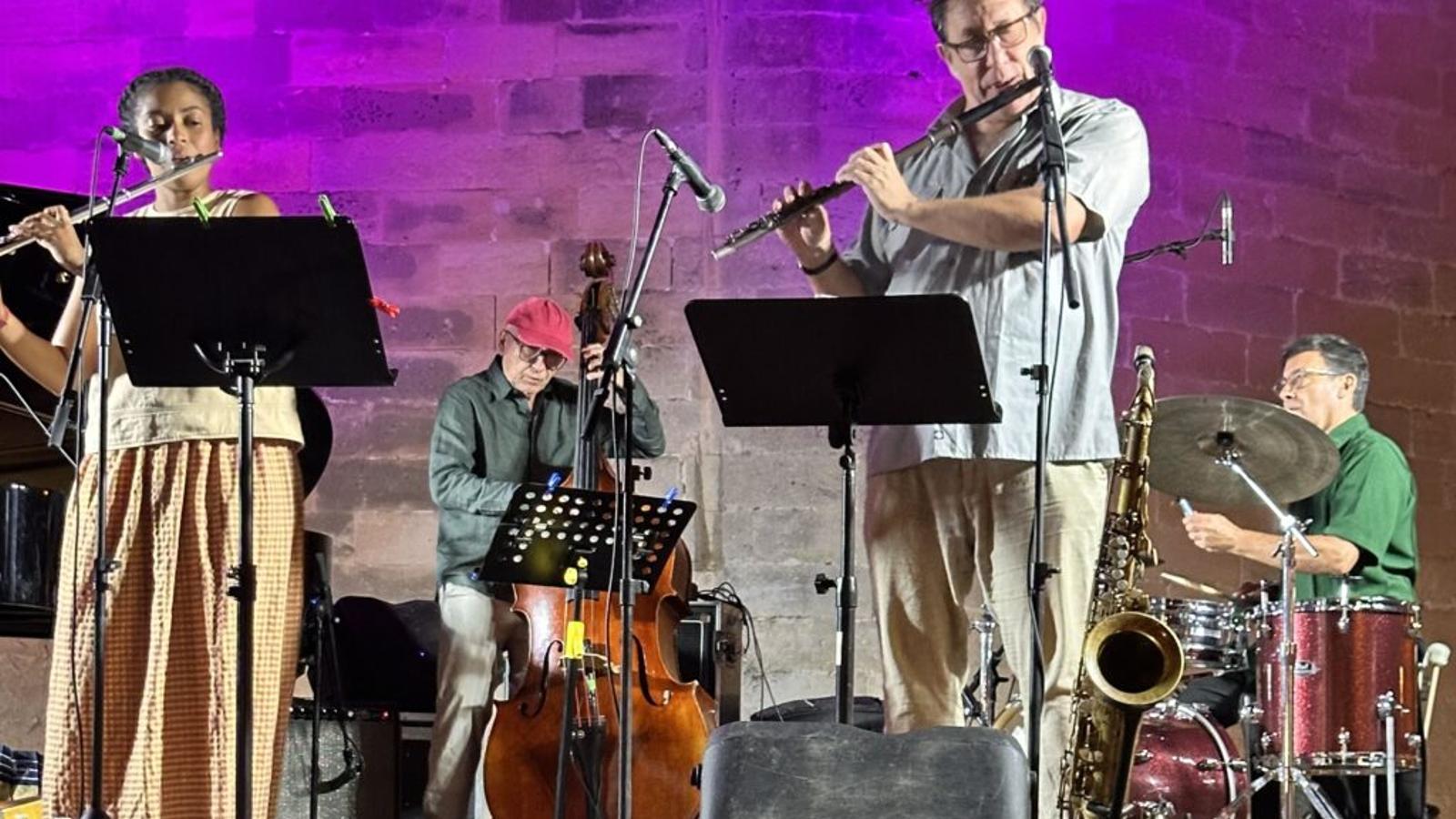
At eight in the evening, the first night of the third edition of the Jazz Festival began, with the Toni Saigi Quartet and the Anggie Obin Quartet. Blue and purple lights illuminated the sandstone walls of the church of Los Dolores, in the Rector Rubí square, while on stage that strange dialogue that only music allows when it is alive was taking place. A written part, another improvised one, and an audience willing to be carried away. Time passed faster than it seemed. Or perhaps it was us who, for a while, stopped measuring it.
The organization calculates that around three hundred people shared the space that evening. Three hundred bodies, three hundred small stories, three hundred different ways of arriving there and, for a few hours, the same sonic experience.
Nazareth Castellanos has been explaining for years from the perspective of neuroscience something that perhaps those of us who dance or listen to music already know intuitively, which is that the brain does not function in isolation from the body, and that the activity of the heart and breathing also participate in our way of perceiving, attending, and relating to others.
In studies on human interaction, correlations have also been observed between the cardiac dynamics of people who meet and listen to each other. This does not mean that three hundred people start to have a single heart, but it does mean that our bodies can begin to respond, in a way, to what is happening in the bodies around us.
I like to imagine that square as a small forest of people. A forest of neurons, perhaps, if we were to ask for Santiago Ramón y Cajal's perspective. Apparently separate bodies that, nonetheless, establish connections. Everyone arrives with their own world, but during a concert, there is something that unites us all at once.
And here Merleau-Ponty also comes to mind. For whom phenomenology, the body is not simply that object we transport from one place to another while our true consciousness lives somewhere in the brain. We are a lived body.
To simplify: we perceive the world from it and with it. Music too... we don't just listen to it, but we feel it, anticipate it, follow it with our breathing, with our foot (tap... tap... tap...), with our head, or with that almost imperceptible movement that begins somewhere in the body when a melody manages to find us.
And when one dances, even if sitting in a chair, there is something liberating in letting the body follow a rhythm distinct from that of the clock and productivity, of work or obligations.
Perhaps that is why there was something so recognizable in the ecstatic faces of the musicians—and some members of the audience, I must say—that evening. They were not just performing. They were also being seduced by what they were building in community through creation.
The music connected them to each other and connected us to them. What for a long time we have explained with words like trance, communion, or even spirituality now begins to be studied also from neuroscience and the sciences of the body.

But a scientific explanation does not have to exclude the others. The fact that we can study how an experience works does not mean that we have to strip it of mystery.
Then came Anggie Obin, with the transverse flute and music that was not content with just sounding good. She also spoke about the struggles against racism and turned the stage into a space where creation and activism could meet without asking for permission.
Because one of the great possibilities of art—and also of philosophy—consists precisely in this: to make us think when we did not expect it, to force us to look at what we would prefer not to look at and, if we are lucky, to move us a little on the inside.
There was a lot of original music and progressive, immersive moments, the kind where one stops distinguishing exactly where the composition ends and the improvisation begins.
And there was also a tribute to the recently deceased Guim Cifré, a figure linked to the Barcelona jazz scene, whose journey was closely tied to the Milano Jazz Club until its closure in 2023 and whose death cut short new projects around that scene.
And then I thought about something that I still find hard to believe. About fifteen or seventeen years ago, when I was just imagining the possibility of a jazz festival with a certain ambition existing near us, it seemed almost like a fantasy, even in Palma. And now it is happening in Manacor.
But it is not just happening. It is happening with a quality and an artistic level that makes it difficult to look the other way.
And this deserves to be supported. Not as a concession, nor as a luxury for super-experts, but as part of what a city can democratically offer its inhabitants.
Culture and art must also be in the streets. They must be shared heritage. And, whenever possible, they must be able to be enjoyed regardless of one's bank account, lineage, or how much one knows about music.
In this, little by little, it seems we are moving forward. Very slowly, mind you. And this does not end here.
This Saturday, the Rector Rubí square will once again become a stage with K12 Trio and Irene Reig Quartet. K12 Trio proposes a journey around an imaginary planet, K12, a universe of its own in which cities, rivers, deserts, inhabitants, and emotions become musical matter.
It is a project that plays with improvisation, but also with imagination and the construction of a narrative that goes beyond the conventional concert.
Irene Reig Quartet, led by the saxophonist, composer and arranger Irene Reig, brings together Will Barry on piano, Pau Sala on double bass and Andreu Pitarch on drums.
The group combines the tradition of bebop and hard bop with elements of contemporary music, chamber writing and modern improvisation. Reig's international career, trained between Barcelona, Amsterdam and Philadelphia, translates here into a unique language and an entirely original repertoire.
And on Sunday, the Jorge Rossy Quartet will arrive, with Jorge Rossy on vibraphone and marimba, accompanied by Milena Casado on trumpet, Robert Landfermann on double bass and Cornelia Nilsson on drums.
An international dimension quartet that brings together different generations and scenes of European jazz around the compositions and arrangements of Rossy.
The vibraphone and marimba will occupy the center of a sound universe open to improvisation, accompanied by a group in which musicians from Catalonia, the United States, Germany and Sweden converge, with international careers and their own recognition.
Three days, three different proposals and the same underlying idea. Jazz can be many things at once. Memory and experimentation, or tradition and rupture. Intimacy and public space. Music and introspection.
None of this would be possible without the organization of the S'Escat Musical and Cultural Association, which from its headquarters at Via d'Alemanya, 22, in Manacor, works for the promotion and dissemination of music, especially jazz.
The association has among its founders Mallorcan musicians with international careers and maintains its own program of auditions and activities for jazz lovers and members, as well as a jam session on Sundays open to the public, frequented by extraordinary jazz musicians from the island (winter schedule 6:30 p.m. and summer 7:30 p.m.).
And we must not forget those who make it possible for a cultural project of these dimensions to be sustained: the private sponsors who support it and the Manacor City Council, whose collaboration allows a program of these characteristics to occupy our streets and our squares.
Because perhaps talking about jazz in Manacor is not just talking about music. It is talking about what kind of city we want to build around it.
