Biel Mesquida: "I write to be loved"
Writer, Honor Award for Catalan Literature
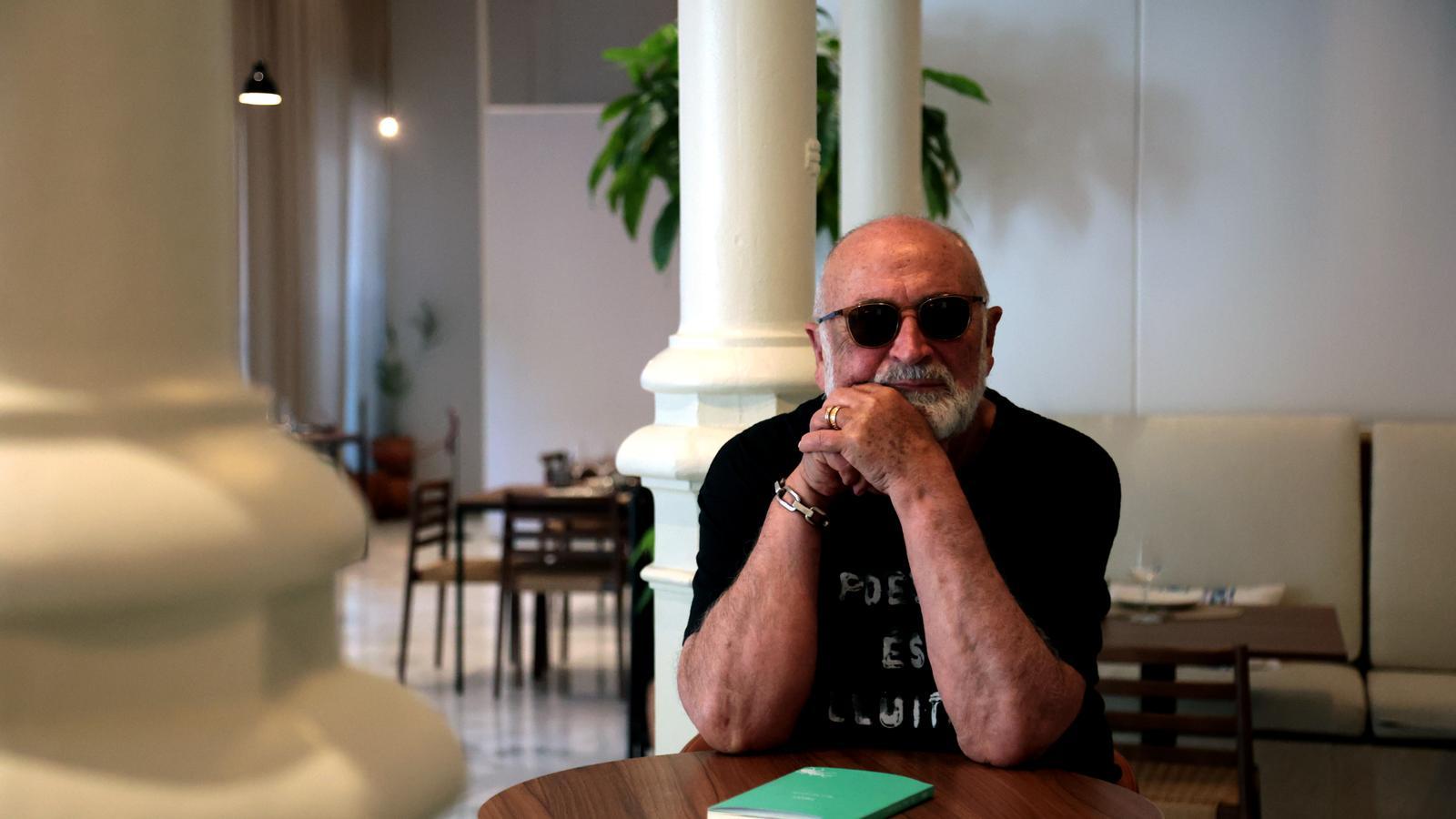

-
CAT -
CAST -
GER
PalmaHe has always been multifaceted: poet, narrator, playwright, reciter, biologist, journalist, literary prescriber, creator and director of the Mediterranean Poetry Festival, eternal activist for various causes. Biel Mesquida received last Monday, June 8, in the incomparable setting of the Palau de la Música, in Barcelona, the Honor Award for Catalan Literature, awarded by Òmnium Cultural. This Mallorcan, born in Castelló in 1947, began his career in 1973 with L’adolescent de sal, banned for two years by censorship. He has just published a new poetry collection at La Breu, Trast.
Is the Honor Award for Catalan Literature the Nobel Prize for literature in our language?
— It is the most important award given in Catalan culture to a person, you cannot be given one of a higher level. You have touched glory. Regarding the Nobel... Empar Moliner has said that if Biel Mesquida were from a normalized culture, they would have given it to him.
In other words, they won't give you the Nobel Prize.
— No. First, because I don't write, nor do I live, for awards. Even though the Nobel has awarded minor authors, like me.
The problem is Catalan.
— Yes. Because it is still a minority culture. We do not have a translation policy like a state might have. Some of my poems have been translated into French and Spanish, and into Spanish Excelsior. The Nobel Prize is awarded to people most of whose work is translated into English, so that the jury can read it. Han Kang [awarded in 2024] had not been read in Korean. Since 1714, Catalan has been marginalized. There isn't even a law of official languages, which would make it possible for other languages to be taught throughout the State: a child from Euskal Herria could learn Basque and Spanish, and also Catalan. The Cervantes Institute does not take other languages into account: it makes excuses, and it is paid for with the money of all citizens. I told him the other day, the director, Luis García Montero.
At the Palau de la Música, you defended, as you always have, the Catalan language. Are we not doing well?
— The Catalan language should be normal, but it is not so normal. When democracy arrived, it turned out that, for politicians, culture and language were not essential. We have always had to fight to achieve a normal status for a European language. We have had to fight all our lives. Within this society, with this neofascism, the language is once again being used. Politicians use culture as an element to gain more power.
Albert Camus only accepted two awards: the Nobel and the medal of the Spanish Republic. Which award would you never accept?
— I would not accept any institution linked to neo-fascism, neo-Nazism, or neo-Stalinism. Of which, unfortunately, there are starting to be in the State.
May you be given the Honor prize, it's like telling you, it's done, you have already fulfilled. Now all that's left is for you to receive tributes?
— From the very moment they communicated it to me, I already said that I am not a museum-able writer, nor a dead writer. I don't believe in genres, my work is unique, and it is all: what I have written in the media, too. I will not stop until I die.
Why are you writing, Biel?
— I write because I live. Writing is another life: I have perceptions, things that, if I didn't write, I wouldn't think about. Because I create a work for others. And I write to be loved.
You have sometimes said that you are more of a reader than a writer.
— I am a professional reader and an amateur writer. Ever since I was two years old, reading has been part of my life. I write because I believe I have a gift, there must be a part of talent. I have tried to create a mesquidià world, made from all the readings, from the Catalan, European and universal literary tradition.
Is your view of what surrounds you that of a biologist? Perhaps a journalist? Because your training is twofold.
— When I was little, they made you choose: science or humanities. I found it absurd, I wanted to do both. They took me to a psychologist who gave me a lot of tests and concluded that I was capable of both. I think science is a bit neglected. Science and technology should be basic subjects.
Perhaps. But technology shows some disturbing aspects. Like artificial intelligence.
— AI is just another tool. It must be seen for what it is useful for and what not. I don't believe that AI will take jobs away; technology has always brought about transformations, at any time. It works in a mechanical way. Humans bring angles that machines will never see. A machine will never be able to give the accent that I have given to a verse. It is a tool. Since we have been humans, we have always made tools, like the wheel or making fire.
Can AI write a poem by Biel Mesquida?
— A friend told me that he had found a poem of mine from the seventies. He told me: it doesn't appear anywhere. I looked at it and there were elements that didn't fit at all. I replied: it must be from a student, who wanted to write a 'mesquidià' poem. The AI had done it for him.

At the award ceremony, in Barcelona, you championed teachers, precisely when they are in conflict in Catalonia and the Valencian Country.
— My parents were teachers. I was born in a school, in a small village in Castelló: the ground floor was a large room for classes and upstairs was the apartment. I saw my mother with the children and I wanted to learn. At three years old I started writing. All this has been part of my life. Being the son of teachers has marked me. I have been in the trenches with the teachers, the last time in 2013 [the protest of teachers from the Balearic Islands against the policy of the Bauzá government].
You are not only a writer, but also a showman. At the Formentor Conversations, a few years ago, you managed to get the whole audience to sing Les flors mortes.
— Yes. It comes from when I was little, when I used to recite in public. At ten years old, they had end-of-year events and they made me go out. There are people who, when I recite, feel, laugh, cry, tremble. One day, in Binissalem, four or five people came and told me that I had made them cry. And a taxi driver, in Barcelona, asked me if I was a radio announcer. I, when I write something, read it aloud. The voice is poorly taught. Actors are imposed a specific model, as if it were the only one.
Do you vote?
— I have always voted.
Will you continue doing it?
— Changes are always slow. To achieve change, there must be a process. I would like us to live in fraternal tenderness. We should recover the great values of the French Revolution: liberty, equality, and fraternity.
In 1974, when Franco was still alive and homosexuality was a crime, you clandestinely published The beautiful country where men love men, with a very explicit title. To what extent has your sexual orientation marked you? If it has.
— My sexual orientation is Biel Mesquida. We all have a unique identity. Within my work there is everything: I tell, like Balzac, the human comedy.
On these same pages of ARA Balears, Jaume C. Pons Alorda has said of your new book, Trast, that it is necessary and that it is a manifesto.
— All the books I make are necessary for me. And yes, it is a manifesto. I set myself the goal, between July 2025 and January 2026, of writing a book of poems, Trast, which would gather all my perception and feeling of the world. A very ambitious project, but with a sense of extreme freedom. I fight to be freer and freer in my writing and that means you have to open yourself up: with relationships, with friendship, with love, with everything.
This marking of a specific time is not what you had done with the previous poetry collections.
— No, I had done them very slowly. I had been with each one for months and months. Not here, I said: bam, bam.
In Trast do not use periods, nor commas.
— No, because that brought me closer to what I wanted to sound like, to jazz music. First, there's a melody; then, a dialogue; then, a sad piece of music... I got into it, and the book has this jazzy quality.
And, at the same time, it presents a well-established structure.
— I wanted it to be divided into cantos and each canto into thirteen poems, which is a number I like. As I was writing them, I recorded them and listened to them, trying to make the minimum corrections. Because what it contains is this society we live in, in which trees, biodiversity, everything collapses and only this remains: a mess. Here the civil war appeared to me and how value and dignity were destroyed by assassins.
Were you reasonably satisfied, with Trast?
— I see that people read it and it reaches them. I've achieved something that is very difficult for me: that, without losing poeticity, it seems simple to the reader. I'm happy about that.
