Jaume Carot, rector of the UIB: "If the guide says that the subject is in Catalan, it must be in Catalan"
The rector vindicates Catalan as a university language and assures that learning it does not have to hinder the arrival of international talent

-
CAT -
CAST -
DE
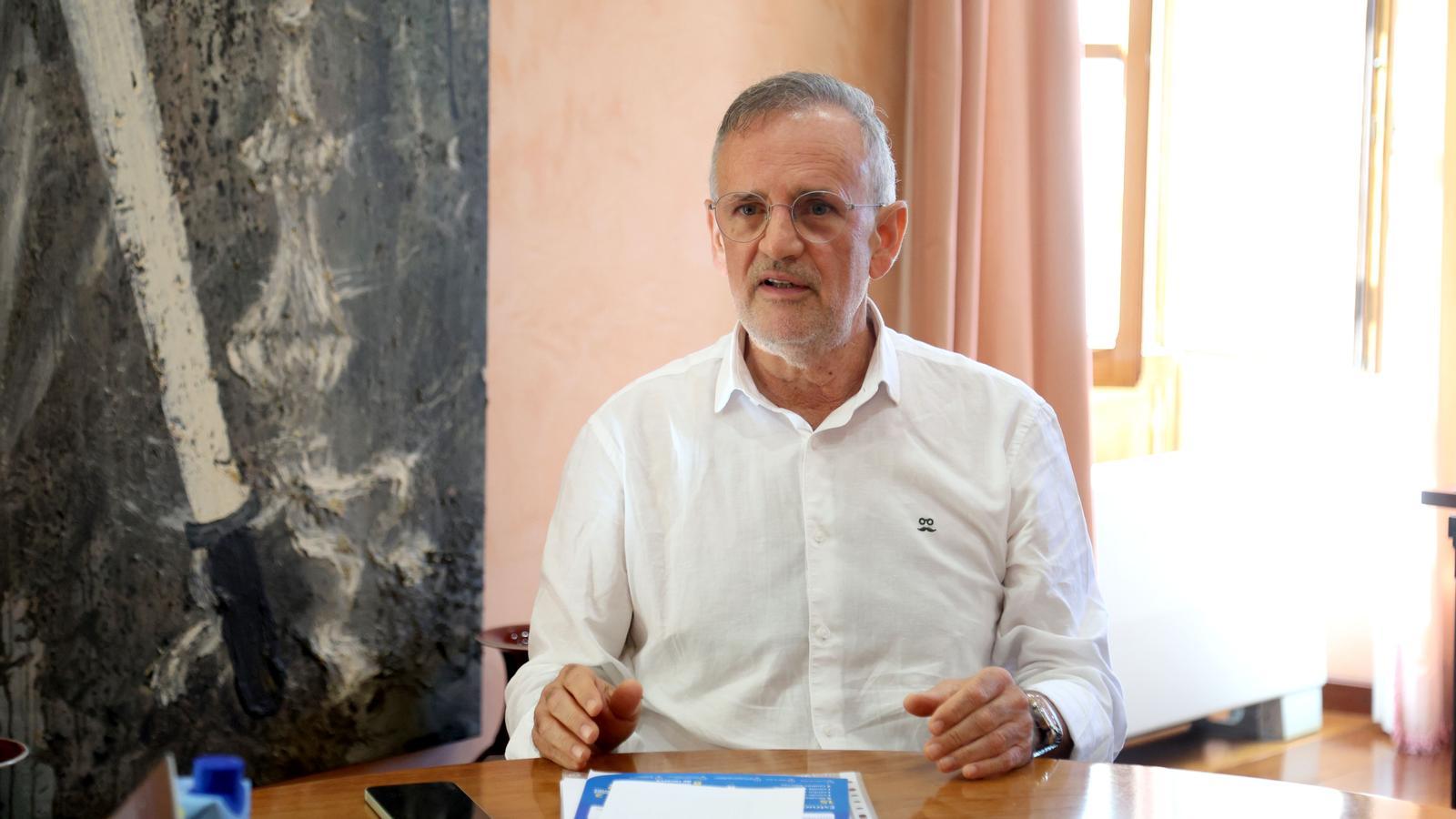
PalmaThe rector of the UIB, Jaume Carot, argues that Catalan should be the language of instruction for a subject if the teaching guide establishes it. "The teaching guide is a contract. If the language indicated therein is Catalan, the subject must be in Catalan," he states. In this sense, Carot considers that students who arrive from outside and do not know the language can adapt to it with ease. If they have difficulties following a subject, he explains, they can request a group change or receive materials and tutorials to continue their learning. "Someone coming from a non-Catalan speaking territory may feel lost at first, but, with a little goodwill, this is resolved quickly," he maintains.

The rector uses his own experience as a professor in Portugal as an example, where he claims he began teaching classes in just one month. Carot also rejects the idea that Catalan could be an obstacle to attracting international students and researchers. "I believe it is not a limiting factor," he states. While admitting that, at first, the language might generate reluctance, he considers that it is not a serious impediment to incorporating talent into the university.
To defend this position, he compares the situation in the Balearic Islands with that of countries like Finland and the Baltic republics. "Finnish is not an obstacle to attracting talent to Finland; the same happens in the Baltic republics," he argues. Carot acknowledges that learning a language requires effort, but insists that this should not hinder the arrival of international professionals and students.
Highlighted contrasts
Regarding the presence of Catalan in the classrooms, the rector assures that the UIB already conducts an exhaustive monitoring and that the percentages vary considerably depending on the studies. In Arts and Humanities, teaching in Catalan ranges between 70.6% and 43%; in Sciences, between 59% and 31%, and in Health Sciences, between 50% and 23% in Medicine, although in this latter degree it has increased notably. The differences are also significant in Social and Legal Sciences, where the figures go from 83% to 8%. On the other hand, all Education degrees are situated around 80% of Catalan presence. In Engineering and Architecture, the percentages go from 79% to 40%, while Tourism registers the lowest presence, in part, because many subjects are taught in English.
For all these reasons, Carot is committed to continuing to promote the use of the language through teacher training and the translation of teaching materials. He admits, however, that the university does not have tools to force professors to teach classes in Catalan. "I neither can nor want to force anyone to teach classes in Catalan, but rather to ensure that everyone who comes to the UIB can function there," he concludes.
