Jaume Carot: "There are teachers who renounce the position because they cannot find a house"
Rector of the UIB

-
CAT -
CAST -
DE
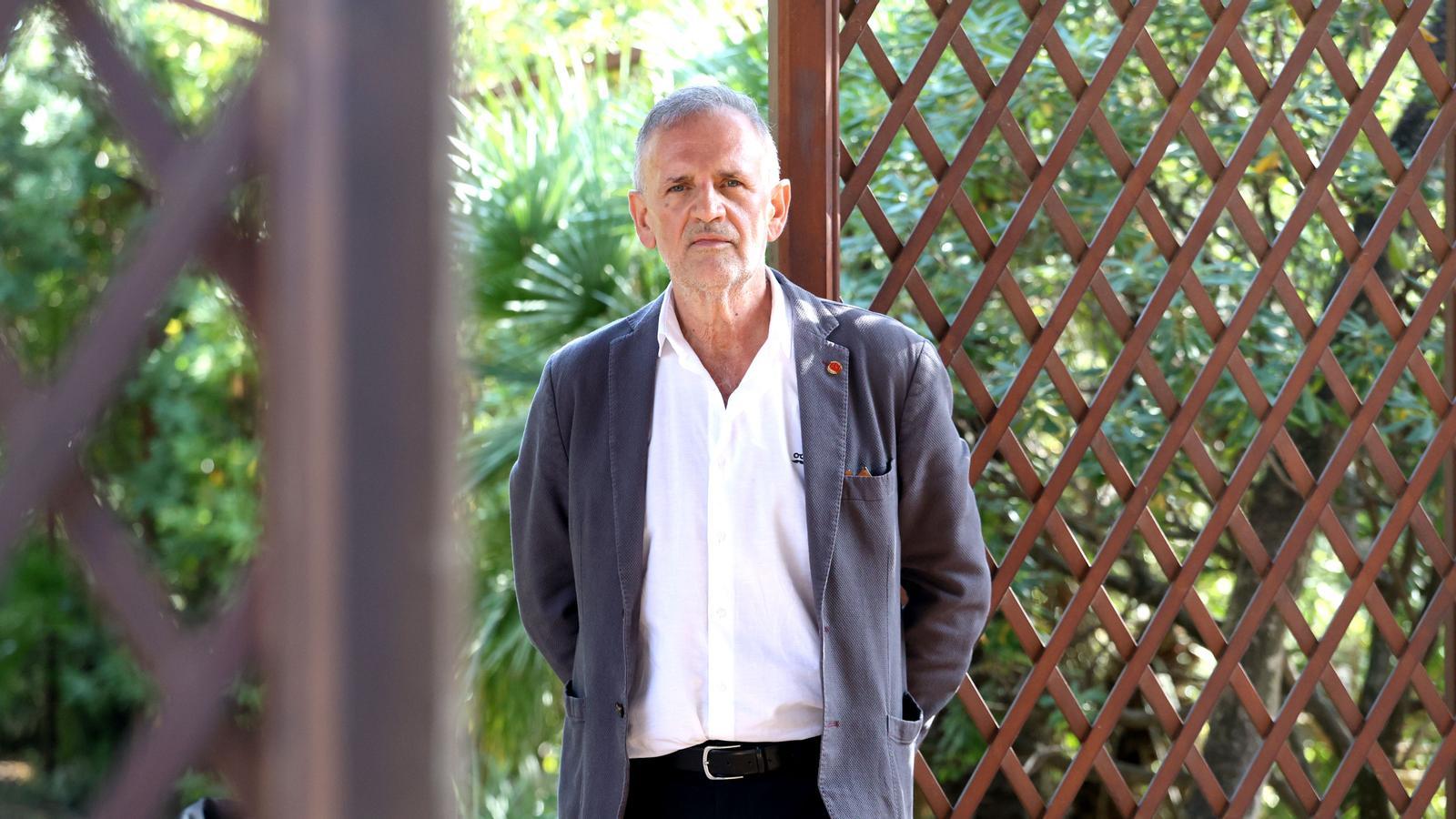
PalmaJaume Carot (Tortosa, 1960) has been the rector of the UIB since 2021. At a time when the arrival of new private universities threatens to gain ground on the public offering, Carot must face the challenge of securing the necessary resources to consolidate research and expand studies. Catalan in the classrooms and the need to bring the university closer to society are other pending subjects. The threat of the commodification of higher education is real.
The UIB has been the main university of the Balearic Islands for decades, but now it must coexist with the arrival of the CEU and the UMAC. Are you worried that higher education will become a business?
— The map of the State's public universities has recently been completed, with the incorporation of the Polytechnic University of Cartagena. There are now 50 public universities and 50 private ones. In the year 2000, there were only 6 private ones. In 26 years, we have gone from 6 to 50 private universities. It worries me that higher education is being commodified and turned into a business. There are decent private universities that have a solid educational project behind them, even if I share a different philosophy. But many others are a business, and I do not like turning something as sacred as education into a business. Most private ones do not conduct research. It is disastrous.

Is there any private university that is especially rigorous?
— It is hard to say. We have four: the CEU, the Pontifical University of Comillas, the Nebrija University, and now, the UMAC. I do not consider them the most rigorous universities one could imagine, because they do not conduct research. The CEU San Pablo is one of the more solid private ones, although, from the point of view of research, it does not have a specific weight within the university system. What they call research is the doctorate, but they do not have research groups or competitive research projects. They do have a solid educational project, with well-designed degrees.
The Minister of Education, Antoni Vera, said that he did not know whether he would choose the UIB or the CEU if he had to study Medicine. Have these statements bothered you?
— I will tell you that I would choose the UIB. He is the Minister of Education and Universities, in plural and in reference to private ones, but we know each other well enough and I think he would choose the UIB.
Has the onslaught of private universities caught the UIB off guard?
— I expected it, because it was a trend throughout the State. Public universities, like the UIB, were not used to strong competition. We have to adapt to it, learn to do marketing and compete for students with private universities. Furthermore, private ones have advantages: they can invest in marketing thanks to investment funds and buy or rent premises more easily, while public ones are subject to the law on public contracts. There are also differences in the hiring of teaching staff: at the UIB one must be accredited and pass a competitive examination, while at private ones they are hired by appointment. Finally, UIB tuition fees cost 1,250 euros.
Have you noticed if private schools have taken your teaching staff?
— We have not noticed it, but we will notice it among our associate professors.
Do you consider that the Government allocates enough resources to the UIB?
— A strong boost to research and R&D&I is needed. Although investment has increased since the previous Government, we remain at the tail end of the State. Since we entered the rectorate in 2022, the UIB budget has grown by 77.5%, from 114.5 to 203.2 million euros in 2026, thanks to the support of the Government. New professor positions have also been funded, and a supplement of 500 net euros per month has been added for assistant doctors, aware of the difficulty of living here. In terms of infrastructure, we are also on the right track, with funding for the Faculty of Science, but we still need more resources.

The UIB has fallen out of the world's top 1,000 universities in the 2026 Shanghai ranking. What do you think is the reason for this?
— Since 2020, new Asian universities have entered the ranking, which evaluates 2,500 institutions and classifies the top 1,000 out of a total of 50,000 universities worldwide. If Chinese ones enter, others from other parts of the world must exit. The Spanish State has gone from having 36 universities in it to 30, and 29 are public, including the Carlos III University of Madrid. We have also dropped and we have been given poor media coverage, which saddens me, because it seems to play into the hands of private institutions and conveys the idea that public universities are expensive and bad. Furthermore, Shanghai uses six indicators, all based on volume, without taking into account the size of the institutions. Publications per permanent professor are the only indicator that calculates an average and they only account for 10%. We had been there because we had many researchers among the top 1% most cited in the world. In addition, the ranking does not consider Arts or Humanities. By field, we are among the top 100 universities in Oceanography and among the top 500 in Education and Sciences.
What role should the UIB play in resolving the structural challenges of the Balearic Islands, such as the housing crisis, tourism pressure, and water scarcity?
— The UIB must contribute its knowledge, because the policies that are implemented must be based on facts, data, and science, not on ideologies. The Balearic Islands need a change of economic model in which not everything is tourism. 80% of the GDP comes from tourism. This is not good. We are capable of producing things, not just providing services. A transition towards another economic model could be carried out based on what we have done here with the ecological transition strategy. We could be leaders in sustainability solutions for all territories located between 45 degrees north latitude and 45 degrees south latitude. This is a knowledge-based economy, and it would mean that the workers who come would be highly qualified people.
Do you feel heard?
— Sometimes yes, sometimes no. Politics is very different from science. Then there are parliamentary games. I relay something to Parliament: do they listen to me? There are parliamentarians who personally I would think would, but, since there is a voting game, things sometimes end up as nothing. In many things, however, we have felt considered. Each time they consult us more and I am happy about it. Transitions are excessively slow. In 2028 we will be 50 years old. Before 1978, when the university was founded, nothing was contributed here to the generation of knowledge in the world. Nothing was generated there. Nowadays we do contribute to it.
There are 300 students waiting for a place at the UIB residence and there has been talk for years about building another one. Will it be a reality soon or is it a long-term wish?
— I have seen the plans for the second residence and I am hopeful to see it within the next two years. At first, it was supposed to be built next to the Conservatory, but now it has been moved to a plot behind it and will be larger. It is budgeted, and I believe that what needs to be done is simply to put it out to tender.
Do you know if there are students, as is the case with the two from Medicine, or professors who stop coming due to the lack of housing?
— The case of the two Medicine students is special. It may be that they have been admitted here and at other universities and that, if they do not find a place in the residence, they will leave. In other degrees there are also withdrawals, but they are few. Ministry scholarships are not enough and students tend to study close to home. I also know professors who have won a position and who, after months, leave because they cannot find housing.
Which new degrees do you want to implement and in what timeframe will you commit to doing so?
— The idea of growing is always there, but it must be accompanied by planning. Since we entered the rectorate, we have launched three bachelor's degrees—Pharmacy, Physical Activity and Sports Sciences, and Marine Sciences—and two double degrees: Early Childhood and Primary Education, and Mathematics and Physics. Within two years, we hope to implement Architecture, Mechanical Engineering, and a STEM degree, still pending a name. In any case, it is not clear that we will be able to launch new studies for the 2027-2028 academic year due to a lack of space. First, we must build the Science building and have the plots at the Parc Bit, where the Government will finance a new building. It is also necessary to incorporate faculty: since 2021 we have incorporated 264 stable professors. To continue growing, we need funding from the Government, since tuition fees only cover 7% of the expenses.
The UIB is often perceived as an institution distant from society: was it a mistake to build the campus on the outskirts of Palma instead of integrating the university into the city?
— It was not a mistake. It was a success. We are not isolated; it is a way of seeing it. By dint of repeating it, people think it is true.
In the 2024-2025 academic year, only 41.96% of undergraduate courses were taught in Catalan. And now?
— We already have the situation monitored. The presence of the language varies according to the fields: in Arts and Humanities it oscillates between 70.6% and 43%; in Sciences, between 59% and 31%; and in Health Sciences, between 50% and 23% in Medicine, although in this latter degree there has been a notable increase. In Social and Legal Sciences, the presence of Catalan ranges from 83% to 8%. All degrees in Education are around 80%, while the lowest percentage corresponds to Tourism, where many subjects are taught in English. In Engineering and Architecture, the figures oscillate between 79% and 40%. Our strategy is to insist, offer training, and facilitate the translation of materials. We do not have tools to force anyone to teach classes in Catalan, but we do have them to encourage its use. Neither can I, nor do I want to force anyone, but rather to ensure that everyone who comes to the UIB can function in Catalan.
At what point are the UIB's sustainability and climate neutrality commitments?
— We are at a fantastic point. After the tornado that tore off 10% of the panels, we are now capable of producing all the energy we lost with those panels. We need between six months and a year to reconnect to the grid and pour the surpluses into it. We already have storage batteries and soon we will have the power plant. We will be one of the most sustainable universities in Europe. We still need to finish the air conditioning project. What has delayed us is the scandalous lack of maintenance of the facilities. This has meant that, when we connected some things, others would break down.
Have you had to be more cautious than you would have liked in your demands in order to maintain a good relationship with the Government?
— No. I have had to be political. A rector must be political and the context is one of institutional loyalty. We owe it to society. I maintain a very fluid and very cordial relationship with the current Government, as well as with the previous one, and that is important.
Have you ever had to bite your tongue?
— In the sense of being a good boy, no, because in private I have talked about everything. Afterwards, as rector, I have a role and there are things I should not say. Jaume Carot has the ideas he has, when he is having an informal beer. I have not rendered obedience. We have published writings and made notes saying what we thought, as for example regarding the ruling against the 25% of Spanish in the classrooms. I have never bitten my tongue, but one must be careful as rector.
