The Educational Network attacks the exemption of Catalan for teachers: "Pacts with fascists, fascist ideas"
The entities that comprise it claim the return of the linguistic consensus and warn that the lack of teachers is due to poor working conditions and the cost of living
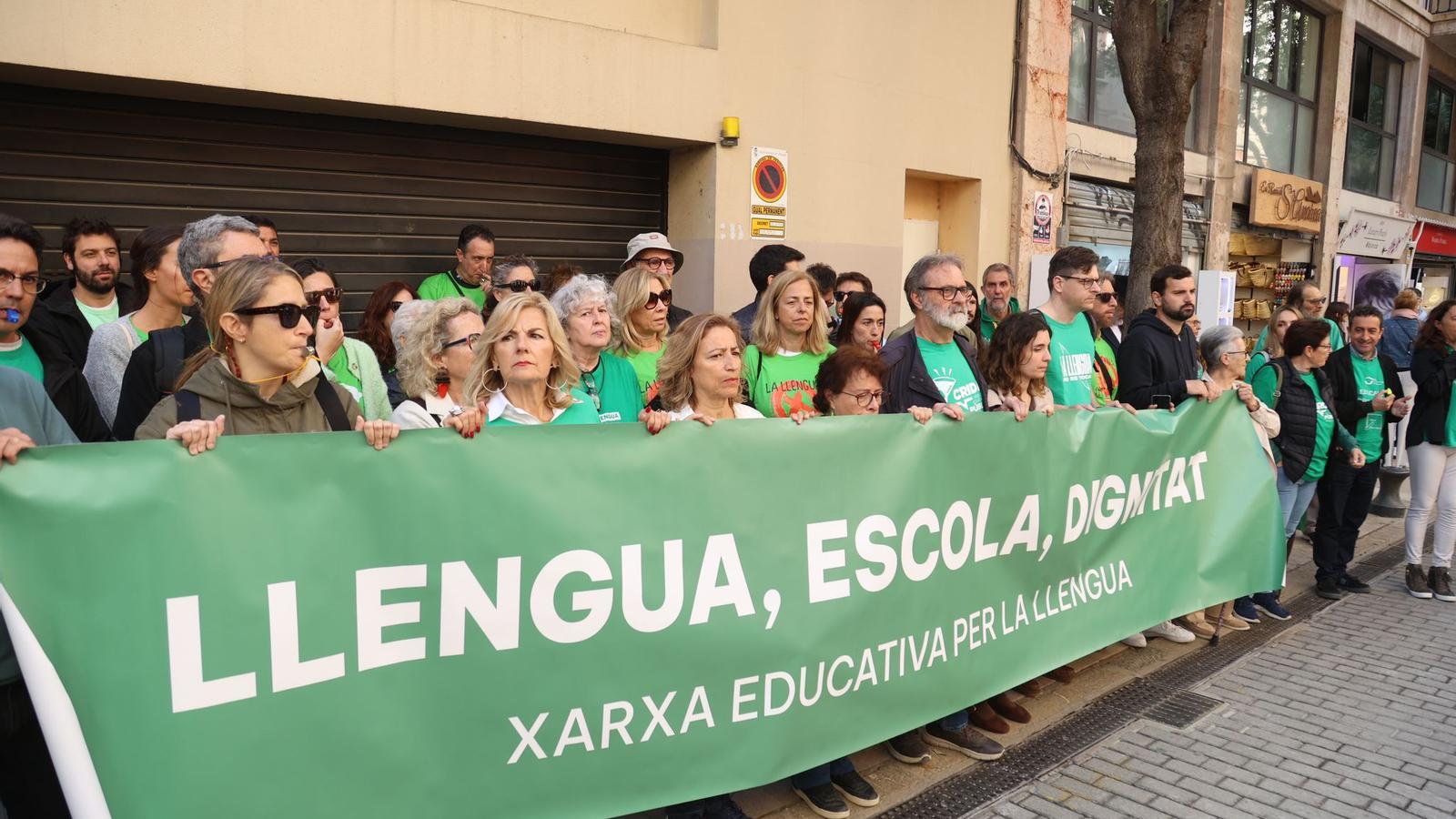

PalmaThe Network for Educational Language has convened a demonstration this Tuesday in front of the Parliament to reject the measure agreed between the PP and Vox that allows teachers who access civil service positions of difficult coverage to be exempted from the Catalan requirement. The initiative, which is part of the agreements between both formations, has opened a new front of tension in the educational and linguistic sphere in the Balearic Islands. "Pacts with fascists, fascist ideas"; "With Prohens, language is not consensus," shouted the fifty or so demonstrators, who attended on behalf of families, unions, teaching directors, among others.
The conveners have placed the linguistic issue at the center of the criticism. "Measures are approved that make our language dispensable in our land," they denounced during the demonstration. In the same vein, they affirmed that these are "measures that respond to the obsessions of the far-right and that are covered by the PP and" measures that make it difficult to live in Catalan in the Balearic Islands and that erode the educational model from within.

According to the entities, the possibility of incorporating teachers without certified Catalan knowledge has direct consequences on the functioning of the educational system and on the rights of students. “The student's right to learn Catalan is violated”, they have assured. Furthermore, they have warned that “the functioning of the centers is hindered” and that “tension in classrooms increases”, especially in already complex contexts.
The protest has brought together representatives from some of the entities that form the Network, who wanted to express their rejection of a measure they consider regressive. The participants have displayed banners in defense of the language and have called for educational policies that strengthen, and do not weaken, the current model.
The measure promoted by the Government is part of the will to respond to the growing difficulty in filling certain teaching positions, especially in some specialities and at advanced stages of the course. The executive argues that it is a specific and necessary solution to ensure that all groups have teachers, even in situations of candidate shortages.
This argument, however, is rejected by the mobilized groups, who consider that the underlying problem is not the linguistic requirement but the lack of attractiveness of the teaching profession and the working conditions.
Structural crisis of teaching staff
In this regard, during the concentration, the focus has been broadened and the debate has been placed within the framework of a global crisis of the educational system. The organizers recalled that “Europe and North America need 4.8 million teachers” and that “90% of this shortage has one cause: they are leaving the profession”.
“It is not for lack of vocation, it is because of the conditions”, they remarked, before detailing the main factors that explain this departure. Among these, they highlighted “the complexity of the classrooms: with more NESE students than in the rest of the State and with constant incorporations during the course”.
They have also pointed out "excessive hours: Spanish teachers work more hours than the European average", as well as "an increasingly tense climate: 79% speak of conflictive classrooms". Added to this is "suffocating bureaucracy; 96% of teachers say it is excessive" and "unattractive salaries".
In the specific case of the Balearic Islands, the organizers have emphasized the cost of living, especially housing. "A teacher can end up dedicating 56% of their salary to housing", they have warned, a fact that hinders both the recruitment and retention of professionals. And a fact that frames everything, the Balearic Islands dedicates 3.6% of its GDP to Education, behind the 4.2% of the state average and the 6% requested by UNESCO.
The proposals
Faced with this situation, the entities have insisted that “the solution exists” and that it involves addressing the structural problems of the system. Specifically, they have called for “more teacher participation, work-life balance, and well-being”, as well as “beter salaries and incentives, and clear professional careers”.
Furthermore, they have underlined the need for “recognition and real investment in education” as key pillars to reverse the current situation and prevent the loss of professionals. On the contrary, they have denounced that in the Balearic Islands “these problems are not being addressed and, instead, measures that weaken the educational system are being promoted”, in direct reference to the exemption from the Catalan language requirement.
The protest took place without incident and highlighted the existing division around this measure. While the Government defends it as a tool to guarantee the coverage of positions, a significant part of the educational community sees it as a risk to the linguistic model and the quality of the system. The organizers have focused the mobilization with a strong message: “Education cannot be built like this”.
