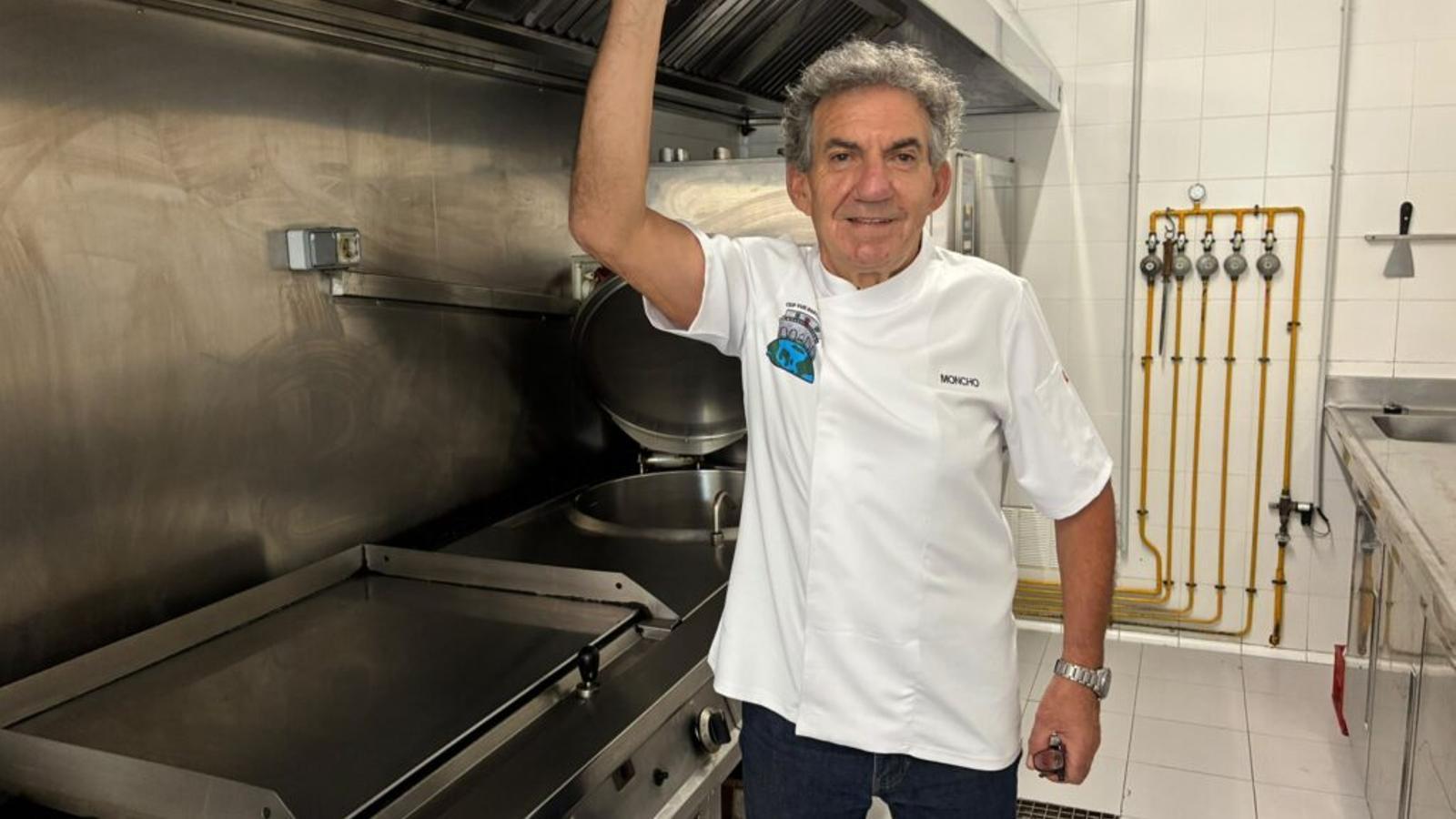
Moncho Gómez Lorenzo: The school cafeteria underwent a radical change when the woman joined the workforce
Cook
-
CAT -
CAST -
DE
AlgaidaThe dining hall of CEIP Pare Bartomeu Pou in Algaida is, since last June and forevermore, Can Moncho. It is in recognition of José Ramon Gómez Lorenzo (Pedrayo, 1962) who from 1988 until this year has been the cook at the public school in the municipality. At times and amidst nostalgic memories, he explains very valid and practical tricks and recipes for any family trying to get the little ones at home to eat everything. Moncho didn't want any farewell party, but after almost 40 years of service, the event was completely inevitable.
Where are you from and how did you arrive in Mallorca and settle in Algaida?
— I was born in Pedrayo, a small village belonging to the Town Hall of Pereiro de Aguiar, in the province of Ourense, in Galicia. At 18 years old, I stood my ground and left home for an adventure. I ended up in La Rioja, where I started working in the fields, harvesting fruit. There I met a couple of young people who were in the hospitality business and they told me there was a lot of work in Mallorca. I didn't think twice: I packed my bags and came with them. We arrived a week before Easter week in 1981 when I was 18 years old.
How did the beginning go?
— Yes, it was quite tough, it wasn't easy at all to find work at first. We stayed at the Bahía Mediterráneo boarding house, in Plaça Gomila. We each had a room and only had enough money to pay for the first month. In the end, my first job was as a warehouse assistant at a company in the Son Castelló industrial estate. I worked from Monday to Friday, and on weekends, which I had free, I got extra work as a waiter, especially in party venues. I remember earning much more from tips than from the salary they gave me. That's where I started getting into the hospitality world.
And when did you jump in the kitchen?
— It was through a man I met who had a restaurant near Plaça Gomila, called Can Mateu. He asked me if I wanted to work with him and told me: "Don't worry, I'll teach you." My job was to clean chickens, remove their giblets to prepare them for roasting, and work behind the bar. I was there from May to October, about five months, until the restaurant closed, because it was only for tourists. When it closed, I met another person who called me for a restaurant that had something very good at that time in Mallorca: it was open all year round. It was the restaurant Los Tordos, located on Carrer del Marquès de la Sènia. The owner told me that if I liked it, he would teach me. That was my first real contact with the stoves. I started to feel what I really wanted to be and I learned a lot. I was there until I was called up for military service.

How did you get to Algaida?
— Two partners and I rented a roadside restaurant in Manacor called Can Fideu. I was the cook. One day the management team from the Algaida school showed up and asked me if I was interested in running the school canteen. We did the math, I proposed a price per menu and they thought it was very good. I went to see the school's facilities and decided it was better to cook directly there. I spoke with my partners and we reached an agreement, and I left the restaurant to start working at the Algaida school.
Do you remember those early years compared to the current volume of students?
— When I started there were very few children, only 25. I was self-employed and responsible for everything: buying, preparing, and distributing the food. The on-duty teachers helped me and supervised the playground and the dining room. I only had to clean the facilities I used. Since I finished at 4:00 PM, for the first ten years I combined it with evening work in restaurants like Cal Dimoni and Quatre Vents. From those beginnings, we have ended up with 302 permanent children.
Why do you think this increase was motivated?
— It is clear that the dining room underwent a radical change when the woman joined the workforce, because they had to leave the children in the dining room. And here, moreover, for many years there was a double school day and they only had the "obligation" to keep the children who came from Pina, Randa and from outside, for the others it was optional.
How have you experienced, on a practical and emotional level, this last year before retirement?
— For many years I had a young man working with me, Francisco Barceló, whom I taught my way. This gave me freedom of movement to be a little in the dining room and in the patio. But when he left, I had to stay on the front lines of the stoves, along with Sergio, who is an assistant, and Lola, who helped us to clean and set up the menus. That's why this last one has been a lot of work, the sensations have been super good, because I have rediscovered myself with the one from the beginnings. Arriving in the morning again, getting in front of the stoves and cooking everything myself until 4:00 PM has been a pleasure. I enjoyed myself, as my phrase said: "Like Toni Kroos, the footballer, who retires with his boots on". I retired with my apron on.
In all these years, how has the way of feeding children changed?
— It has been a 180-degree change. Before, families used to eat six, seven fixed dishes. The Ministry of Health itself was the first to bet on this change with campaigns in APIMAs and town halls with the slogan: "Eating well is not eating a lot, it is eating varied and balanced". The beginnings were quite tough. We went from eating fried potatoes three days a week and canned fruit two or three days a week, to eating potatoes once a week and making canned fruit disappear and introducing a lot of vegetables and legumes; also introducing creams, a lot of varied salads... everything more cooked and fried, at most, twice a month.
And how do you approach this change? How does it affect you as a cook? Because making healthy food for boys and girls can't be easy…
— Because of this change, I went to university at 45 years old! I did a postgraduate degree in child and adolescent nutrition and dietetics in the afternoons and on Saturdays. I did it, because even I didn't understand it at first. I thought: "Listen, they are children, if you give them a plate of pasta or potatoes with breaded steak, they will burn it off in the playground in thirty seconds anyway!". But they insisted that it had to be done this way, and in the end, by preparing things with a lot of care, we achieved it.
Some examples?
— For example, I make pumpkin, parsnip, and legume creams and then I strain them well, so they are like baby purees; they eat them without seeing anything and they value the texture. With salads, the secret is the cut. If you cut the lettuce thickly, like at home, children are unable to get the leaf into their mouths. But if you cut it julienne, very finely, accompanied by corn, tuna, and beetroot, they eat it little by little and assimilate it very well. Nowadays salads are fantastic. There are many tricks to make children eat everything.
Do you have any other tricks for vegetables and legumes?
— With lentils, for example, the grandparents come and tell me: "What on earth do you put in the lentils, because my grandson says he doesn't like those at home and he likes yours?". The secret is the vegetable stock: spinach, carrot, pumpkin, chard, and onion. Everything is well sautéed and, when cooked, the onion disappears, the finely chopped spinach too, and the carrot and potato are cut very, very small, like for a salad [he draws it in a notebook]. For younger children, when they don't like them, I get them used to it by giving them a spoonful the first week, two the next, and after 15 days they eat the whole plate. You have to be cunning: if a child is not a big eater, you can't give them a full plate that will overwhelm them from the start. The main courses should also have a good visual presence that makes them hungry. Another trick I have is that grilled fish or meat, like chicken breast, is always accompanied by a bit of lemon sauce, Rioja style or Biscay style if it's cod. The child who doesn't want it pushes it aside, so it doesn't dry out. And the fish, always, absolutely free of bones. A bone in a child's mouth is a danger and they get scared. You have to do all this arriving here in the morning as if it were the first day and enjoying what you do and preparing it in such a way that you make things easier for them when eating.
They say that children ate better at school than at home…
— It is a fact, the director himself told me: "Everything Moncho does is good and at home there is always a but." This has an explanation: for many years I also cooked for the nursery school for 0 to 3 year olds. We would go with a cart with the hot food just out of the pot. The children who started school at three years old ate what I made from when they were little. They already came in trained, and their main diet had developed with me.
After so many years you must have fed entire generations of Algaidins. Have you had people from whom you have also had their children afterwards?
— And grandchildren! Think that I started here at 26 years old. At that time there were children of 16 years old who had repeated —before the system was different— and who already looked like men and women. Those people have had partners, have had children and now these children leave the children to us in the dining room. We even have some grandchildren already! That parents leave you their children means that their own experience in the dining room was good, otherwise, they wouldn't leave them.
In 1996 the canteen management system changed. How did it affect you?
— I started here in 1988 as self-employed. In 1996, the Ministry put all school canteens out to tender with a sealed bid. A project had to be submitted which, among other things, included the price of the menu with supervisors included, that is, what the menu should cost the father and mother, and an annual fee that I paid to the school. I won the tender for five years, competing against large companies, because I adjusted the price very tightly, I think it was 165 pesetas at the time, and that's why I won. Then, in 2002, it came up again and I won again. This last tender allowed me to have the service for 25 years, but it was renewable each year and an report had to be sent to the Ministry with an evaluation of the quantity, quality, and cleanliness that the management team, the APIMA, and the Town Hall had to carry out; and so on until now. From then on, the school took a back seat in management and everything was up to me: I had to hire staff, asking that 70% knew Catalan and that they were leisure monitors. In fact, in the summer of 1997, we organized the courses here to obtain the leisure monitor qualification. And most importantly: I submitted an educational project for the dining room and the playground that is still posted at the school.
What does this educational project consist of?
— It consisted in the fact that the dining room was also a classroom. You had to enter in line, respect the monitors, sit properly in your chair, wipe your mouth after drinking, speak in a moderate tone, ask for things "please" and say "thank you". And in the playground, the children had to empathize with each other. It went much further than just eating lunch, there was a very important educational part. Furthermore, we involved the boys and girls. We placed two older children from fifth or sixth grade at each table. They were in charge of serving the soup. For the second course, the older children took turns getting up, entered the kitchen in an orderly manner - as if it were a wedding banquet - took their prepared tray and served their six table companions. When they finished, one of the older children collected the plates, another the glasses, a younger one carried the bread basket (if it fell, it didn't matter). Everyone had a role and this educated them and they liked it.
What has helped you maintain the motivation to cook for 40 years for the same client profile? What is the secret?
— The secret is to go to work with the enthusiasm of the first day and always keep in mind that you are cooking for children. This means that if you make the dishes with taste, you will make it easier for them to eat. And all this, obviously, respecting the nutritional regulations, which are very important. It motivates me a lot to go out and have the kids ask me to have seconds. If out of 140 older children, there are 70 who want seconds, the fact that I know I've made that dish is the best motivation. At first it was difficult, because the vegetables didn't go down easily, until they got the picture in their heads and say: "Moncho's pilaf rice" or "rice with herbs". Then they no longer see "the green", but they value the flavor. Rice is a star dish. And Galician-style potatoes, slices with aromatic herbs and leeks, well seasoned with a little oil and sweet paprika. You'd be amazed how they eat them. Modesty aside, I have many dishes like this. Another curious case is that of cannelloni. When I started here, if 50 children stayed for lunch, only 5 liked them. Nowadays they drive them crazy. Many children didn't know these dishes before.
And fruit, is it hard for them to eat it?
— Fruit, they must eat it anyway, at least half a piece. They were not used to it. With the orange, which is from here, there was no way. At first I had to peel it, slice it and with a pinch of sugar, because otherwise, there was no way, even though it is very good. Now they eat apples and pears very well, even though in winter the stored fruit is harder to ripen properly. In summer, oranges, melons and watermelons are a hit.
Returning to the courtyard, you say that education also happens there.
— And so it is. In the dining room we educate with rules of behavior, and in the playground by empathizing with the children, treating them all equally. For me it is essential that there be very intensive supervision by the monitors. From 2:00 PM to 4:00 PM I am responsible for everything that happens in the playground. Furthermore, children like for there to be a figure of respect. I used to go out to the playground and act as a referee in football matches between third, fourth, fifth, and sixth graders. I played with them and acted as a referee. On the last day I even refereed a match. If you do it this way, they listen to you; if not, things and problems start. When I started in 1988, the teachers had lunch and then went out to the playground to play with the children. Nowadays this is no longer seen, and children need to see this figure and empathize with them.
Leaving school, how have you seen the evolution of the town since you arrived in 1988?
— When I arrived, the town didn't even reach 3,000 inhabitants. Back then, everything was concentrated in the square: football was played there, conillons... Life was the square and also at the football field, which back then was dirt. There was also the room to play ping-pong. Then the town started to grow a lot, because it's close to Palma, the airport, the beach and the hospital and also with the new road... The town has grown a lot.
What message would you like to send to the educational community and the town at the moment of your farewell?
— I want to sincerely thank the educational community and the City Council for the trust they have placed in me and my team of monitors over all these years, and I apologize if at any time I have not lived up to what was asked of me.
And what about the people who would enter your place?
— I would give them two basic tips: they have to like children and they have to like cooking. If they have these two things, all the other things come by themselves.
