Tender almonds for an image
We explain how to prepare aubergines for going to sea at home

PalmaThen the street was flanked by plots of land. The almond trees leaned over our path, offering such green almonds that we could still eat the skin. We opened them with our teeth and took out the kernel that burst in our mouths like a small gulp of acidic water. We filled our pockets with them and ran off in fours for fear that some neighbor might give us away. In the month of September, when it was time to harvest the almonds, I always ate some of those we shelled outside the cloths. The pulp broke crunchily in the mouth, milky and sweet, braving such a wonderful transformation, just like a chrysalis waiting for its final state.
Nature is always in a state of metamorphosis. We also change. The almond alley is no longer that alley, the plots have taken other forms, and the trees that bent their branches have ceased to be a daily presence to become a memory. It is then that memory needs another skin to survive. Photography accomplishes this marvel by stopping all this movement in a precise instant that allows us to capture the butterfly before it disappears from the garden. The image ends up being the only landscape we can inhabit without time altering it.
Today, most of the old almond trees adorn the landscape as if they were negative images, and it is inevitable to think of the photographs that Joan Fontcuberta presents at the Fundació Toni Catany. In this project, the dying or dead trees are portrayed as if they were figures, sculptures in the middle of the field that retain a suggested human form and are treated as if they were in the artist's studio. While the Llucmajorer photographer preserves the daily life of objects, fruits, and flowers in the intimate stillness of still life, Fontcuberta contemplates the trees and turns them into a landscape that can now only persist as visual memory. Between the two, the same gesture is established: to give shape to what is about to disappear or has already disappeared.
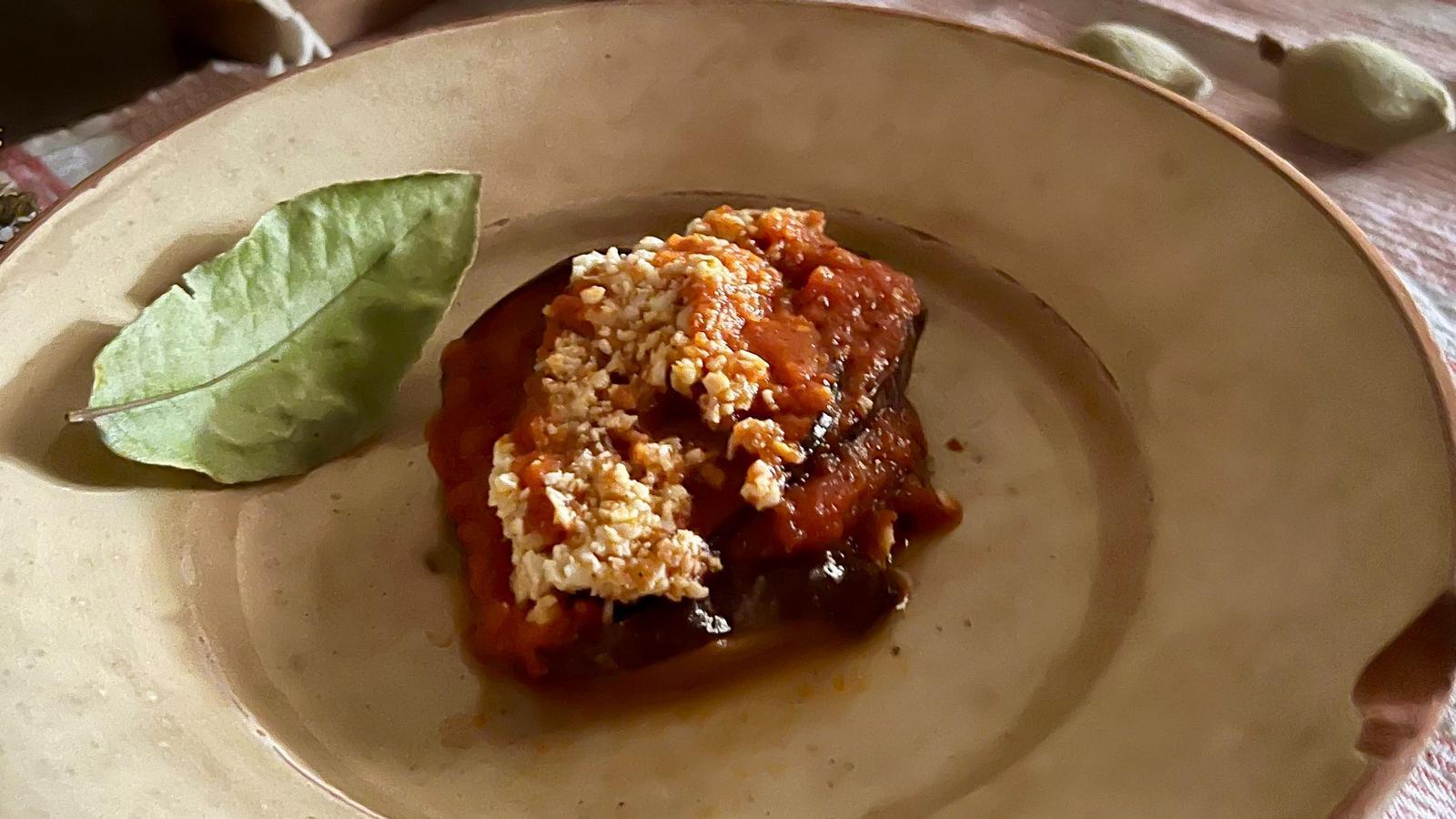
The recipe for aubergines with tender almonds that they prepared at Toni Catany's to take to the beach becomes a third piece of the same system. I cook thinking that it is a privilege to be able to make and offer it, because it is born from the hand of a photographer who amazes me and because cooking it is also a way of getting closer to his gaze, of continuing it in another language. A recipe is also a form of photography, because it allows us to delve into a time, into a precise moment, and to give shape to a landscape. For this reason, the aubergines to go to sea with tender almonds that they prepared at Toni Catany's not only preserve a taste, but also an exact moment of the year, when the almonds have not yet finished their process and the summer fruits are blooming.
Perhaps cooking and photography are nothing more than two ways of offering silent resistance to time. One fixes the light; the other, the taste. Between the two, they manage that, many years later, we can still feel that milky and sweet bite explode in our mouths, hiding a tender almond.
I take the opportunity to thank Toni Garau for transmitting the recipe to me – it has been a pleasure for me to be able to make it – and Xesca Riera for providing me with the tender almonds.
We will cut the eggplants into slices and put them in a bowl with water and salt. Meanwhile, we will scald the tomatoes, peel them and chop them. We will make a sauce by adding salt, black pepper, a bay leaf and some crushed garlic cloves. When it is well cooked, we will remove it from the heat.We will drain the eggplant and fry it in batches. We will let it drip on absorbent paper and put it in a casserole dish. We will season it.We will make a paste with the peeled almonds, a garlic clove and a pinch of salt. We will add a splash of vinegar, as much as the paste absorbs. We will mix the paste with the sauce and pour it over the eggplant. We will put the casserole dish in the fridge and wait for it to cool. It is better if it is made from one day to the next.This very summery dish may seem dangerous to take to the beach, as the acidity of the sauce and the heat are not very compatible. The vinegar, in this case, acts like a marinade and preserves it.
2 aubergines1 kg of tomatoes1 handful of tender almondsbay leaf, garlic cloves1 glug of brandy or red winevinegaroil
