Armand
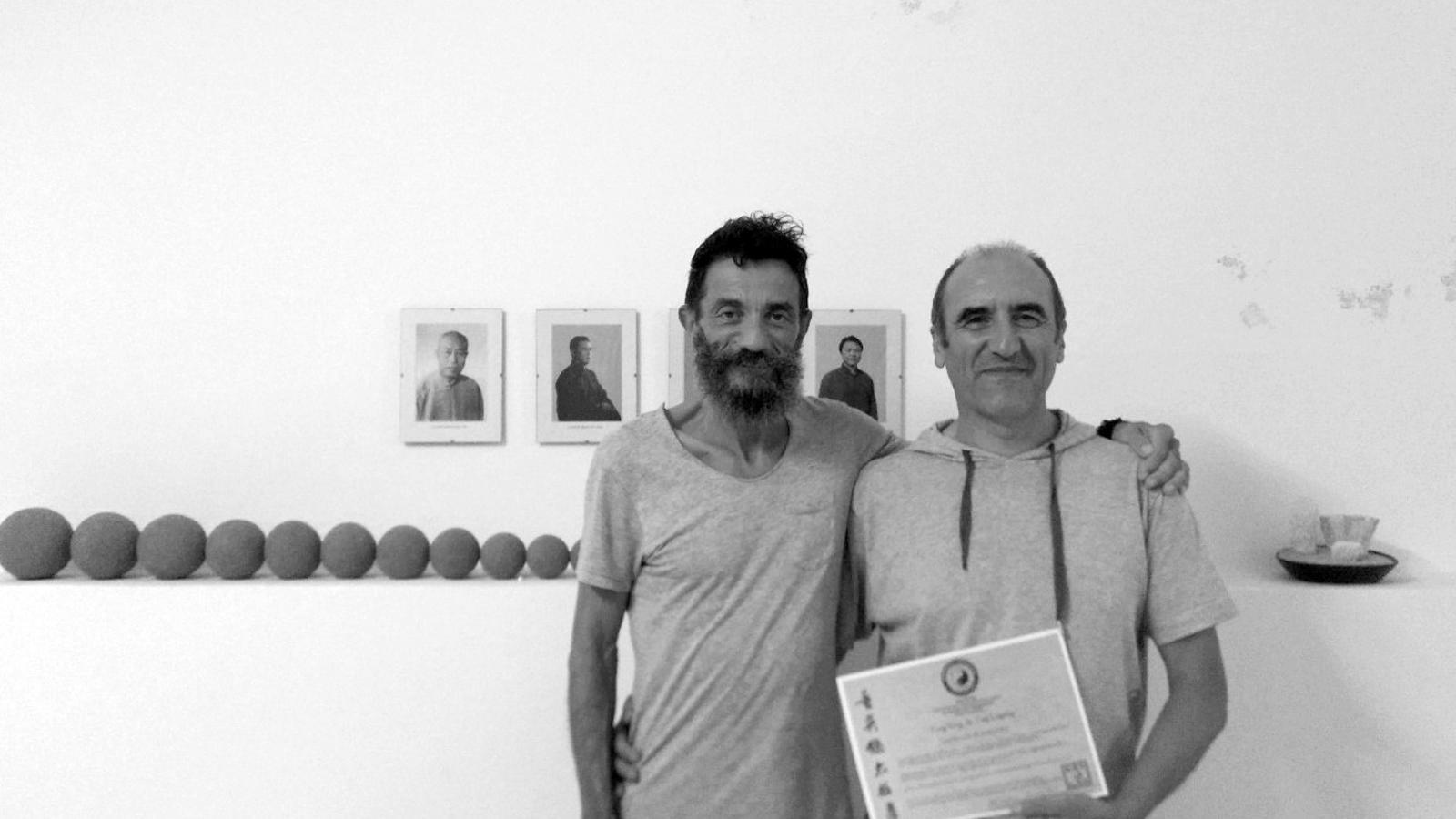

At sunset I saw him by the sea, on the small pier of the bay of Pollença. He was a thin man, with a long, untidy beard. His movements were slow, harmonious. He was doing his practices and it seemed that his body was there, but his spirit was very far away. That instant of eternity exuded serenity and tranquility. Who was that man? What life story did he have behind him?I stopped at a certain distance, I didn't want to bother him. Everything began to slow down, the small waves that moved, the orange sun that wanted to set behind Tomir, the children running with their bicycles, the slow body and hands of that thin man with a long beard. Every encounter is unique and unrepeatable. That afternoon I didn't know who he was, I only knew that he exuded a serenity that made you want to stay still and watch.“Every breath is an opportunity,” says Ester when she leads the yoga practice. To understand Armand's story, we must go back to the early 80s. In sa Pobla, AIDS arrived without knocking. It wasn't the only guest; heroin also arrived, along with the need for easy and quick money. The appearance, the skin of the town, changed radically in a short time. A string of young people began to die, always silently and on tiptoe. Homosexuality was present, but it couldn't be spoken of; they said it was taboo, or perhaps a sin.Faced with the facts and the news that reached us about that red death, there was a deep-seated collective sense of survival. It seemed to us that those stories belonged to another world, that what was happening was in New York, in London, to the artists we saw on television, but not in our town. "These misfortunes don't happen to us," we thought; meanwhile, the young people began to fall, dying one after another. Lives shattered, without opportunities, without return, without explanation.Between 1981 and 1995, almost twenty young people died in sa Pobla infected with AIDS or killed by an overdose. The same number of young soldiers from Pobla who died on the Ebro front in that fateful 1938. For a small community, it was another war. Without bombs, without uniforms, but equally devastating.“Every session, every practice, is like starting with a blank page”.Tai chi is reached through continuous movement, shifting of weight, rooting to the ground, and breathing. There is no rush, each movement is born from the previous one and prepares the next. Time ceases to be something that ‘happens’ and becomes something that you ‘live’. Armand needed to inhabit his body and time, he needed to contemplate to gain distance and make the illness bearable. Yoga also seeks this. When you hold a pose with conscious breathing, you don’t simply ‘hold’ a pose, you learn to be present within your own body. The body ceases to be a tool you use and becomes a place you inhabit. When he contracted AIDS, Armand began a journey of deepening within himself, without much noise or visibility. The practice and contemplation of tai chi gave him life and meaning.“Living with a tranquil spirit,” Joan Socies, my childhood friend and Armand’s disciple, used to tell me. With Joan, we learned to walk and ride bicycles on Gran Street in sa Pobla; it was the 1960s. Psychology, teaching, and the search for his inner path were his constant pursuit and, at the same time, a vital necessity. One day he told me: “I’ve started doing tai chi and I like it. The teacher is half Basque and half French and lives in Santa Margalida. You would like it... Why don't you come?”Three years ago, Joan died of cancer and we buried him in Son Tut, facing east. Armand, his teacher, visited him a few days before he left. They talked and hugged; they had shared a part of the journey. Joan died with a peaceful spirit.Armand sought a corner, a quiet refuge in the bay of Pollença. He knew he had to prepare for his departure, he had little time left. AIDS had taken over his body when he was only 24 years old, while he was working as an engineer in London. In those years there were no vaccines or answers. But he decided to live his time, his own time, with more awareness.“Every breath counts... Take a breath. This time is just for you,” says Ester in a calm voice.N'Armand knew how to transform suffering into a serene way of life. In the documentary that in 2019 broadcast IB3 about AIDS, Armand said he would not give up his illness for anything.Throughout his life he sought silence. He was not a 'media master', he did not publish books nor seek notoriety. He simply lived. And this, nowadays, is extraordinarily rare. Joan told me: "The important thing is to have a calm spirit". Now we know that this phrase was not born out of nowhere. It was part of a way of living that he had probably learned alongside Armand. A teacher is not one who creates dependent disciples, but one who helps others to walk on their own two feet. Armand's greatness will not be having been perfect, but having continued to live.Now we have that scene on the pier, that man in front of the Bay of Pollensa. A very thin man, with a long beard, a man ravaged by consumption.In the last days of June this year, Armand died, accompanied by the people who loved him. Grief spread through the small corner of the bay. The women who lived there in winter had welcomed and adopted him; he made himself loved. I often walk past the jetty and still see that thin man, with a long beard, practicing his routines, living each day as if it were the last day of his life.
