Territorial tension
-
CAT -
CAST -
DE
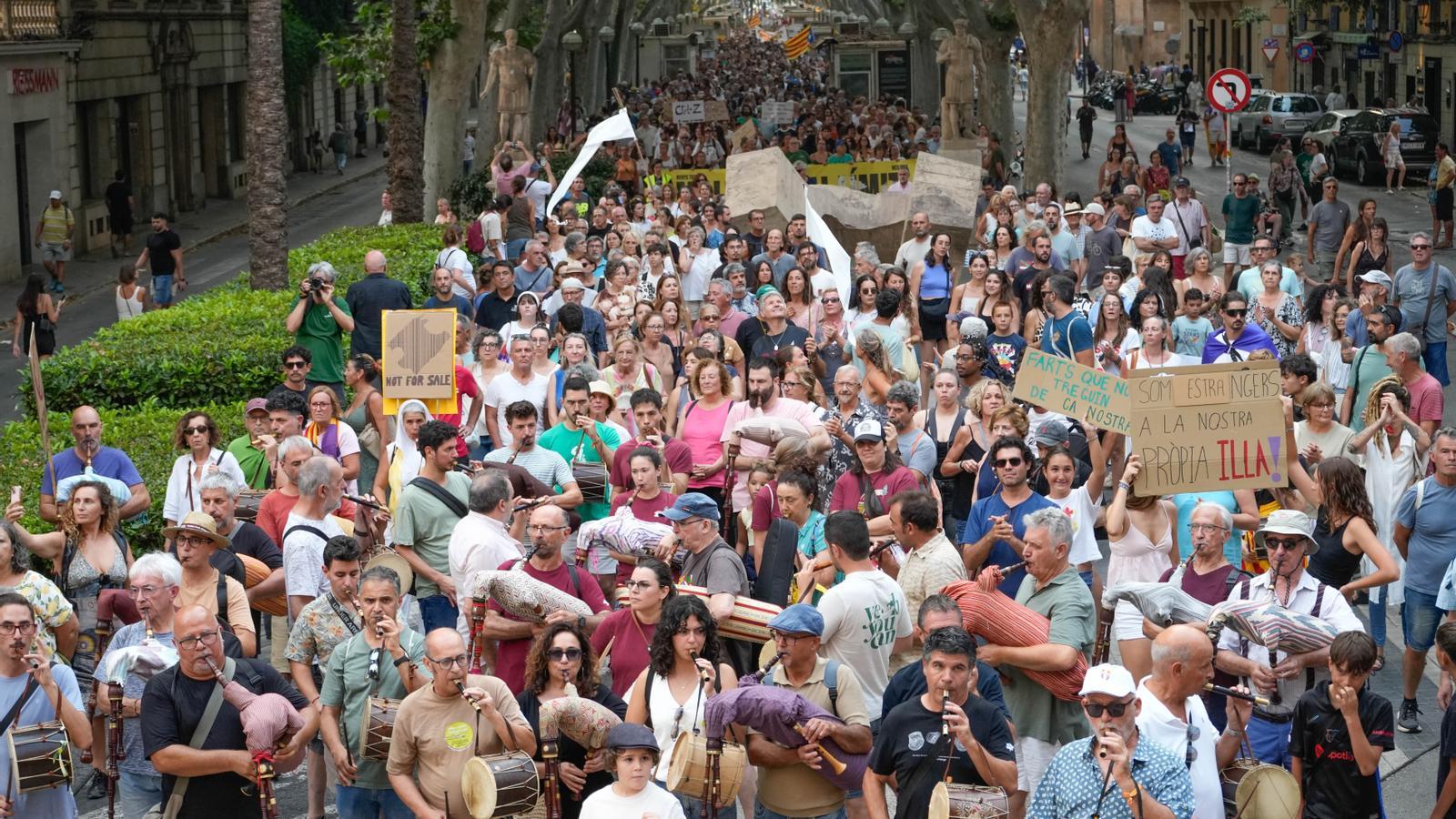
PalmaThe violent outburst at the end of the last and successful demonstration called with the aim of achieving less tourism, more life, is another indicator of a whole series of contradictory policies implemented simultaneously in our Autonomous Community. When the CAIB was constituted (1983), it assumed, among other things, competences in urbanism and territorial planning, but the State reserved the cards that could condition, directly or indirectly, urban and territorial plans: economic policy, taxation, justice, police, and large inter-community infrastructures, including the energy distribution network and ports and airports of general interest. Since then, the objectives of the policies implemented by both administrations have not always been consistent.
The first law approved by the Parliament of the Balearic Islands was the one that allowed our legislative chamber to protect natural areas threatened by new urban developments (Law 1/1984) and, two weeks later, it was applied to the case of Trenc (Law 3/1984). A whole series of unique protections followed Trenc, which, like firefighting operations, put out urban fires as they began to flare up. The general plan against 'urban fires' was the Natural Spaces Law (LEN) of 1991, which prohibited new urban developments in one-third of the Archipelago, the one with the most outstanding natural values.
Eight years later, in 1999, the Territorial Planning Directives (DOT) had just nailed it, setting a limit on the possibility of urban expansion, while prohibiting new urban developments disconnected from existing ones and along the entire still undeveloped coastline. These and other urban and territorial measures have made the Autonomous Community of the Balearic Islands the one that has approved the most measures to contain urban growth. But notice that I say 'measures to contain urban growth', not measures to 'contain growth'.
The State, in parallel and often contradictorily with objectives such as those of the LEN and DOT, has carried out determined growth-oriented policies. It has widely opened its doors to investment with financial and mortgage policies that have ultimately gentrified a large part of the Balearic Islands. The result, among other things, has been a sharp increase in housing prices and the consolidation of rentierism as the most profitable and lucrative way to accumulate profits. To implement this policy, incentives and attractions were needed for investors, tourists, and visitors, and for this reason, airports are key components. Thus, in 2001, the master plans for the airports of Palma, Ibiza, and Menorca were approved, which, when executed in different expansions, have achieved records in activity and passengers year after year. A parallel policy to that of ports of general interest, especially those of Palma, Maó, and Ibiza, which have continuously expanded their capacity to mobilize goods, trucks, cars, passengers, and, especially, cruise ships. Regarding energy supply, the State has connected us to the peninsular networks via a gas pipeline (2009) and an electricity cable (2012), which means our islands are no longer islands from an energy perspective, as we have been integrated into the continental supply networks. Thanks to these connections, we can now consume Algerian gas and nuclear energy.
The various administrations and governments of the Autonomous Community have almost never stood up to this mad escalation of infrastructure; the chronic fiscal deficit has served as the perfect excuse to accept these State investments, even though they exacerbate the territorial tension of the Archipelago. The CAIB has also collaborated in this race towards collapse by signing agreements with the State to obtain funding for desalination plants and highways or by participating, on its own initiative, in every nautical or tourist fair that was held (“More wood, it’s the war!”, Groucho Marx would say).
In other words, the State, in coordination with the regional and island governments, has controlled, favored, and encouraged the inflow of people, capital, and necessary energy to CAIB for the consumption of businesses, residents, and tourists. For its part, the Autonomous Community has ordered, or attempted to order, the great flood that it has hardly ever questioned. With these simultaneous and contradictory policies, territorial tension is indeed served, and, as the call at the last demonstration says: “Mallorca, at its limit”. The violence of the demonstration on July 26th, beyond the police's Francoist tics, is the clearest proof that we have already overloaded the territory and reached the limit. When the pot boils and the lid is kept tightly closed, sooner or later, it explodes.
Proponents of business freedom, of the 'freedom of the wolves', will say “well, we need to lift the lid so it doesn't explode”, which translates to repealing the LEN, the DOTs, and whatever else is necessary, rewriting the history of urban planning protection inaugurated at Trenc. Well, no, what is needed here is to protect ourselves from classist policies, gentrification, and the investor flows that invade us: limit tourism, limit the purchase and rental prices of housing, do not invest more in airport expansions and set caps on their annual movement capacity, do not allow more cars in, limit and condition new investments, tax large landowners, reduce and limit vacation rentals... Translated: de-escalate the territory and opt for sustainable degrowth and definitively abandon the oxymoron of sustainable growth; lower the heat of the pot so it cooks slowly and everyone can enjoy the aroma of a good meal.
