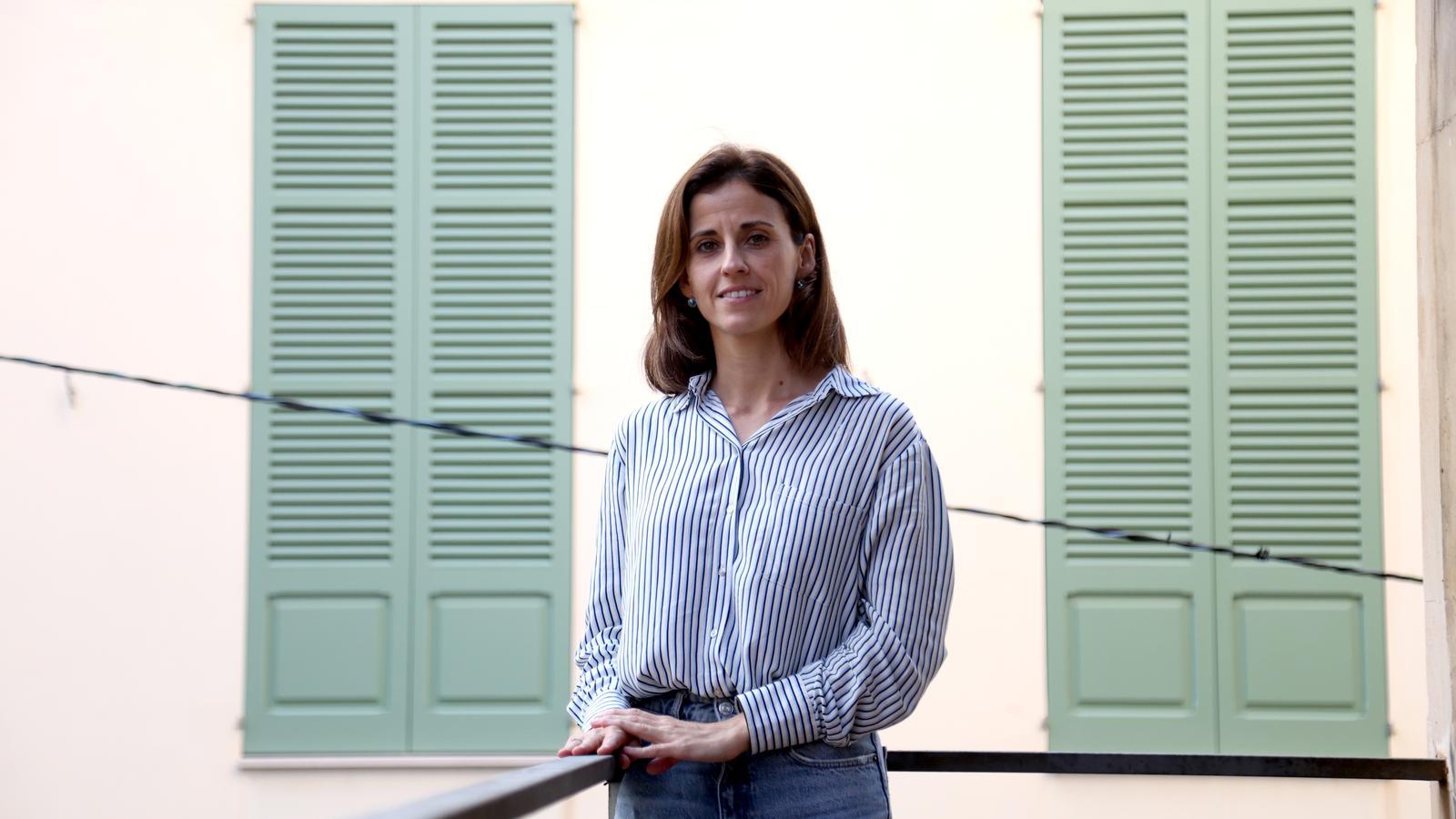
Maribel Cerezo: “I cannot define what is extreme right”
Vox Balears candidate for Congress

-
CAT -
CAST -
DE
PalmaThe announcement that Maribel Cerezo (1986) would lead the Vox list for Congress in the Balearic Islands surprised even the party's leadership on the Islands. A scientist by training, Cerezo set the condition that ARA Balears send her the questions in advance and showed up to the interview with the things she did not want to forget written down. She does not consider herself far-right and explains that she joined Vox after becoming a mother.
Your designation has been a surprise. Even Manuela Cañadas [spokesperson in Parliament] said she did not know you.
— I have been with Vox since 2019. I joined because, when my son was born, I said “What kind of world will I leave him?”. Vox was the one that gathered all the ideas I had and my principles. I started working with them because I was called as a member. Little by little I have become more involved. Since 2023 I have participated in several working groups. It has been more than a year since we have been on the Culture, Youth and Education committee. I am not known in the political sphere, because I have been in the shadows.
Were you hoping to head a list?
— No. To be part of it, yes, because I have a very versatile profile that can help in various areas. But I did not expect to head the Balearic Islands list.
You began your career in the Valencian Community. To what extent are you familiar with the reality of the Balearic Islands? How do you plan to defend the interests of the Islands in Congress within the ranks of a national-level party?
— I started living here in 2010, 16 years ago. I came here to do a PhD and I haven't left. I have built my adult life here, which is when you realize the real problems of day-to-day life. I am very aware of the real problems in the workplace, in the family, in education, etc. It is essential that those who have a problem on the scale of the Islands contact us. It cannot be that they see a deputy as something separate because they are in Madrid. I intend to do a lot of street work. In fact, I have no intention of living there.
Are you aware that many things will depend on party discipline?
— My intention is to take [to Congress] all our problems and, if we can, solve them all. There will be a lot of work.
What are the main problems you identify in the Balearic Islands?
— Here we have the problem, for example, right now, with the EMT. The money comes from the [national] government and the income is stalled. Right now, the EMT is in a complicated economic situation. If we want a good public transport service, they need to get their act together from Madrid. This income that should come is not arriving. So, in this regard, for example, it is a problem. Another problem we might have would be, for example, that they have also not paid the money for the roads. In the end, the roads are the responsibility of the province, of the autonomous community, but the money comes from Madrid and it has not been paid.
The roads are the responsibility of the island councils.
— This, about the councils.
There have also been thousands of people who have cried out for housing and living conditions. I do not know if you consider it a problem in the Islands.
— Yes, yes, yes. Housing, security, healthcare... I believe these are problems we share at a national level, they are not just from here on the island. They are not specific to the Balearic Islands. For example, in the Balearic Islands we have a problem, I believe, with housing, aggravated in comparison with other places on the Peninsula. It is what the island has. Millions of people have come in a very short time and very little has been built. This must be addressed and a solution provided. How? There are many fronts from which to attack this problem. One is the issue of trying to get those who have properties to put them on the market. How do we achieve this? By toughening the squatting law, for example, for those who do not pay or occupy. And by providing tax incentives to the owner who puts a home up for rent. And, of course, that more can be built. One of the great pillars of the program is to reduce the issue of bureaucracy, deregulation.
You talk about occupation, but you do not mention the role of speculation in the rise of housing prices. Do you think something should be done about it?
— I believe that here a solution is social housing. And what Vox says is that roots will be rewarded in order to be able to buy [social] housing. Therefore, I believe that this type of construction must be favored, which is really the housing that the average citizen needs. A normal person cannot get into a home in the Balearic Islands at the current price. I believe that this initiative is included in the program and I believe in it a lot. I hope that hopefully it could be done, because I believe it is this, roots, that must reward access to housing, especially social housing, with decent prices that allow people to access it and live decently here in the Balearic Islands.
You have a scientific profile. Do you consider that Vox's position on climate change and its causes aligns with the criteria of the scientific community?
— Let's see... Vox, and I tell you this, is not a denialist. If Vox were a denialist, I would not be going as head [of the list] to Congress for the Balearic Islands, because I would not have been put in this position. Vox does not deny climate change, what it does deny is the climate emergency. Climate change has been used as a political tool to justify certain laws that pressure our producers, ranchers, farmers, and entrepreneurs. The product is more expensive because of all this regulation surrounding the 2030 Agenda, which is justified by climate change. On the other hand, we allow the entry of foreign products that have a much higher carbon footprint than local ones, which are manufactured under quality standards that have nothing to do with the Spanish ones and which also do not pass health checks. We are fostering unfair competition with the tool of climate change.
Don't you believe we are in a climate emergency situation?
— No, I do not think so. The temperature increase is indeed happening, because it is a natural process. But Spain has CO2 emissions that are not comparable with those of other countries. We represent less than 1% of the world total and we are being punished.
The emergency is planetary.
— But global change implies many more things such as, for example, ocean pollution. This is where the problem must be primarily attacked, on pollution. It is very easy to impose an equivalent CO2 tax and collect it. Then we set aside other problems. I do not believe that the climate is rising in an exaggerated way, nor in an emergency. It is true that by looking at the data from the IPCC [Intergovernmental Panel on Climate Change] we will see that this temperature increase is not happening as quickly or as high as was initially thought.
Many scientists warn about the speed and intensity of climate change.
— I will not get into the subject of which studies are published and which are not. That is another debate.
Do you think that Spanish is a minoritized language in the Balearic Islands?
— Look, I believe that just as with climate change we cannot play politics, language should not be a political tool. The only thing it does is divide society. I can say that I see that with Spanish, in certain spheres, there is an attempt to diminish its importance or an attempt to impose other languages over it. And I believe in language freedom, that both Spanish and regional languages should be on equal footing. Being bilingual is a great privilege, as has been cognitively demonstrated. Therefore, every family must be able to choose in which language they want to educate their children. Not all families choose for their children to study regional languages.
Do you consider yourselves far-right?
— I do not consider myself far-right, nor do I consider my party to be far-right. Vox right now is a party of extreme necessity. It is necessary for it to govern because our goal is to oust Sánchez and his entourage of corrupt individuals.
What is the extreme right to you?
— Here we enter into what is far-right and what is far-left. I cannot define it for you. Neither can I define it for you, nor will I give examples of it.
What do you think about the fact that Vox ends up being the crutch of the PP?
— Vox is running in the elections to win and govern. If the PP is willing to accept all of our measures and all of our proposals, of course they will find Vox willing to reach an agreement. What Vox will not allow is for the PP not to support our proposals. Vox wants to change everything we currently have in Spain.
All of them? Are you not planning to give up anything if you negotiate?
— Of course. I cannot say which ones, because we are not on the negotiating team. I wish I could be, but I will not be. However, there are red lines that Vox will not let pass.
What do you think about measures taken in the Valencian Community such as cutting the emergency budget and increasing the money allocated to bullfighting?
— I did not see this measure because I was not in the Valencian Community reviewing their budgets. I can tell you, however, that there are a great many emergency plans that Vox pushed forward.
For example?
— The fire plan developed by the Department of Agriculture, Livestock and Fisheries under the mandate of José Luis Aguirre.
How do you see the relationship between PP and Vox in the Balearic Islands?
— This is a matter for the Parliament and those who are there to assess it. I will work with Vox in Congress and on the needs of the Balearic Islands.
Do you believe that the solution to immigration problems is remigration?
— Vox says that we need national priority and the remigration of people who are committing crimes or are in our country illegally. Vox proposes three things: repatriating people who are in Spain illegally and who have entered without permission; remigrating people who thought they would prosper in Spain, who live off income and aid without having worked and it is proven that here they will not find the future that was promised to them; and deporting criminals, even if they have obtained citizenship. It cannot be that we have prisons full of foreigners whom we are supporting. We have a lot of insecurity on our streets. Criminality rose by 5.6% in 2025, and in the Balearic Islands it is seven times higher than the average for Spain.
Use three verbs: repatriate, re-emigrate and deport. What difference do you establish in each case?
— Look, deporting would be those people who are here, who are here legally, who have obtained their nationality, but who are committing crimes. Then I take them to their country. Repatriating is an illegal immigrant who comes and, the moment they come, I take them to their country.
The result is the same.
— Yes. It is making them foreigners in their own country. Totally. We are there, yes, yes, yes.
What discourse do you propose to employers who are demanding labor?
— We need prepared labor for the jobs that are being requested. The problem is that there are very many people of working age who are unemployed and have never worked.
Then if there are job offers...
— Well, but there are many people who live on benefits. If I need labor, I must make it easier for the person to come legally, without getting on a dinghy.
How many people live on benefits?
— I cannot give you a specific piece of data.
Does regularization not serve to bring order to these matters?
— No, because you don't know who you are regularizing. You cannot massively regularize the people who are entering without knowing who they are.
Identification and a criminal record certificate were required.
— It is questioned how this documentation was obtained. I do not trust it. It is questioned how they accessed all this documentation and how they accessed this legalization massively. If you do not know who you have here, how will you obtain their criminal record certificate?
The criminal record certificate is requested in the country of origin.
— But a country that encourages its own citizens to enter my country illegally... I can no longer trust the criminal record certificate paper it will give to the people it encourages to come.
Are you saying that other states can lie?
— Totally, totally. We cannot trust countries that take their armed forces to the border to facilitate those from their country entering ours.
If you are referring to Morocco, there are many people who come from many other countries.
— The thing is, of course, it has to be analyzed. Let me tell you something: we are not against nationalities.
The President of the Parliament, Gabriel Le Senne, will be tried for a hate crime. How are you experiencing this circumstance?
— I believe in justice and, of course, in the presumption of innocence. This issue has been used as a political tool to discredit him.
Have you seen the images of what happened?
— I will not go into that. I am not a judge, nor a lawyer.
The vice president of the Council of Mallorca is also under the scrutiny of justice, and Council reports point to an improper use of institutional vehicles.
— The courts are the ones that must reach a conclusion. What cannot be allowed is for justice to be used as a political tool to discredit and attack us, while those who have committed very serious crimes, such as Pedro Sánchez, his wife, Koldo, etc., are not being judged for the real crimes for which they must pay.
Ábalos and Koldo are in prison. And Pedro Sánchez is not charged with anything.
— Yes. But everyone should pay.
