The opposition attacks the second beltway: 240 million more than expected and "old concrete recipes"
The PSIB denounces that the budget has tripled without technical justification and MÉS warns that the road expansion will perpetuate the dependence on the car
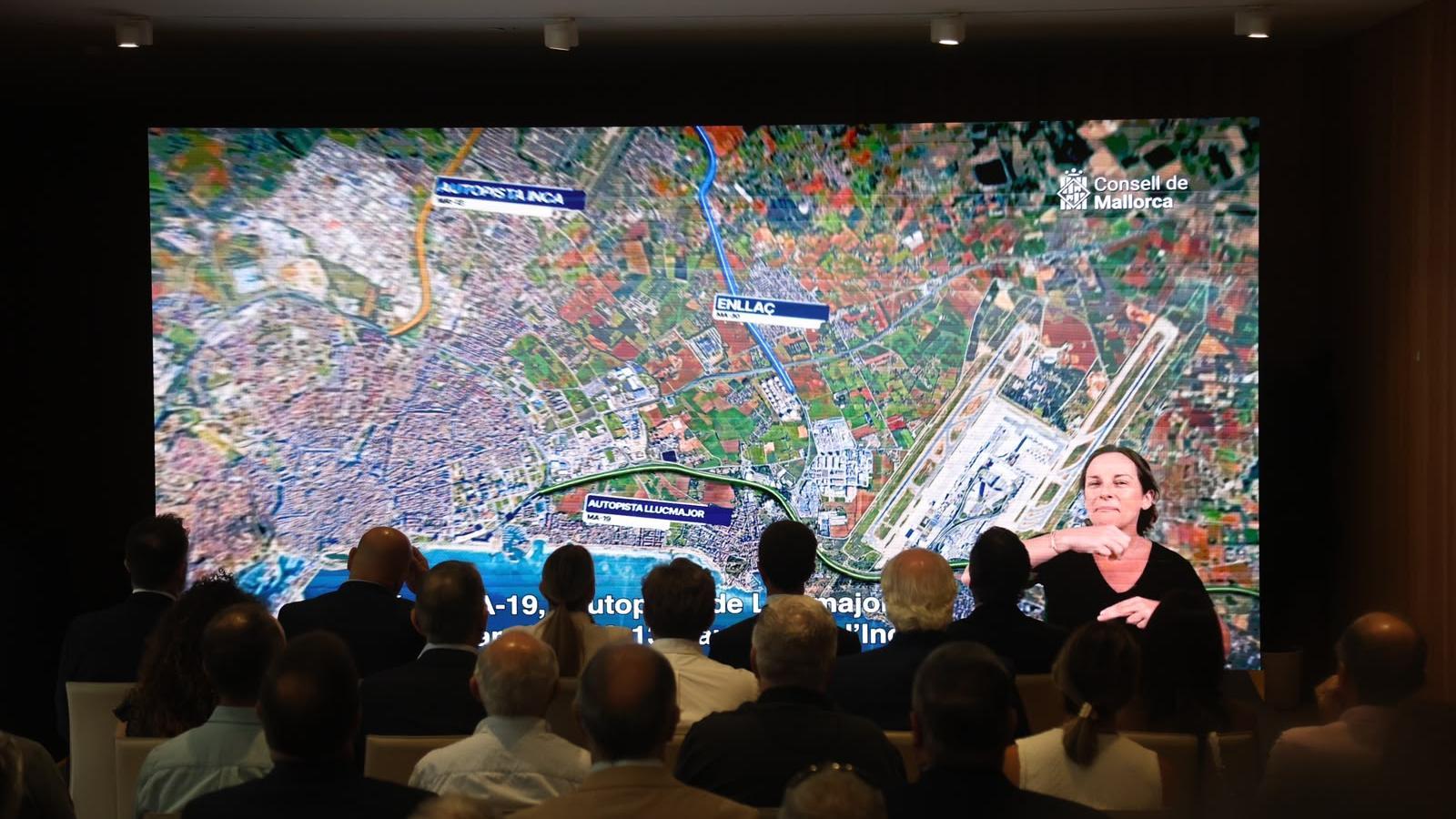
PalmaThe opposition parties in the Council of Mallorca, the PSIB-PSOE and MÉS per Mallorca, harshly criticize the project for phase I of the second ring road made public this Wednesday. The Council of Mallorca announced in 2024 an initial project for phase I of the second ring road in Palma valued at 110 million euros. The president of the island institution, Llorenç Galmés, appeared this Wednesday accompanied by the president of the Government and the mayor of Palma to present the definitive project, which has been budgeted at 350 million euros.
The PSIB-PSOE did not take long to react and is already speaking of an “unjustifiable cost overrun”. They denounce that the project has become 240 million euros more expensive “without any clear technical explanation”. Therefore, the socialist councilor, Jaume Mateu, demands that “it be clarified why the estimated cost of the works has tripled”. They accuse Galmés of managing public resources in an “irresponsible” manner and consider that this 218% increase “confirms the lack of concern with which Galmés treats public resources”.
The councilor also points out that “there is no substantial change in the project that explains why a work presented two years ago for 110 million now costs 350”. They assert that the project presented in 2024 already included the tunnel, the roundabouts, the boulevard, and the cycling connections, and that the current version does not incorporate any structural element that justifies such an extraordinary increase in the budget.
For this reason, the PSIB-PSOE has announced that it will request the technical and economic documentation of the project to clarify the reasons for this increase and with the aim of ensuring that public resources are managed responsibly.
The socialists also criticize the “electoralist stench” of the project presentation act this Wednesday at the Palma Congress Palace and describe it as a “pre-campaign pamphlet” by the Popular Party, instead of an institutional act. “Three presidents to take a photo and present a project that we already knew about and that now, furthermore, triples the initial cost. It is a staging designed for campaigning, not for informing the citizenry,” pointed out Mateu.
MÉS per Mallorca: “The PP is once again imposing the old recipes of concrete”
MÉS per Mallorca has also harshly criticized the project for the first section of Palma's second ring road. “Mallorca cannot continue to be trapped within the same mobility model” which implies “more roads, more cars, and more gridlock.” Regional minister Joan Llodrà denounces that the Popular Party “is once again imposing the old recipes of concrete and big roads, as if expanding road capacity were the only possible answer to traffic jams.” A solution that, they claim, will not solve the dependency on private vehicles.
Regarding the cost of the project, the eco-sovereigntists assert that “the PP insists on spending a fortune on asphalt” and demand that “with 350 million euros we could move towards a Mallorca with more trains, more buses, and better connections,” a commitment so that citizens can travel without having to depend obligatorily on private vehicles.
Llodrà also questions that the Council and the Government present the project as a solution to the gridlock “without explaining what measures will be implemented to prevent the increase in road capacity from ending up attracting more traffic. If the only answer is to build more roads, we will remain trapped within the same circle.”
In this sense, they warn of the territorial and environmental consequences of an infrastructure like the one presented this Wednesday. “We cannot continue treating Mallorca as if it were an infinite road. We do not need more promises of fluidity that condemn us to continue inside the car,” they conclude.
