Vox turns Ibiza into its spearhead in the Balearics
On one side, 1,500 people to adore Abascal; on the other, about ten teenagers with banners and slogans like ‘Yes to ‘The black ball’’

-
CAT -
CAST -
DE
IbizaWhat is happening in Ibiza with the far-right? Historically, Vox has recorded quite poor results on the island: both in the 2019 and 2023 general elections, Vox was 2.5% below the Balearic average. But last October 24th, the party made a show of force in Ibiza. Of the three rallies led by Santiago Abascal in the Islands between October 23rd and 24th (Maó, Palma, and Ibiza), the one in Ibiza was the largest according to various sources, with between 1,500 and 2,000 attendees; the Santa Llúcia bastion, the largest of the seven that defend the walls of Vila, was filled. That is a lot of people.
A figure that even seems beyond the reach of the omnipotent Ibizan PP: during his last visit to the largest of the Pityusic Islands in 2023, Feijóo gathered a scarce thousand sympathizers. And it must be considered that the PP is a party with a historic and very strong rooting throughout the island.
That is not the case for Vox. Vox has practically no structure in Ibiza. Its leaders dedicate themselves to invisibility, to just getting by; somewhat as if the problems of the Ibizans were not their business. So, where do the 1,500 attendees at the rally come from? Why this Ibizan furor with Vox?
The answer, after the announcements
Before answering, let's have a bit of propaganda. An image of Abascal's rally in Ibiza has been posted for days on the Vox website as the main photo. I will try to describe it: the protagonist of the image, in the center, is facing away, waving; nevertheless, he is perfectly recognizable if you have seen him some time: it is Santiago Abascal; all eyes converge on him, he is the center, the only focus of attraction of the image; in the photo one can also see a lot of people, Spanish flags waving here and there. It is an amateur photo; it is crooked and not very well framed, but it is understood perfectly. On the Vox website, the main photo changes every couple of days, but it usually maintains a similar narrative: Abascal in the center and a crowd around him. The leader and the masses. And Spanish flags. The underlying message is this: “Abascal is the great leader, there are many who follow him, all united under a single flag”.
A bit more propaganda. Perhaps a good exercise is to compare the ‘Vox-style’ communication with that of the two major parties. Both in the case of the PP and the PSOE, the websites open with professional-quality photos. The one from the PSOE shows President Pedro Sánchez taking a selfie with an anonymous crowd around him, mostly young people; they are not well-known faces of the party. The message could be: “Sánchez is the leader of normal people, he is by their side and behaves like them”. The PP website opens with a very different image: Feijóo surrounded by his team, in the center; it is a well-ordered composition, everyone sitting, everyone facing the viewer; the participants smile, yes, but it is a very cold image if we compare it with those of the PSOE or Vox; it is the only one where everyone is a professional politician. I think it admits these three readings: “The PP is a well-structured organization and Feijóo is its center”, “We maintain order but we try to be liked” and, finally, “Feijóo is not alone”.
They are really three very different styles. Of the three ways of communicating, the PSOE's turns out to be the most predictable –it is the image that is expected from a more or less progressive profile–, the PP's is surprising for being so boring and formal; finally, the photos of Vox almost all distill a powerful aroma of cult of personality. The cult of personality has been, always and everywhere, a characteristic of any totalitarian regime. In fact, at the time of closing this writing, the six featured news items on the Vox website started with the same word: “Abascal”: Abascal defends..., Abascal claims..., Abascal accuses...
And, now yes, an attempt at an answer. What has happened specifically in Ibiza since 2023? Why does Vox gather 1,500 people at a rally? I offer you some hypotheses. What has happened is that the migration route between North Africa and the Pityusic Islands has become established – and the state government took too long to acknowledge it –; day in and day out, we read news about the arrival of migrant boats. This creates an environment very conducive to the discourse of "re-migration." What has happened is that an increasingly large sector of the population does not have access to decent housing or to services or goods that turn out to be too expensive. The problem is general but more acute in Ibiza: a scattering of illegal settlements gathers hundreds of people in substandard housing. Traditional parties have been incapable of either avoiding this scourge or providing citizens with a roof. What has happened is that the public education system has continued to degrade, in the Balearic Islands in general (as the PISA report records) and I believe very especially in Ibiza. If 15-year-old kids struggle to understand a simple text, one cannot expect that when they are 18 they will all be aware and democratic citizens.
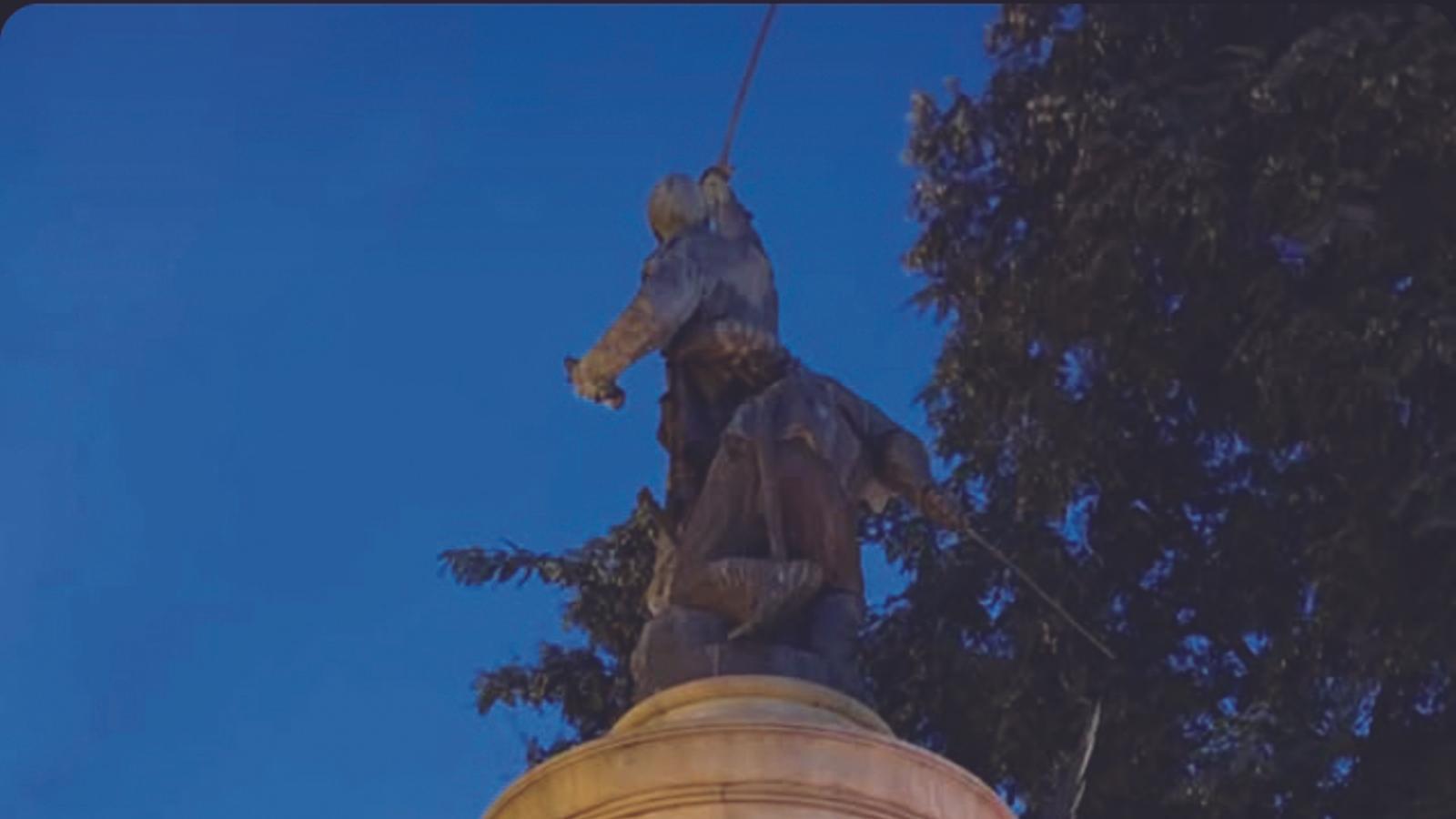
And, in general, it happens that many people are very lost. And, when humans do not know where the shots will come from, they tend to opt for strong leadership and simple ideas. The Vox rally in Ibiza left the image of the Santa Llúcia bastion packed to the rafters to listen to the charismatic leader. It also left another image, much less disseminated: a small group of about a dozen teenagers with signs and slogans like ‘Ibiza is not Vox’s’ and ‘Yes to The black ball’. The police denied them access to the bastion. So the group went to demonstrate at the Vara de Rey statue. It is true: a dozen is few. But, right now, they are the resistance. I, if I were Vox, would start to fear them. They may be few, but they are not cowards.
