After the judicial victory, the Jeronimas propose a religious, social, or educational future for the convent
The Federation of Jeronymite Nuns' Monasteries prioritizes a religious use for the Palma convent after the Supreme Court has ratified its ownership and does not rule out dedicating it to social or educational purposes
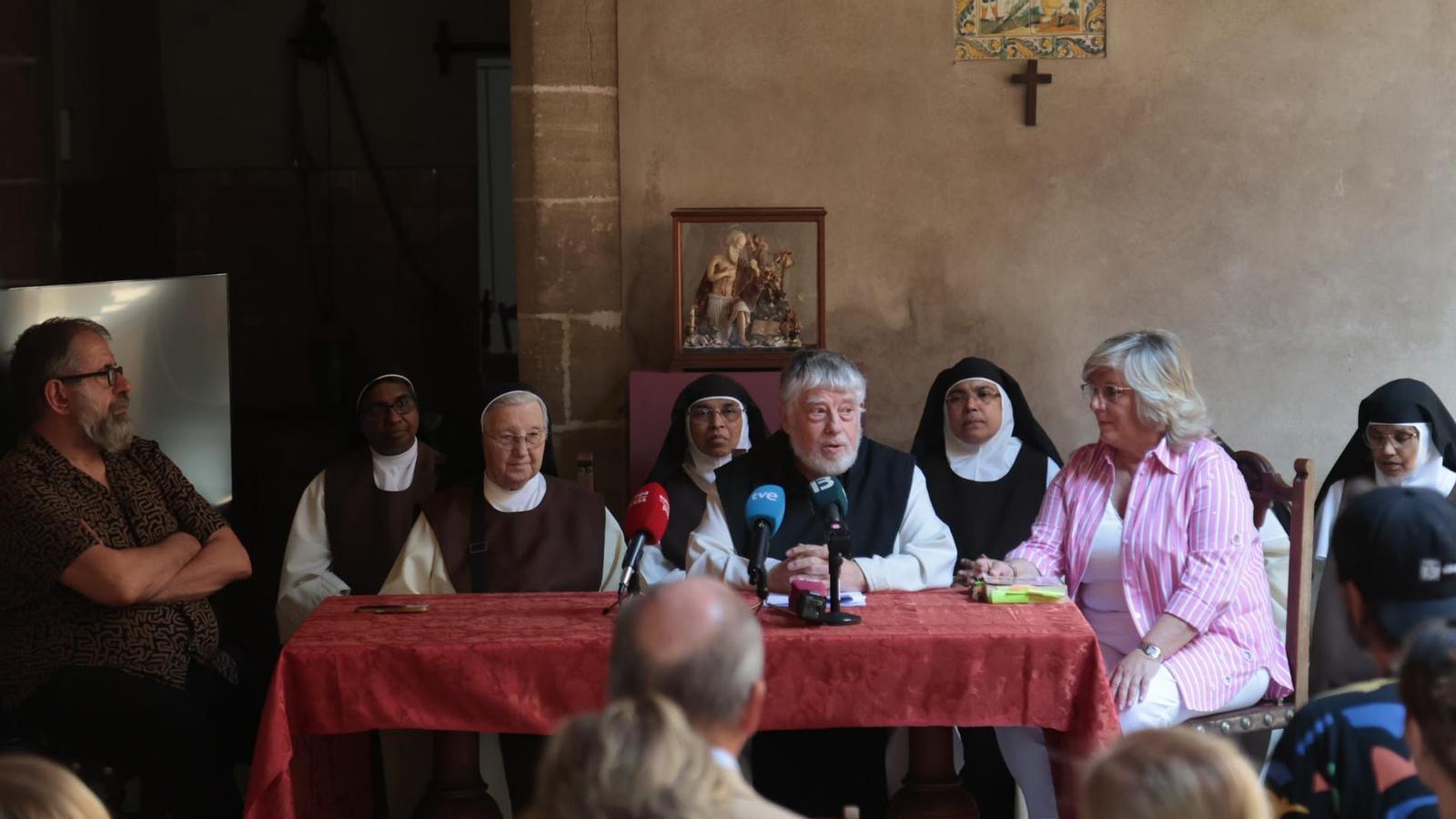

PalmaThe Federation of Monasteries of Hieronymite Nuns of Santa Paula is studying the future of the Santa Elisabet de Palma monastery and has made it clear that they will prioritize its use for religious purposes, if possible, to house a community of nuns. Among other options, they have pointed to the possibility of dedicating the convent to social or educational use, as Saint Jerome was dedicated to teaching Christian morality. In any case, the order of the Hieronymites is clear that the convent will not, under any circumstances, be converted into a hotel, and they have pointed to this possibility as an "unfounded rumor" from the time of Bishop Javier Salinas.
This analysis of the future comes after the Supreme Court dismissed the appeal for cassation filed by the Bishopric of Mallorca against the ruling of the Provincial Court which recognizes that the Hieronymite nuns are the owners of the convent located at the gates of the Calatrava neighborhood. This was explained this Tuesday by the president of the Federation and prioress of the monastery, Ángeles Sanz, and the lawyer who has represented the nuns for the twelve years the litigation has lasted to clarify the ownership of the building, Maria del Pilar Rosselló.

"An era is ending and, with all our hope, we are opening another where we begin to work together with the Council. We will surely find a good purpose for this sacred place," said the nun. In this regard, the lawyer celebrated that the judicial process has ended with a true triumph and allows for new paths to be opened to determine the future of Santa Elisabet. "We have just come out of the lawsuit and the question of what will house the property still needs to be studied," explained Rosselló, who pointed to some options that could be carried out, taking into account the legal and patrimonial characteristics of the place, since the lawyer recalled that the Jerónimas are an order governed by pontifical law. That is, any process related to the monastery, whether for sale or rent, will be supervised, tutored, and overseen by the Holy See.

In this context, he referred to the guidelines that the Holy See gives for governing the legal life of religious institutions under its mandate. "These instructions make it clear that these stones, this art, speak and have an evangelizing function. And, therefore, the indication to maintain, if possible, religious life is insisted upon. And if not, to seek a destination that is compatible with the order's plan," he pointed out. The Holy See, he continued, allows different solutions for this type of historic buildings as long as they allow "the raison d'être" of the religious order "to survive in another way". "Whether it is by reconciling worship in the Church, attention to artistic and historical heritage, or by reconciling a social, educational destination compatible with this survival of the charismatic plan," the lawyer emphasized.

The only project that over the past decade, during which the ownership of the property has been pending a judicial resolution, has been presented, they explained, was the one presented by the entity Amadip Esment, which works with people with intellectual disabilities.
It has also opened up to other possibilities, such as reconciling a university use, "it would be fantastic," he added, with the exhibition of the "very valuable" collections of sacred art that the Jeronymite order treasures. "There can be many legal formulas, whether it's a cession of use, a rental...", pointed out Rosselló. In a similar vein, the Cistercian monk and religious assistant of the Jeronymite Federation of Santa Paula, Enrique Triguero, expressed himself, who entrusted the future of the property to God.
"The ideal is for a community of Jeronymite nuns to live here. God seems to bless some communities of the order with vocations. In the future, not in the near future but in the medium term, this possibility could be considered. But in the meantime, we will have to see the process, because right now nothing is planned," he pointed out. Nor has he ruled out the possibility that nuns from another religious congregation could establish themselves in the monastery, for which it would be necessary to open a process of dialogue with the Diocese of Mallorca which, for the moment, has not even been considered.
The curator, restorer and head of Fine Arts of Santa Elisabet, Pere Terrasa, has assured that the structure of the property is in good condition thanks to the work carried out over all these years. "Could a congregation be installed there tomorrow? Yes. It is not a modern monastery, it is true, but one can live there," he affirmed.
The structure of the building and the heritage, in good condition
Terrasa has also reviewed his work on the preservation of the artistic, cultural and historical heritage of the Monastery of Santa Elisabet, with which he has worked in recent years, which he has assured is in good condition.
Three inventories have been drawn up, one of painting and sculpture, another of 15th-century altars, and another of liturgical vestments, which are in the hands of both the Consell de Mallorca – the highest authority in heritage policies – and the Holy See. In addition, work is being done on one of ceramics and another on furniture. This is complemented by the restoration of a wall or the roof, which was affected by a whirlwind. Also, several paintings, such as those by Ramon Llull, Sant Honorat and Sant Antoni, and the embroideries by Antoni Gaudí, which have been the subject of various exhibitions. The archive and works of art were temporarily transferred to the chapter house of Inca, where it is in "good condition". "Things are not mixed up, as they say. The work has been carried out with diligence and professionalism," he concluded.
