
In the past, many churches used to have sundials on their facades as a complement to their bell towers. The ringing of the bells was considered the ‘voice of God’. They not only served to announce the canonical hours for prayer, but also to regulate civic life. It was the main communication channel in an era when there were neither mobile phones nor social networks. The bell tolls were different depending on the announcement to be transmitted: the death of a child under 7 years old (the well-known ‘infants albats’), the celebration of a funeral and popular festivals, the alert of any emergency, such as pirate attacks, fires, storms, etc.Each town had a bell ringer. Each had their own peculiar way of ringing. The profession gradually disappeared in the 20th century with the progressive electrification of the bells. With technological sophistication, a rich sonorous heritage that had marked the lives of so many people also died out. In 2022, UNESCO declared the manual ringing of bells as Intangible Heritage of Humanity. Today, in some towns where it is electric, there have been cases of tourists complaining at night that the sound of the bell towers does not let them sleep.In 1283, the first mechanical clock in the world was installed in the abbey of Dunstable (England). Connected to the temple bell, it did not show the time, but only made it sound. From this era, in French, the word ‘cloche’ (‘bell’) for clock was born, which was also reproduced in English as ‘clock’. It was from the 14th century onwards that time could be visually displayed thanks to the introduction of a hand within a numerical dial, devised by the Italian astrologer Jacobo Dondi. The 14th century was also when bell towers with mechanical clocks began to be built in civil buildings. The first in the Spanish state was that of the Palma City Hall, in 1386. Its bell was called Figuera after its builder, the silversmith Pere Joan Figuera.The 14th-century bourgeoisie also rivaled the Church for the monopoly of time. They did not hesitate to build their own bell towers with mechanical clocks so that their workers would be well aware of the bell tolls that were to mark their working day. Thus, time not only became independent of the Sun, but was also ‘secularized’.In current capitalist society, clocks are omnipresent: on wrists, on mobile phones, on computers... Chronocracy, the dictatorship of time, has imposed itself, forcing us to make any hour of our lives profitable, even those of leisure – there are already gyms open 24 hours a day, seven days a week. This is a denunciation that the British writer Lewis Carroll already made in 1871 in Alice in Wonderland (1871). A white rabbit appears, tormented by haste, constantly looking at his pocket watch and complaining about not having time.
Mallorca, the paradise of sundials
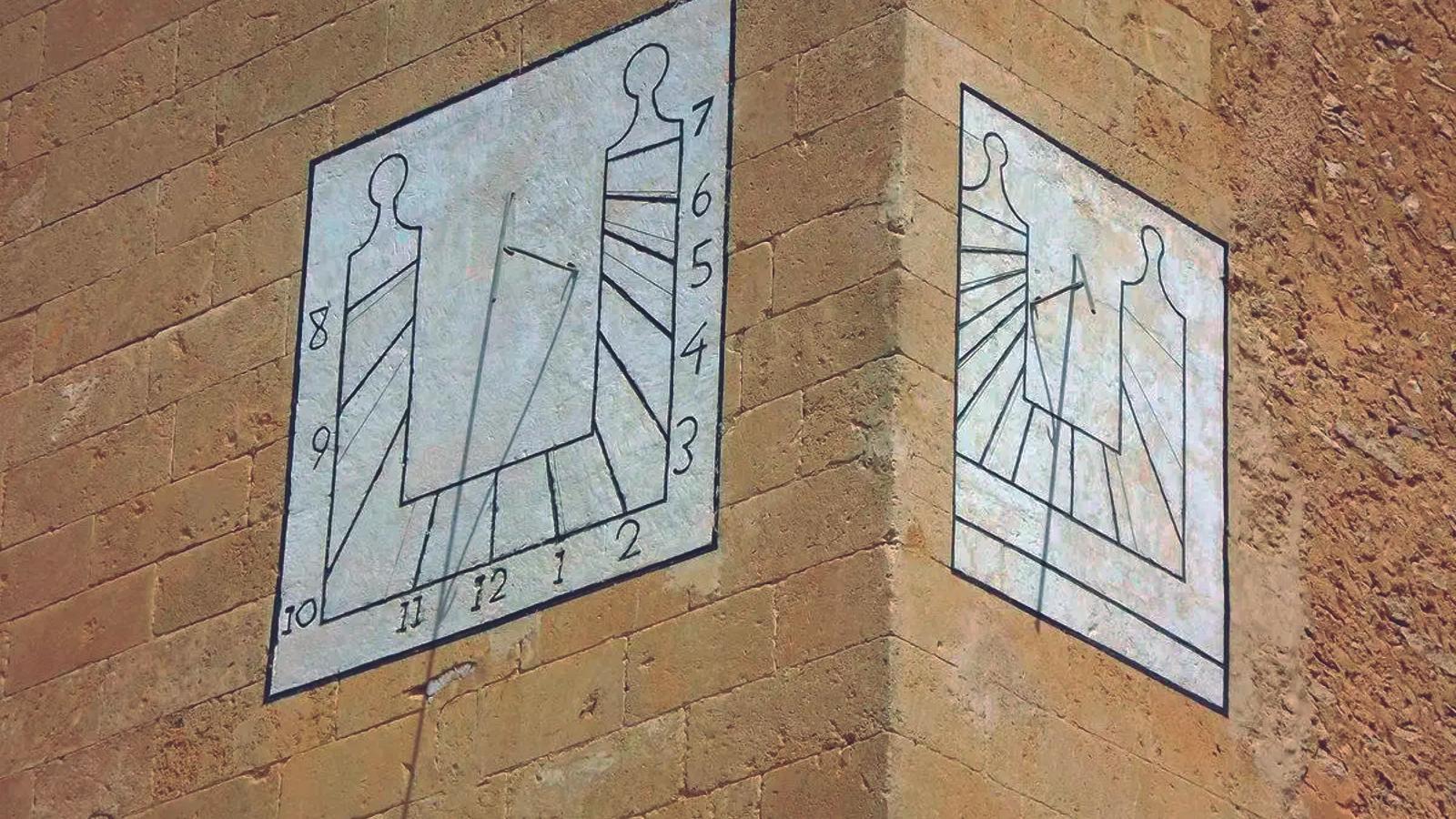
The island is one of the regions in the world with the most solar clocks for telling time, close to 1,300. The oldest preserved is from the 16th century. The vast majority are in very poor condition. Today the entity ARCA fights for their architectural protection

-
CAT -
CAST -
GER
PalmaThe beginnings of humanity were marked by the Sun. People worked 'from sunrise to sunset' to earn a living, a word that derives from the Latin adjective 'diurnus' ('daily'). As they became sedentary, various ancient cultures set out to follow the movements of the king of the stars in order to organize themselves better. They did this by measuring their shadows with a stick stuck in the ground. In Greek, this stick would be known as a gnomon, from which comes the term 'gnomonics', the art of building sundials. Thus began the process of domesticating time. For us, that astronomical invention would arrive with the name of clock also from another Greek word, 'horológion' ('hour indicator').
During the Sun's transit from east to west, the shadow projected through the gnomon, which in ancient Egypt could also be an obelisk, kept changing, which allowed time to be divided into three parts (dawn, noon, and dusk). With the Romans, sundials became popular on the facades of buildings. In Mallorca there are nearly 1,300, 112 of which are located in Palma. This is according to data from the inventory compiled in 2006 by Miguel Ángel García Arrando, a 72-year-old retired draftsman, a member of ARCA (Association for the Revitalization of Old Town Centers). 'Our island - he says - is one of the regions in the world with the most sundials per square meter. This is because we are a superpopulated territory. Since the Catalan conquest in the 13th century, Mallorca was gradually filled with constructions, both in Palma, with its noble houses, and in the countryside, with the well-known estates. The same did not happen in Menorca and Ibiza. Many of these constructions would eventually incorporate a sundial, generally facing south. However, the oldest one preserved is from the 16th century and is located in Santa Margalida. There are none left from earlier periods'.
The Majorcan Babylonian hours
At least, buildings usually had two solar instruments: one on the main facade for people working outside and another in the cloister, for the residents. “There – points out the researcher – where there are more is in Palma and in the south of the island, especially in Llucmajor and Felanitx. The author of many is unknown”. Hung on the walls, the sundials would change the horizontality of their beginnings for verticality. A perpendicular gnomon projected its shadow onto a surface, called a quadrant, which was divided into 12 equal parts. This division, which also extended to the night, came from the duodecimal enumeration of the Sumerians, for whom the hand was the first calculator. With their thumb, they counted the phalanges of the rest of the fingers of one hand. The total sum was twelve. With the five fingers of the other hand, they kept track of that operation, which would lay the foundations for the sexagesimal system (5 x 12 = 60), the skeleton of the future 60 seconds and 60 minutes.
“In Mallorca –García assures– sundials had a peculiar time system, the well-known Mallorcan Babylonian hours. The 24 hours of the day were not counted from one dawn to the next, as was done elsewhere, following the model of the inhabitants of Mesopotamia, nor from sunset to sunset, in the Italian way (Italic hours). It was a mixed system. During solar hours, the Babylonian enumeration was used, and during the night, through the bell towers, the Italic one. The population never came to understand that kind of computation, which varied depending on whether it was summer or winter. This is demonstrated by the expression: ‘This is more complicated than Mallorcan hours!’”.
During the Middle Ages, the sundials of some convents and churches only had the hours corresponding to prayer times marked. These were the well-known canonical hours, which were in tune with the Benedictine rule ‘ora et labora’ (‘pray and work’). Initially, there was ‘prima’ (when dawn appeared), ‘tertia’ (mid-morning), ‘sexta’ (midday, which was the hottest part of the day when people took their nap or siesta) and ‘nona’ (until sunset, from which comes the expression ‘anar a fer nones’ to tell a child they have to go to sleep; the English term ‘afternoon’ refers to the same old time period). At night, four more would be added: ‘matines’ (around 3 AM), ‘laudes’ (at dawn), ‘vespers’ (at sunset), and ‘completes’ (before going to sleep). As there was no sun, these night hours were counted with other instruments such as a candle – the hour was marked by its consumption – or the clepsydra (‘water thief’ in Greek), consisting of a container of water that dripped into another – the hour was marked when it was full.

‘Sic vita fugit’
In Mallorca, the majority of sundials indicated the time with Arabic numerals, which from the 15th century onwards displaced the Roman ones. There were two types: those that were placed above the roofs, which were smaller, and those that were carved into the walls. Some of these were accompanied by Latin sayings, which mainly recalled the fleetingness of life: ‘sic vita fugit’ (‘thus life flees’), ‘morior cum sol moritur’ (‘I die when the sun dies’), ‘ultima multis umbra’ (‘the last shadow for many’) and ‘brevis sunt dies hominis’ (‘short are the days of man’), among others. On the Peninsula, the repertoire was more classical: ‘omnes vulnerant, ultima necat’ (‘all hours wound, the last kills’), ‘mors certa, hora incerta’ (‘certain death, uncertain hour’), ‘memento mori’ (‘remember you must die’), ‘tempus fugit’ (‘time flees’), ‘carpe diem’ (‘seize the day’)... There were also some in Catalan such as ‘who passes a day, pushes a year’ and ‘hours pass, works remain’.
Sundials presented a series of problems. “Since summer is the time of most sunlight – notes García–, there were not twelve daylight hours, but fifteen. Furthermore, local time could vary greatly from one point to another depending on its location. In the case of the two extremes of Mallorca, Artà and Andratx, the difference was very noticeable.” Located in the southwest, Andratx has a sun on its coat of arms to indicate precisely that it is the last village on the island to see the Sun before it sets. Sóller also has one, although its presence is related to a popular etymology of the toponym.
In the countryside, day laborers who worked far from the estates could not see the sundials or hear the bell tolls. However, they calculated the time by the different positions of the king star in relation to cliffs, rocks, caves, or vegetation. The main natural time reference was midday. This is reflected in the toponymy in names such as puig del Migdia (Andratx, Calvià); penyal del Migdia (Fornalutx, Valldemossa, Banyalbufar, Andratx, Calvià); penya del Migdia (Puigpunyent, Pollença, Alcúdia, Bunyola, Selva, Escorca); roca del Migdia (Estellencs); cova del Migdia (Algaida) and comellar del Migdia (Esporles).
Broken life rhythms
In the 18th century, during the Age of Enlightenment, sundials were a symbol of knowledge and progress. Soon, however, they would be replaced by mechanical ones. It was the triumph of the known mean solar time (artificial) over true solar time – which corresponded to the Earth's transition around the Sun and the inclination of the axis of rotation with respect to the plane of the ecliptic. During the Industrial Revolution, mechanical clocks would preside over the walls of many factories. The proletariat, who worked in shifts – day and night – never lost sight of it. From a capitalist perspective, hours were a source of profit. There was, therefore, no time to lose. Thus was born the maxim 'time is money'.
In the 19th century, the arrival of the train in Mallorca also imposed mechanical clocks on the facades of many stations – by then Europe had already adopted a common, synchronized time system. Travelers had to pay close attention to them. ‘The train waits for no one,’ said a popular saying. At the beginning of the 20th century, the advent of electricity would forever break people's life rhythms, who before, when guided by solar time, did not sleep in one go, but in two phases, in what is known as biphasic sleep. After a long workday, they went to bed shortly after sunset and woke up naturally at midnight, a moment they used to pray, converse, or do small household chores. Two hours later, they went back to sleep until dawn and woke up again to the crowing of the rooster.
In the 1980s, some parts of Palma, such as Portitxol and the Passeig Marítim, were decorated with monumental sundials, while the old ones fell into oblivion. Today, their architectural protection is a priority for ARCA. “More than half – concludes García – are in very poor condition. When a facade has been renovated, they have been hidden or rebuilt in any way. Now, after 30 years of work, our goal is to also inventory the sundials of Menorca and the Pitiuses. We have an impressive gnomonic heritage that we must reclaim.”
