Difficulty 2 out of 5Distance 12.18 kmElevation gain 22 mDuration 2 h 45 minMaximum altitude 124 mCircular route
Biniali, a long and meaningful walk through a sea of vineyards
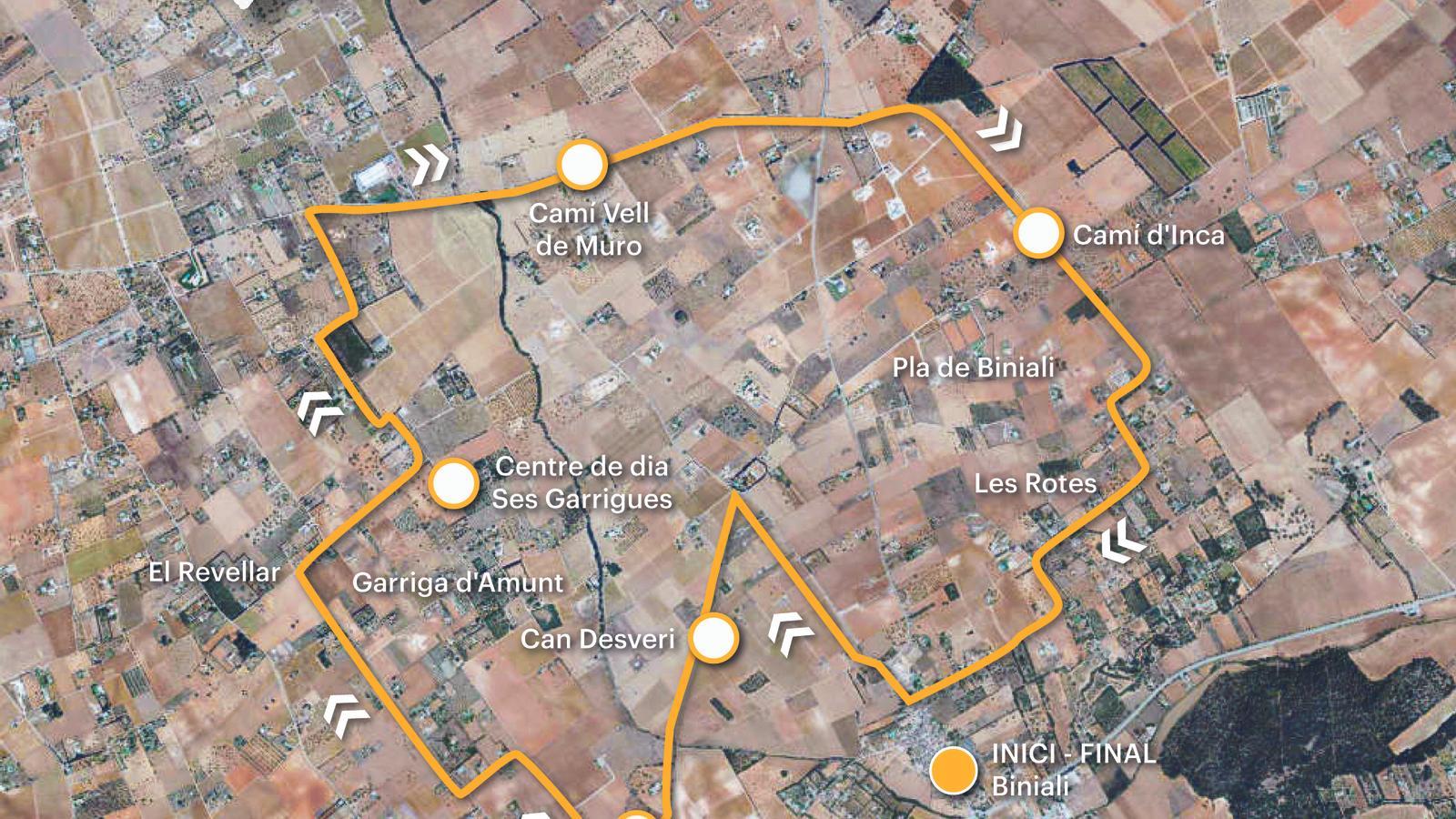
Circular itinerary around Biniali through paths dressed with vines from which 'the blood of the earth' of the DO Binissalem springs
15/05/2026 - 20:31 h
-
CAT -
CAST -
DE
PalmaOn the border between the regions of Pla and Raiguer in Mallorca, we find the small town of Biniali, in the municipality of Sencelles. Its surroundings are dressed in a deep sea of vines from which flows 'the blood of the earth' (an expression borrowed from the great poetess Antonina Canyelles), a sea of vineyards where the craftsmanship of wineries with long history and enormous prestige is breathed. It is no coincidence that we are in one of the most important wine-growing areas of Mallorca, with great tradition and quality. The Designation of Origin (DO) Binissalem, recognized in 1990, brings together a dozen small and medium-sized wineries, of family tradition, spread across the municipalities of Santa Maria del Camí, Consell, Binissalem, Santa Eugènia, and Sencelles, with a total area of 154.75 km2. The wines produced in these lands of Pla and Raiguer enjoy great Spanish and international recognition.
Literature and Biniali are one and the same. Few hamlets in Mallorca can boast of being such an extraordinary setting for the art of words as this one. The journalist and writer Joan Ramis d’Ayreflor i Saura (Ciutadella, 1881-Palma, 1956) was linked to Sencelles as a member of the family that owned the Ayreflor estate. Part of the childhood of the poet and writer Jaume Pomar Llambias (Palma, 1943-2013) took place in the village of Biniali, specifically in a house on Carrer de l’Estrella (No. 6). This relationship with the hamlet led to it appearing transformed in his work under the literary name of Mosafat. Finally, the novelist Maria Antònia Oliver (Manacor 1946-Biniali, 2022), although a resident of Barcelona since 1969, bought with her husband, the writer Jaume Fuster, at the end of the seventies the house known as So n’Arrom, at number 1 on Carrer del Pou. (source: visitsencelles.com)
As always, we recommend using public transport. Line 304 (Inca-Sencelles-Palma) of the Consorci de Transports de Mallorca (check routes, schedules, and availability on the website tib.org) stops in Biniali, right at the entrance to the village (km 8.2 / Ma-3020).
The route
[00 min] Our starting point is located in front of the parish church of Sant Cristòfol, a 17th-century temple about which a beautiful legend circulates, collected by Antoni M. Alcover, in his collection of Rondalles Mallorquines, titled 'Es peu de sant Cristòfol'. It seems that while going from Llucmajor to Algaida, the saint stumbled with the Puig de l'Heretat, in the Serra de Galdent. From the first fall he left the jagged rock; from the second, he marked his foot on a rock in Porrassar, behind the town of Algaida; and from the third, he landed on top of the bell tower of Biniali, and remained there as patron.

Having heard the story, we begin the trek with the echoes of the words of Maria Antònia Oliver, a neighbour of the church, in an article published in 2006 in VilaWeb titled ‘My Village’: “It is a small village, elongated on both sides of a very secondary road, which serves as the main street. Perpendicular to this street (which has several names) are eight or ten alleyways that lead to the outskirts. There is a very beautiful and very large church (like in all the villages of Mallorca) from the 18th century. It has two lovely little squares. There is a grocery store, which is also a tobacco shop, three bars, and a restaurant. There is no bank (for money) nor a supermarket, nor a dollar store. No police nor municipal officers. There is no town hall because it is a hamlet. On most maps of the Balearic Islands, it does not appear. That is fortunate. If you see any tourists, it is because they are lost. Registered residents, we are about 160. You can almost always find parking spots”.
We start walking from in front of the parish church along Carrer Major, heading north, until we reach Plaça de la Concepció, the heart of the hamlet. In the very center, surrounded by buildings of notable historical value, stands a monument dedicated to the Immaculate Conception, begun in 1854 by Father Gabriel Ribas de Pina i Gallard and finished in 1918 by Father Gabriel Ribas de Pina i Conrado, as we can read on a plaque. Carrer Major changes its name to Carrer d’en Fiol. We leave aside Bar Centro, the house of Son Raió, and also Carrer de Sant Joan, on the right, where we will return. Just leaving the village, on the left side, we find the Binigrau winery [10 min]. Here, we leave the road to Binissalem (Ma-3021) on the right and continue straight ahead along the path of Consell de Biniali.
The path advances pleasantly and quietly among the first vines, the main protagonists of the area and the route. [15 min] We arrive at an important crossroads, on the right the path of Puputs and on the left the lane of La Torre, along which our trek now continues. Oriented to the south, we advance fully among vineyards; those on the left, Can Desveri, belong to the Jaume Bennàssar wineries. The stretch leads us to cross the torrent of Solleric [30 min], where, already within the municipality of Santa Eugènia, we regain the asphalt until a new fork appears. The lane of La Torre turns right, past the old Hort de la Torre, where our route continues, again on a dirt track.
We advance until we find the first path on the left. We skirt the estates of Sa Vinya and Villa Pelayo and emerge onto the road to l’Hostalet, where we turn right. The stretch is again asphalted and surrounded by vineyards, we follow it to the end, with the Serra de Tramuntana directly in front of us. Where it ends [1 h 00 min], known as El Revellar, we turn right. The flock advances through the extensive territory known as La Garriga d’Amunt. We walk on asphalt oriented towards the northeast until the next fork [1 h 10 min]. We leave on the right the access road to the residence and day center Ses Garrigues, and we turn left. After a double bend, the flock – now within the municipality of Consell – appears accompanied by a good row of cypresses. We turn right and left until the flock leads us to the Camí Vell de Muro [1 h 35 min], which we join on the right, heading towards Biniagual, again in the municipality of Sencelles.
Historic farmhouses
We skirt vineyards and dodge cyclists, heading east, until we reach the Muro bridge over the Solleric stream [1h 40min]. We leave the Consell de Biniali road to our right and continue straight ahead. After passing the Can Puput wineries, [2h 00min] we cross the road from Binissalem to Biniali (Ma-3121) and continue forward along the old Muro road. Just as we glimpse a large pine forest, we leave a road to our left and a few meters further on turn right onto the Inca road [2h 05min], bordering the municipality of Binissalem. This same road will take us back to Biniali, where we will enter Sant Joan street, which houses historic houses such as Son Macià, Can Grau, and Can Jordiet. From here we return to the starting point, to our left [2h 45min].u
Data
@Fita_a_Fita
