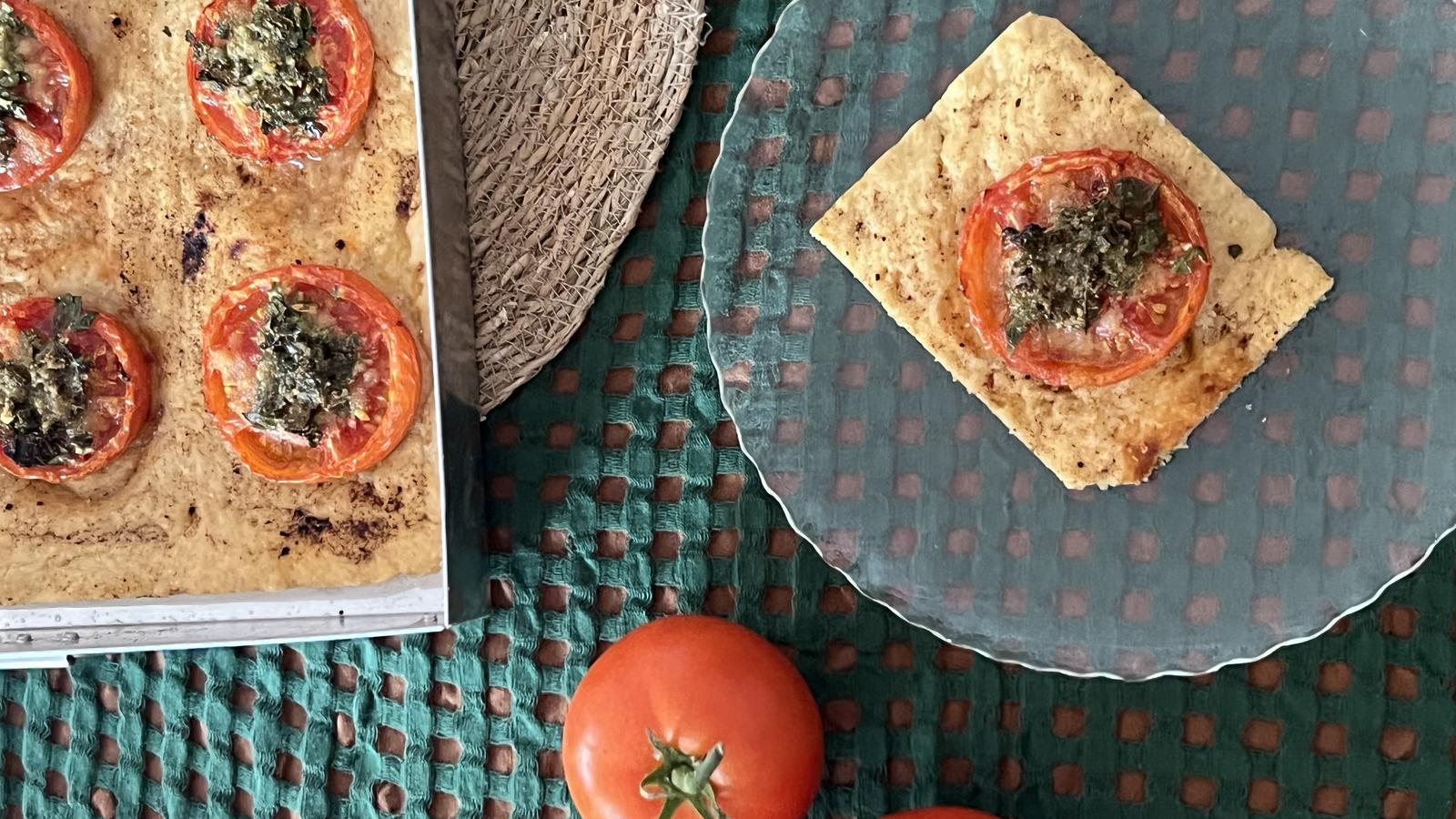
We will dissolve the yeast in lukewarm water. We will add the oil, mix it well, pour in the flour and knead for a while. We will spread the dough on a baking sheet and let it rise for an hour, an hour and a half.We will make a garlic and parsley paste.We will mix oil with salt and chili pepper and brush the dough with this juice. We will place the halved tomatoes on top. On top of each one, we will put a teaspoon of garlic and parsley and a spoonful of crushed biscuit. If you want, you can also add a little powdered sugar.We will bake the bread at 180ºC for about 40-45 minutes.
For bread and for salt
A cake in the open
11/07/2026 - 13:19 h.

3 min
PalmLittle did Christopher Columbus imagine that his journey would end up transforming the way half the world ate. They had set sail with the objective of opening a new route to the riches of the East, especially spices, highly prized and coveted for centuries. Instead of the Indies, they found a continent unknown to the Castilians. And, with it, a biodiversity that would forever change the history of gastronomy.
In the following decades, the ships that crossed the Atlantic transported not only gold, silver, or merchandise. Seeds, animals, fruits, and plants also traveled. The potato, Indian corn, cocoa, beans, peppers, sweet potato, guinea pigs, and tomato began a long one-way journey that would modify the eating habits of Europe. Of all these foods, few have taken root in the Mediterranean as much as the tomato. Today it is hard to imagine summer without it, and it is very present in the most emblematic dishes of the season.
Ornamental plant
The tomato, however, was not received with enthusiasm. For a long time it aroused more suspicion than interest, so much so that many people cultivated it only as an ornamental plant. It would not be until the 17th and 18th centuries that it would begin to occupy a place in our cuisine. In the case of Menorca, the exact moment of its arrival on the island is not well known, but everything indicates that it entered gradually. In Art de la cuina by Fra Francesc Roger, the first Menorcan recipe book written around 1767, the tomato has an almost testimonial but significant presence. In one of the recipes in the book, the panadera with small tomatoes, plums, and preserves, we are told to make a sofrito with raisins, plums, leeks, tender onions, and small tomatoes, if available. This brief clarification makes us think that this fruit was not a common pantry item at that time. Other recipes with tomatoes from the same collection are fish with small tomatoes and garlic (fried spiders eaten without heads or bones with a tomato and allioli sauce) and two different ways of cooking a dish of peppers and small tomatoes, where the vegetable is cut into long pieces and fried in oil.
A century later, the panorama changes radically. When Archduke Louis Salvador of Austria toured the Balearic Islands during the second half of the 19th century to write Die Balearen, he was fascinated by the richness of Menorcan popular gastronomy. Among the many preparations he describes, the coques stand out, which he considers one of the most characteristic dishes of the island. The Archduke records a great diversity of them: sweet and savory, with vegetables, fish, meat, fruit, a sample of the imagination of a cuisine that knew how to adapt the same dough to the products of each season. This is the idea that Pedro Ballester conveys in De re cibaria in 1923 when he talks about bread coques. In his text, he explains that the most typical was oil and sugar and that in the countryside they were also made with cherries, with plums and small tomatoes using the same dough. The difference is that when they added fruit, the dough was covered with a layer of sugar, while the one with small tomatoes was seasoned with salt.
Tomato cake is, probably, the most representative of Menorcan summers. It is prepared with a paste made with lard or oil, which is covered with slices or halves of very ripe tomatoes seasoned with salt, parsley, paprika and a little biscuit or chopped bread, which absorbs the juices during cooking. In some homes, also added are dogfish, hake, or skate.
The recipe I propose today is the simplest version of this cake, where the tomato is the authentic protagonist. I have adapted it from Bep Al·lès' book Sa cuina des poble de Menorca. Rebosteria i pastisseria. La cuina del dolç i salat a Menorca (2014), an essential work to discover one of the richest and most beloved gastronomic heritages of the island.

Bread with tomato
Ingredients
l 500 g flour l 150 g water l 175 g olive oil l 50 g pressed yeast l 3 or 4 ripe tomatoes l black pepper, salt and paprika l garlicl parsley l crushed biscuit or bread
