City councils have the key to reduce tourist pressure and they do not use it
The reduction of the tourist accommodation ceiling approved by Artà makes it clear that municipalities do not depend on other institutions to degrow
-
CAT -
CAST -
DE
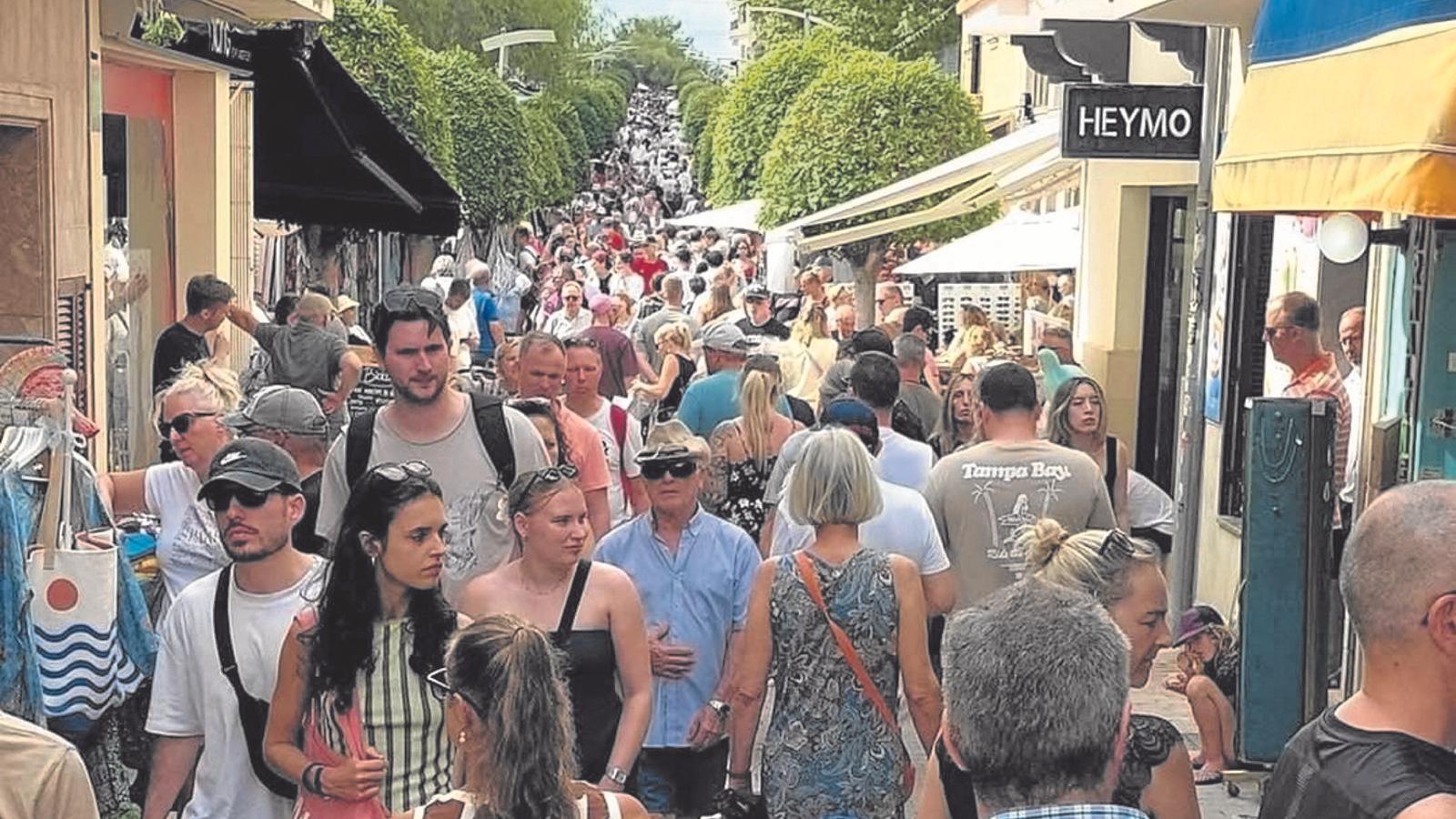
PalmaOnly one town council in Mallorca has approved reducing tourist accommodations. While the debate over degrowth and containment drags on at the Council of Mallorca and the Parliament, Artà has found a way to relieve tourist pressure in the municipality without having to wait for supramunicipal institutions to implement concrete measures for the degrowth of tourist accommodations.
The strategy followed by the Artà Town Council is very simple and within reach of all municipalities in Mallorca: adapting to the Intervention Plan for Tourist Areas of Mallorca, the PIAT, the territorial planning instrument that regulates tourist activity throughout the island. With the measure, initially approved by the plenary session without a single vote against it last September, the Subsidiary Norms are being modified to establish a ceiling for tourist accommodations that effectively achieves a 20% real decrease in the municipality, on both urban and rustic land.
The PIAT sets a ceiling for tourist accommodations, distributes uses and places by zones, and establishes criteria for town councils to adapt their respective urban planning schemes. By adapting to it, Artà has brought a contradiction to the table: why, if the debate on saturation is persistently on the table, has it not been until now that a town council has approved a measure of these characteristics?
An expired deadline
The Council of Mallorca approved the PIAT in July 2020. The instrument established that the town councils had a period of four years to adapt to it, a period that ended in July 2024. Since then, only one municipality has done so: Palma; and Artà has initially approved doing so.
By adapting the planning, a town council can delimit where tourist use is admitted and set municipal limits. If these limits remain below the current places, they can curb growth and open the door to a progressive reduction. Although this formula does not imply an automatic cutback of current licenses, it does allow a certain margin for municipal plans to set maximums of places per hectare, in accordance with the land classification. It would be this maximum that would allow, in certain cases, to contain the supply, as has happened in Artà.
“If all the municipalities were to adapt to the PIAT, for the majority it would mean a reduction in the supply of tourist places,” explains the geographer specializing in planning, Margalida Mestre. The town councils, she assures, “have the power to impose order regarding maximum capacities.”
The four-year term for town councils to adapt to the PIAT expired in July 2024. For Mestre, the failure of the exercise of the own competencies by the town councils, without having to wait for the help of supra-municipal institutions, “is a mixture of lack of political will, long and complex processes, and lack of knowledge.” The PIAT also marks that, in the event that the town councils do not adapt to it, the Council will be able to act in a subsidiary manner, but that has not been done either. “If a town council fails to comply and does not adapt the planning to a higher standard or plan, there is no coercive measure and, therefore, nobody does it,” warns a lawyer and expert in urban planning. “If a town council does not comply, however, there is no consequence,” she laments. “The town councils do not adapt because it would mean limiting the tourist capacity and they prefer to live without rules,” she concludes.
Measures that do not attack the root
The Palma City Council has closed the door on new residential tourist spots and could reduce their number over time. In May 2024, it definitively approved a modification to the General Plan that prohibits new tourist accommodation spots throughout the municipality. While the city had 4,473 spots distributed across 632 homes, the measure eliminates a forecast of 374 new spots.
The mayor of Artà has acknowledged that other municipalities have been in contact with him following the approval of the measure, although he does not reveal which ones. This would demonstrate a certain interest in following in the footsteps of the Llevant municipality. However, if one takes into account that in Artà the process lasted more than a year, it is unlikely that any local government could approve a similar measure before next May's municipal elections.
Beyond Palma, the Artà measure is the only one that tackles the reduction of the municipal cap on tourist spots, although there have been other municipalities that have promoted measures of a different nature, such as the regulation of cars and parking or the containment of urban expansion.
Campanet and Capdepera, for example, have approved not applying the regional exception that allows for obtaining tourist spots in listed buildings. In the case of Sóller, one of the most saturated municipalities, they have limited themselves to acting on vehicles in specific points. They have done so through the construction of park-and-ride facilities for 508 spaces, a fact that has been criticized by civil society, which is calling for solutions aimed at reducing the tourist and residential collapse of the municipality. “The more parking you provide, the more you will fill, and you will not fix the road saturation or the traffic chaos; you won't alleviate anything. Fewer people need to come. Sóller has not implemented any containment measure,” criticizes Bartomeu Miró, a Sóller activist.
