The sea boils the posidonia: 225 days of heat wave in one year
IMEDEA detects an increase in discolored leaves and mortality, while Marilles warns that wastewater aggravates the situation

-
CAT -
CAST -
DE
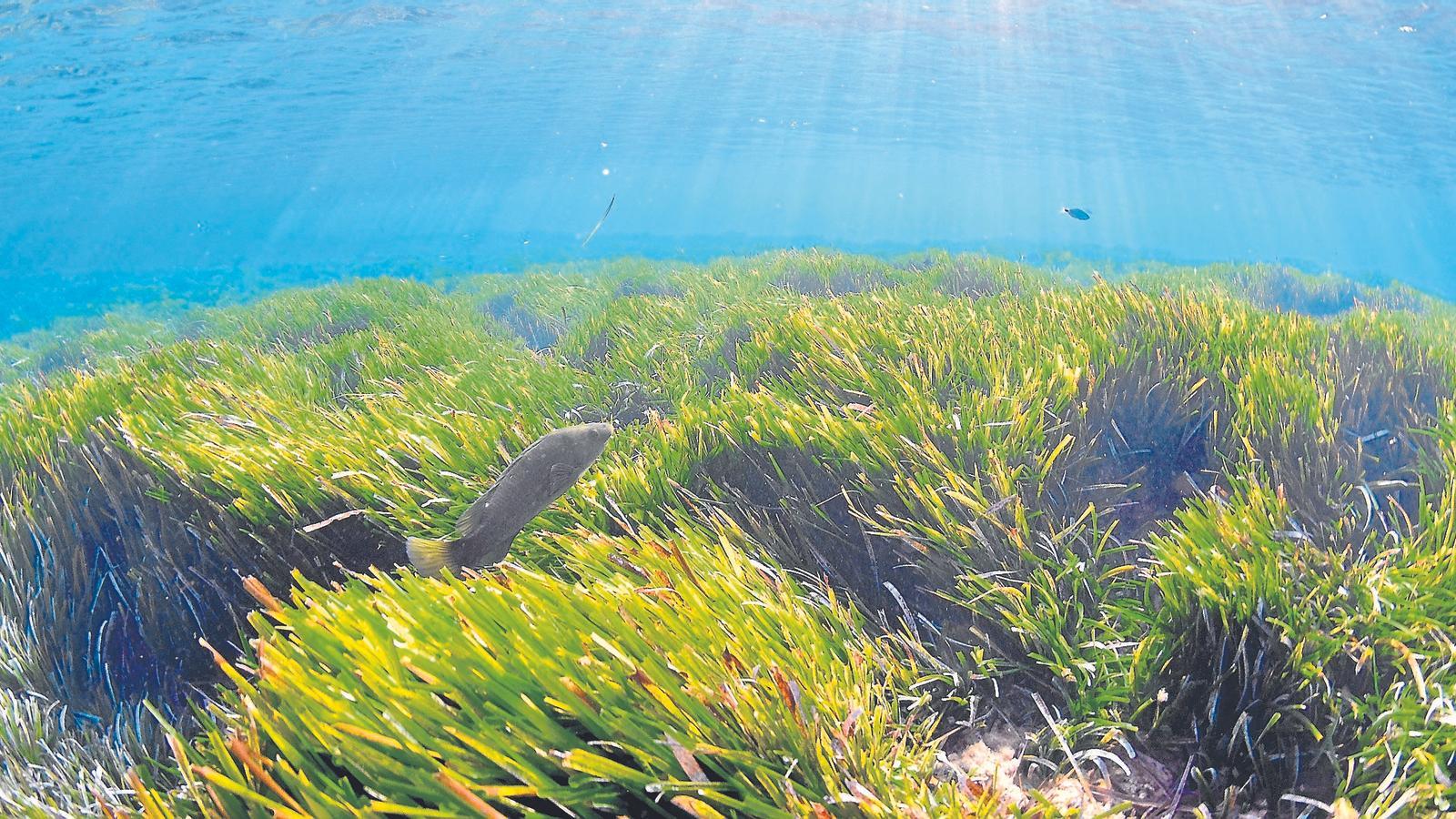
PalmaPosidonia leaves lose their characteristic green color and turn whitish in some shallow areas of the Balearic Islands. This is the disturbing phenomenon that researcher at the Mediterranean Institute for Advanced Studies (IMEDEA, CSIC-UIB) Núria Marbà has observed again this summer at the port of Cabrera, in front of Pagès beach, where the water reaches especially high temperatures, a phenomenon that has been repeating in recent years. “The leaves are whitening, it seems they are losing their chlorophyll,” she explains. It is not a new alteration, but its causes and consequences are still not known with certainty. “We don’t know if it is because of the temperature, but it seems so, because it happens in the summer,” she points out.
That Posidonia is the lung of the Mediterranean, that it retains suspended particles and contributes to keeping the waters of the Balearic Sea transparent is as true as the fact that its future is increasingly compromised. The sea temperature is rising at an accelerated rate and the meadows are accumulating the effects of thermal stress that threatens their survival. But sewage discharges, excess nutrients, and physical impacts on the seabed further complicate the situation.
The Balearic Sea has warmed by 1.73 degrees in 44 years. In 2024 it accumulated 225 days of marine heatwave and this summer the Dragonera buoy recorded a record temperature of 33.02 degrees. These are data from the Mar Balear report, advanced to ARA Balears by Raquel Vaquer, head of the Mar Balear report of the Marilles Foundation, which evidence the magnitude of the warming and the persistence of extreme temperatures.
Marbà, who has been participating in the monitoring of meadows in Mallorca, Cabrera, and Formentera for 25 years, explains that the whitening still needs more research. In some areas where she had observed it, years later there were still living shoots. Now she plans to mark plots to study their evolution. What scientific monitoring has confirmed are mortality episodes higher than usual after hot summers.

Mortality increases with heat
“Yes, there are areas where we see high mortality rates. Not all the seagrass shoots die, but the percentage that does die is higher than normal,” explains Marbà. The first major alert arrived in 2003, when some stations recorded mortality rates of nearly 15%. The phenomenon repeated in 2006. “Posidonia does not remain indifferent to the increase in temperatures. That is clear,” the researcher warns.
Exceeding 28 degrees in the water is no longer exceptional. This summer, IMEDEA sensors at a depth of six or seven meters in Formentera recorded temperatures above 30 degrees and exceeded 29 degrees for numerous days. The recovery capacity varies depending on the depth. In certain meadows located at less than ten meters, the lost shoots can recover in approximately two years. But the succession of heatwaves hinders this recovery.
“Everything depends on what the frequency is like. Those that survive can keep going, but, of course, if another heatwave comes, it is very hard,” she points out.
A more intense warming
The data from the Mar Balear report, compiled from records of various scientific organizations such as SOCIB, indicate that the sea surface temperature has increased by 0.39 degrees per decade between 1982 and 2024. Since 2005, thermal anomalies have been systematically positive and, since 2020, they have exceeded one degree. In the spring of 2024, anomalies of up to 2.2 degrees were observed.
The persistence of heatwaves is especially worrying. In 2024, 225 days of them accumulated, with a maximum regional intensity of 5.05 degrees above usual values. The analysis of the 1982-2024 period shows that their intensity, duration, and frequency have increased, with a particularly marked acceleration in the last four years.
Warming also affects the intermediate and deep layers of the sea. The problem, therefore, is not only the isolated records, but the accumulation of heat and the little recovery time between episodes. Extreme temperatures also alter the reproduction of Posidonia. Marbà recalls the extraordinary blooms observed after the heatwaves of 2003 and 2022.
An international study published this year in Communications Earth & Environment analyzed 442 Mediterranean locations after the summer of 2022. In 333, 76%, flowering was detected, with a particularly high incidence in the Balearic Sea. Flowering, however, requires a significant energy investment and does not necessarily imply an improvement in the meadows. “I don't know if the plant can invest so much energy in flowering again,” reflects Marbà, who considers a new significant flowering possible after the summer of 2026, still pending confirmation.
Climate change does not act alone. Raquel Vaquer, from Marilles, identifies other pressures affecting the meadows: “anchorages, coastal construction, excess nutrients from discharges, and invasive species,” she states. Vaquer explains that certain wastewater, even after being treated and meeting legal requirements, can retain considerable concentrations of nutrients. This excess favors the proliferation of algae and reduces water transparency, which makes it difficult for enough light to reach the Posidonia. The decomposition of organic matter can also consume oxygen on the seabed.
Episodes of intense rainfall exacerbate the problem when sanitation systems discharge wastewater mixed with rainwater into the sea. Vaquer also notes that a study prepared with researchers from IMEDEA, still pending publication, indicates that the effects of treated water discharges can reach several kilometers from the discharge point. Environmentalists have grown tired of asking the Administration to review investments in sanitation, because not only have they not been carried out, but the resident population and tourism have increased in recent years and, therefore, the pressure on treatment plants. "They send water into the sea that, in many cases, does not meet legal requirements, and here no one does anything," laments Neus Prats, from GEN-GOB Eivissa.
The combination with warming is particularly harmful. Marbà explains that the loss of water transparency can reduce the plants' tolerance to high temperatures. "Temperature leads us to a not very favorable scenario, but if we mitigate the other impacts, it is more achievable," he states. This summer, IMEDEA and other entities have demanded more institutional commitment. "It is not enough to be aware, we must act," concludes Marbà.
-
28 degrees. A very common record
Just a few years ago, the water temperature did not usually exceed 28 degrees and reaching that level was considered an extraordinary event. This year, it has often exceeded 30.
-
2003. First worrying year
The first year in which more mortality cases than expected were detected was 2003. Since then, the figures for plant losses have not gone down.
-
15% mortality
For some years now, IMEDEA has been able to confirm that at some control points, Posidonia mortality reaches 15% in a year.
-
1.73 degrees. Accumulated increase
Over the last 44 years, the Balearic Sea has seen its temperature increase by 1.73 degrees, according to the latest available data. An increase above what was expected.
