Cort begins to remove elements of the encampment and Martínez threatens with fines
The mayor of Palma has demanded again the urgent and immediate dismantling

-
CAT -
DE
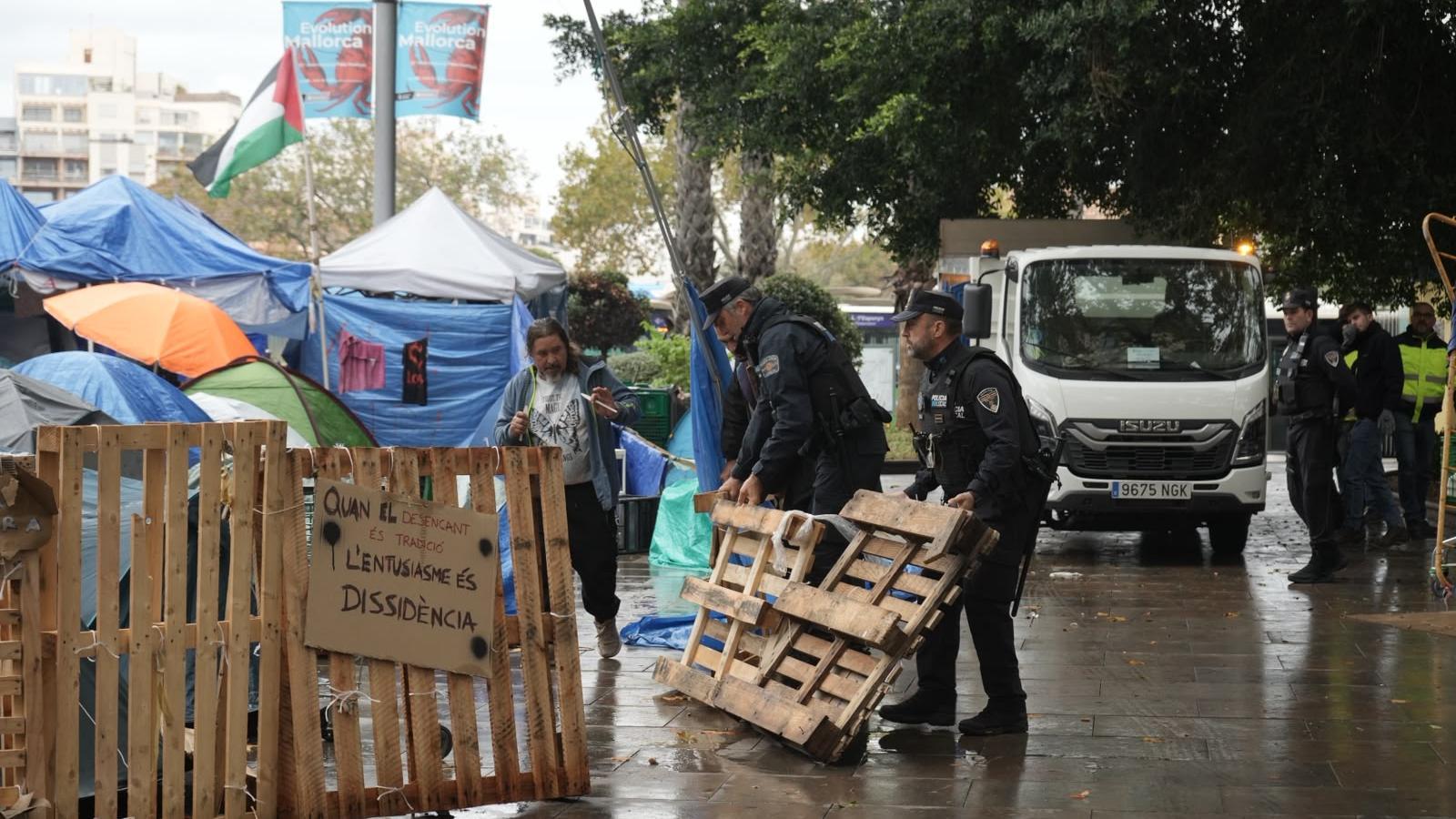
PalmaThe Local Police of Palma arrived with Emaya workers and began to remove the external structure, signs, and proclamations of the housing protest camp in Palma's Plaza de España. They did so minutes after the city's mayor, Jaime Martínez, issued a new statement demanding the total dismantling of the camp and threatening identifications and fines for everyone who remains there.
So far, they have not forced the removal of the tents, simply the elements used for structure and protection, such as some pallets and ropes that had become a kind of wall that separated the pedestrian area from the camp.

The action comes after Martínez has once again pressured the Spanish Government Delegation to dismantle the encampment at Plaça d'Espanya, following the police intervention that put an end to the one at Puerta del Sol in Madrid. This Tuesday, the mayor submitted a new formal request to the government delegate in the Balearic Islands, Pere Joan Pons, to act in the same way in Palma.
From London, where he is participating in the World Travel Market (WTM), Martínez has defended that the gathering is no longer protected by the right to demonstrate and that, therefore, the administrations must intervene. "They should act the same way as in Madrid, and we will do so," he asserted. He also argued that "the Balearics are no different from Madrid," because, as he said, the same laws and rules apply there.
The mayor went further and, as a threat to the campers, announced that the Local Police will begin opening sanctioning files against the camped individuals who violate municipal ordinances on civility and occupation of public space. He has given instructions for agents to identify the people they consider to be violating the regulations, draw up a report, and initiate the corresponding sanctioning procedures. Furthermore, he reminded that these ordinances provide for economic sanctions.
Martínez has defended the police intervention, alleging that public order problems have also occurred at Plaça d'Espanya, as, according to him, happened at the Madrid encampment. Furthermore, he has argued that the occupation hinders the City Council's cleaning and maintenance tasks and prevents the square from being used normally. To justify the eviction once again and demand immediacy and urgency, he has assured that about 50,000 people pass through this public space every day.

Cort insists on the eviction
It is not the first time that the City Council has demanded that the encampment be ended. On October 1st, it already formally requested the Delegation of the Spanish government to assume its responsibilities and take the necessary measures to put an end to the occupation, after the deadline that the organization had communicated to maintain the protest had expired.
The City Council has also questioned the installation of enclosures and other elements, as well as the unauthorized connection to the electrical grid, because it considers that they may cause damage to the pavement and other elements of the square.
Despite ensuring that it respects the right to demonstrate and assemble, Cort defends that this right cannot justify an indefinite occupation of public space. Meanwhile, the Delegation of the Spanish Government in the Balearic Islands is still analyzing Martínez's new request and the Local Police have already begun to act on the elements of the encampment, without the tents having been removed for the moment.
