The touristification of the countryside reaches another historical estate: Montblanc projects 50 places
The Maria de la Salut estate, with medieval origins and protected for its heritage value, plans to transform the old livestock facilities into tourist accommodations with a declared budget of 1.4 million euros

-
CAT -
CAST -
DE
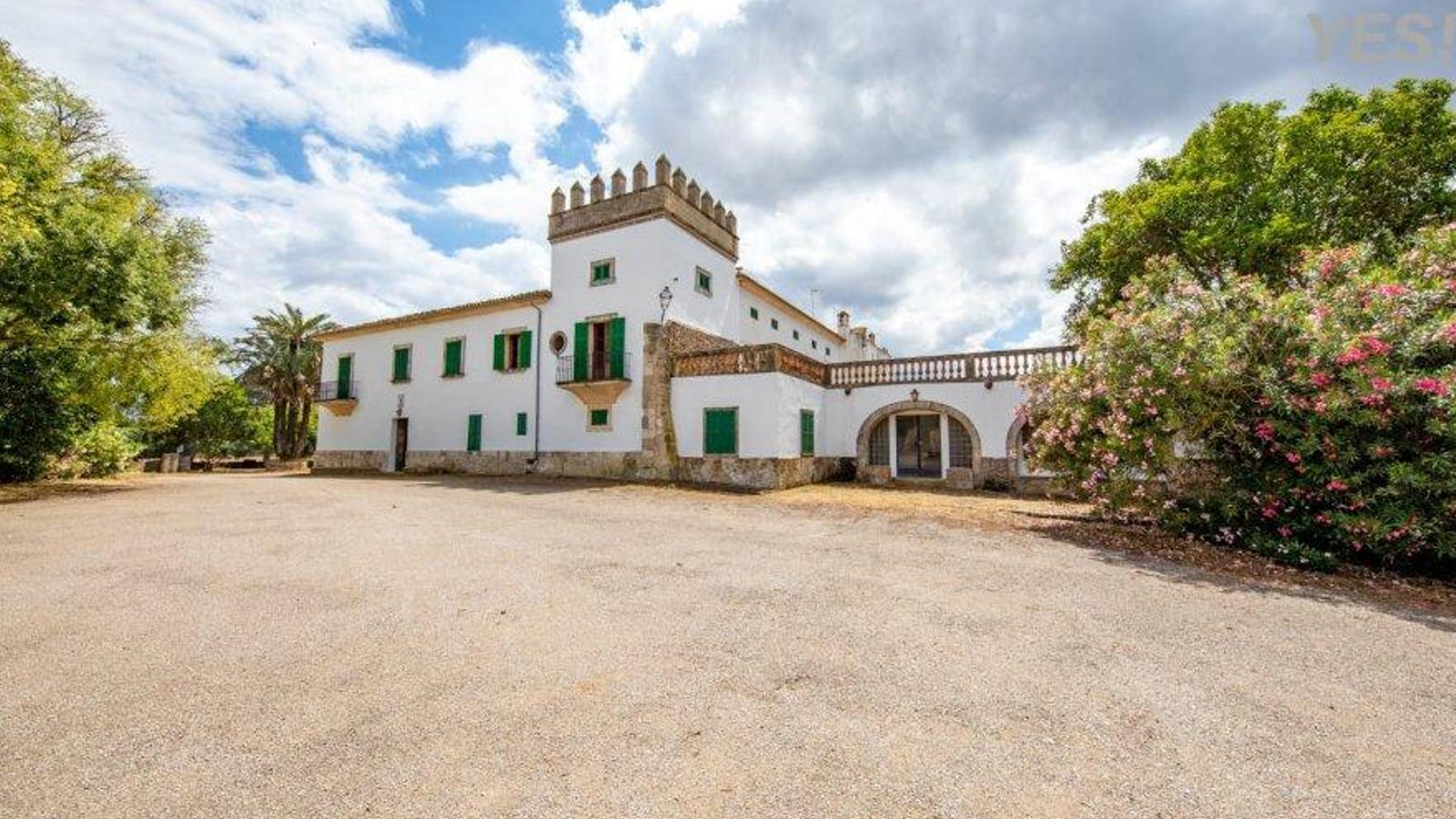
PalmaAnother one of the great historical estates of Mallorca is preparing to join the island's tourist offering, within the framework of an already globalized and constant process in the Balearic countryside. It is Montblanc, one of the most unique properties in Maria de la Salut, in the Pla de Mallorca, which for centuries was an important center of agricultural and livestock production and now plans to transform part of its old dependencies into a 50-bed agrotourism establishment. The buildings that for generations housed livestock will be converted, if the initiative succeeds, into rooms and facilities destined for visitors. The company Solar de Conrado SL has promoted the project, with a material execution budget of 1.4 million euros, which has now been released for public information.

Montblanc is thus incorporated into the transformation process being experienced by some of the traditional Mallorcan estates, ancient production units that for centuries marked the economy, the landscape and the social relations of the rural world. The uniqueness of this estate goes beyond its dimensions: it is a listed architectural complex, with buildings from the 16th and 17th centuries and origins that date back to the Islamic era. The tourism project proposes precisely to recover a part of the spaces linked to its livestock history, while other facilities on the estate would maintain their agricultural function.
Rooms where there was once livestock
The initiative of Solar de Conrado SL plans to reform mainly the old livestock buildings constructed before 1956. According to the report written by the architect Alfons Barceló, action will be taken on 875.59 square meters of structures that were formerly used for porcine and bovine cattle. These spaces will be transformed into rooms, common areas, and facilities linked to the future agritourism.
The project provides for a total of 25 double rooms, one of which is adapted for people with disabilities, which will add up to 50 accommodation places. It also includes the conversion of an old hut of 52.10 square meters into a unique suite, as well as the use of some dependencies of the main building for the operation of the establishment. The intervention incorporates new access points, a pergola, small ornamental water features, and an outdoor parking lot with thirty spaces for cars, in addition to spaces intended for bicycles and electric motorcycles. The reference material execution budget is 1,407,000 euros, a figure that does not necessarily equate to the total investment of the operation.
On the other hand, the project leaves out of the tourist conversion the old animal enclosures, which the report keeps linked to livestock activity, and the warehouses built during the second half of the 20th century. The architectural proposal defends the recovery of traditional buildings and the preservation of their original characteristics. The affected estate occupies a plot of 283,166 square meters, about 28.3 hectares of rustic land. This surface area should not be confused with the historical dimensions of Montblanc, which in other eras had reached a much larger extent.

A possession protected for its heritage value
Montblanc is listed in the municipal catalog of buildings and elements to be protected in Maria de la Salut. According to the technical report, the main buildings have an approximate chronology of the 16th and 17th centuries, even though the origins of the estate are much older.
This protection conditions the planned intervention. Before the City Council can grant the building permit, the project must have a favorable report from the Heritage Commission of the Council of Mallorca and another from the Ministry of Tourism, among other administrative procedures. The processing also has a water dimension. According to the documentation presented, the property is self-sufficient with its own well to which an approximate flow of 90,000 liters per day is attributed. This figure does not necessarily correspond to the water currently being extracted or to what the tourist establishment will consume. The report consulted does not specify what the expected consumption for the 50 places will be, nor the authorized annual extraction volume.
The 50-place project and the limit of 24 provided for by agrarian regulations
The capacity of the agritourism is another aspect that will need to be clarified during the processing. The developer proposes 25 double rooms and a total of 50 tourist beds. However, Decree 39/2015, which regulates agritourism activities on preferred agricultural holdings in the Balearic Islands, sets a maximum of 24 accommodation places for establishments covered by this regime.
This limitation has already appeared in the processing of other tourism projects on rustic land. In the case of a 50-place agrotourism in Son Amar, in the municipality of Bunyola, an administrative resolution expressly recalled the limit established by Decree 39/2015 and warned that it was up to the substantive body to determine if the project was legally viable.
In the case of Montblanc, the documentation presented provides for exactly 50 places. The project report includes a justification for compliance with tourism and agrarian regulations, but the part of the file consulted does not allow for determining what criteria the Administration will ultimately apply or whether the 50 places will obtain the corresponding authorization. The proposal is currently in the public information phase before the Directorate General for Water Resources. Therefore, the tourist reconversion does not yet have, by the simple fact of this announcement having been published, all the necessary authorizations.
From the Islamic farmhouse to the Mallorcan nobility
As documented by the historian Antoni Mas i Forners in a study on the territorial configuration of the estate, the history of Montblanc dates back to the ancient farmhouse of Benilacham, documented during the Islamic domination of Mallorca. After the Catalan conquest of the 13th century, these lands underwent a process of reorganization of property that would eventually lead to one of the great estates in the district of Maria. According to the research of the historian Bartomeu Pastor Sureda, settlers from Tarragona gave the estate the name Montblanc, in memory of their place of origin.
Throughout the centuries, the property passed through different families and lineages linked to the nobility and the large landowners of Mallorca. In the medieval period, it was part of the barony of the Count of Empúries and, subsequently, became associated with the Santmartí, the Santjoan, and the Torrella families. In the 17th century, it was acquired by the Genoese merchant Domingo Belloto and, later on, passed to the Morell family and the Counts of Spain.
This connection to the nobility did not turn Montblanc into a leisure residence. Quite the contrary. According to these studies, the Counts of Spain preferred the Defla estate for rest stays, while Montblanc maintained an eminently productive function. The wealth of the estate was measured above all by its capacity to generate cereals, meat, wool, cheese, firewood, and other agricultural products. The scale of the operation was extraordinary. In 1863, Montblanc had approximately 1,378 quarterades, more than a thousand of which corresponded to scrubland. The rest contained crops, clearings, and spaces destined for livestock. The property covered a considerable extension of the municipal area and constituted one of the great centers of agricultural activity in the Pla de Mallorca.
A workplace for generations of farmers
Montblanc was not just a large landed estate. For generations, it was also a space for living and working for numerous families from Maria de la Salut and neighboring towns. At the end of the 19th century, the estate usually maintained between ten and twelve permanent workers, to whom day laborers were added during periods of peak agricultural activity, especially in the harvesting and threshing campaigns.
Messengers, shepherds, swineherds, plowmen, scrubland keepers, and gardeners were part of a labor organization in which the estate houses, sheepfolds, barns, and auxiliary outbuildings constituted a complex closely linked to production. A portion of the remuneration was paid in kind, with products from the same farm, such as cereals, wool, cheese, or firewood.
Livestock farming continued to play a prominent role well into the 20th century. In fact, the memory of the new tourism project places one of the moments of maximum expansion of the facilities intended for livestock around 1973. It was then that several large-scale sheds were built, which considerably increased the farm's capacity. These more modern constructions are still part of the complex, although they are not included in the tourism reconversion now proposed. The historical and architectural value of Montblanc had also aroused the interest of the real estate market. In July 2023, IB3 reported that the estate appeared among the large Majorcan properties listed for sale, with a price of 3.77 million euros. More recently, in January 2026, the researcher and heritage popularizer Tomàs Vibot cited it in a report by ARA Balears on the future of Majorcan estates and especially highlighted the beauty of its houses. The new administrative documentation now confirms that the property is the subject of a specific tourism reconversion project.
