Emaya's preferential treatment of hotels uncovers obsolete water tariffs
A former worker has again brought to the table how establishments must consume much more water for the more expensive price to affect them. Experts demand transparency from the municipal company

-
CAT -
CAST -
GER
PalmaWhen a family in Palma increases its water consumption, so does the price it pays per cubic meter. This is the principle on which Emaya's tariff is built: the first blocks are cheaper, and as consumption grows, after exceeding certain quantities, each tier becomes more expensive. The progressivity aims to encourage savings and penalize high consumption.
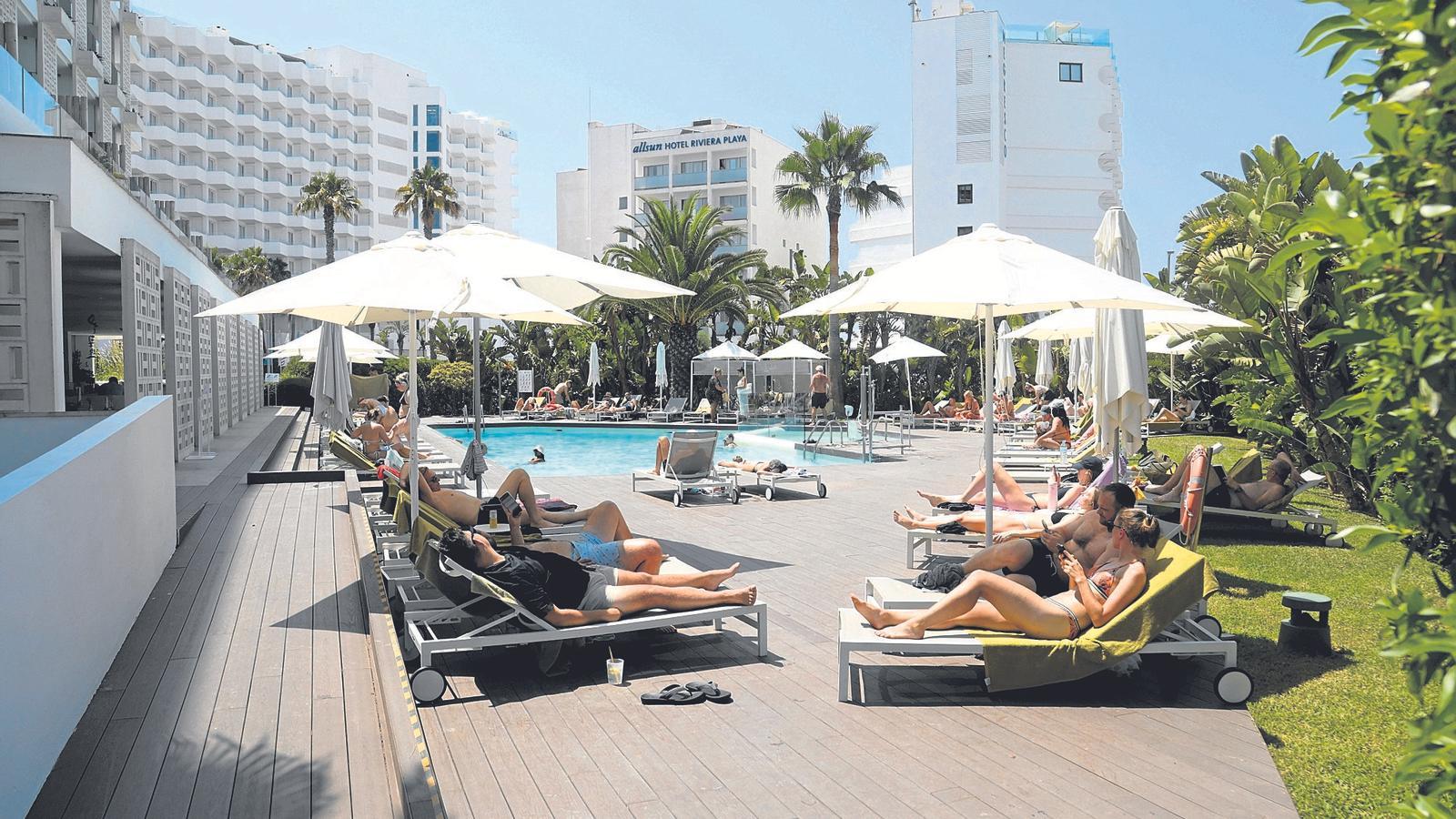
Hotels, however, do not enter this system in the same way. They also pay a different price per cubic meter if they exceed certain tiers, but they have to consume much more water to reach the highest tariffs. In practice, this means that a larger proportion of consumption is billed at low prices, which is 0.60 euros per cubic meter. "It is an example of the tariff obsolescence of the municipal company," explains Juan Calvo, spokesperson for the Alliance for Water.
The difference is hidden in the way consumption blocks are calculated. Before applying the progressive tariff, Emaya distributes consumption among equivalent units of two hotel places. This means that a much larger portion of water is billed within the first, cheaper tiers. The mechanism is still included in the current municipal ordinance. It is a rule practically unknown outside of technical circles, but it has been part of Palma's tariff policy for decades.
The story was uncovered by Miquel, a former Emaya employee. He states that "this system distributes consumption among the hotel's places, two by two." "For a hotel with 240 places, it is considered as if it had 120 meters, when in reality it has one. Thus, they never, or almost never, exceed the basic tier, and they save thousands and thousands of euros on water, which families cannot do," he explains to ARA Balears.
“They are dividing consumption among multiple small consumers, and thus progressivity is not applied,” laments this former municipal company technician. One of the cases studied by this former company employee corresponds to a hotel in Platja de Palma with 240 places and a consumption of 3,760 cubic meters. According to the figures provided, if this same volume of water had been billed applying domestic progressivity, the amount would have been 21,225.60 euros. In contrast, with the real tariff applied by Emaya, the payment is 2,356 euros.
Although ARA_Balears has tried to get a spokesperson from Emaya to explain this system and has requested information about the tariff differences, it has not received a response from Cort. It has, however, spoken with Neus Truyol, the councilor who, during her time in charge of the municipal water and sewage company, carried out an initial tariff reform. Although it did not directly address the inequality between hotels and families, it did pave the way for reducing inequality.
“The main objective was to reinforce progressivity so that those who consumed more paid more and, at the same time, to protect small consumers,” she recalls. The reform froze the initial domestic blocks, introduced social bonuses for vulnerable families, and modified the treatment of large families so that they would also be subject to a progressive system adapted to the number of members.
The ones with more stars, benefited
But the municipal government also acted on hotel tariffs. Until then, establishments of higher standing enjoyed an even more favorable system than the rest, inexplicably. “At one point, the intention was to encourage the creation of high-level hotels, four and five stars, and water was given away,” explains an Emaya technician who requests anonymity. The same internal documentation of the municipal company acknowledged this difference.
From 2017 onwards, all hotels, regardless of their category, began to calculate the tariff using the same criterion: one equivalent unit for every two hotel places. This resulted in significant increases in the bill for higher-category establishments, and put an end to a historical irregularity. “Our intention was to eliminate that injustice and have all hotels pay the same,” Truyol now recalls in statements to ARA Balears.
The former councilor defends that the political debate at that time was not whether hotels should have a specific system, but rather to correct a situation that caused higher-category establishments to pay less than lower-category ones.
However, she also admits that the government did not question the two-place mechanism. “The technicians explained to us that it had logic, and we did not dispute it. Now would be the time to carry out a new, very thorough review,” says Truyol.
For its part, the Hotel Federation assures that establishments do not enjoy advantages. “Palma hotels do not have a subsidized price for water. The price per cubic meter applied to each band is the same as for domestic users,” assures the entity. According to the employers' association, the difference “lies solely in the width of the bands, which is calculated based on the number of places in the establishment and not as if the entire hotel were a single dwelling”.
Review the tariff for homes
Juan Calvo, spokesperson for the Alliance for Water, introduces a nuance that shifts the focus of the discussion. He does not reject that a hotel's consumption should be distributed according to the number of people it can accommodate. “Behind 240 beds there are 240 people and it makes sense to take that into account,” he explains. “The problem is that this criterion is only applied to hotels.”
For Calvo, the question is why this adaptation disappears when it comes to other users. “In homes, consumption is not divided among anyone,” he points out. According to his calculations, with identical consumption per person, a family of six can pay almost triple per person than someone living alone, because the combined consumption rises more quickly to the higher-priced tiers. Ultimately, he believes it is time to review the tariffs and adapt them always with the aim of discouraging consumption and rewarding those who use little.
The situation is even clearer, he states, in buildings with a single community meter. “They are the only category of collective user in the entire ordinance that pays the full progression up to the most expensive tier. It is not divided by beds or by homes.” Calvo defends progression as a fundamental tool so that whoever consumes more pays more, but believes it should be redesigned to better adapt it to each type of user.
He gives the example of Malaga, which calculates domestic tiers according to the number of registered residents, and Barcelona, which expands the tiers based on the size of the home.
The Alliance proposes distributing the consumption of buildings with a single meter among the homes they supply, calculating domestic tiers according to registered residents, and adapting the hotel tariff to actual occupancy, not just authorized beds. “This encourages savings,” he states.
Own scale
It also claims a specific scale for the tourism sector. The first blocks of the domestic tariff, he explains, are designed to cover the basic needs of a family, while a hotel incorporates swimming pools, gardens, laundries, kitchens, and common areas. “The consumption of a swimming pool ends up being charged at the price intended for a family's shower,” he summarizes. His proposal consists, above all, of penalizing hotels for their inefficiency: a affordable tariff for establishments with responsible consumption and more expensive for those that exceed the appropriate thresholds per occupied bed.
The former Emaya worker who has brought this debate to the table, Miquel, believes that “it is high time that a review of the tariffs is carried out, and that hotels stop being benefited in this way.” “Furthermore, when we use desalinated water, it costs two euros per cubic meter, while the hotel pays for it mainly at 0.60 euros. Who pays the difference?” he asks. “We must ask Emaya for a cost audit, they are hiding water information from us,” denounces Juan Calvo.
Nearly 100,000 residents of the Balearic Islands lived in 2025 in areas where the water for consumption was declared unfit at least at some point during the year. Specifically, this concerns 98,452 inhabitants, a figure that rises to 145,027 if people residing in the 22 areas considered “at risk” are included, meaning those with recurrent non-compliance that could eventually lead to a declaration of unfitness.This is the conclusion of the annual report by the Water Alliance, prepared using data from the National Information System for Drinking Water (SINAC) of the Ministry of Health. The study, which analyzes 992 tests conducted in 2025, warns that many of the detected problems are not isolated incidents but have been recurring since 2016 or 2017. The most concerning situation is registered in Menorca, which presents the highest percentage of unfit test results in the Archipelago, with 26.1%. Non-compliance affects ten supply zones in Maó, Es Castell, and Ciutadella.
