How does the Gag Law affect police charges? The keys after the Palma incidents
Police charges at the end of the demonstration against mass tourism have reopened the debate on the Gag Law, in force since 2015

-
CAT -
CAST -
GER
PalmaThe massive demonstration against mass tourism held last Sunday in Palma passed without incident throughout its route. Tens of thousands of people marched through the city center to demand a change in the tourism model and denounce the housing crisis, in a mobilization that took place without confrontations with the hundreds of tourists strolling through the same streets, nor with damage, graffiti, or incidents in front of hotels, shops, terraces, or real estate agencies.
The protest came after a week marked by the arrest of two activists in Santa Maria following a protest graffiti against real estate agencies, an operation that had generated strong criticism and increased tension before the mobilization. Despite this context, the demonstration maintained a peaceful character until the final stretch.
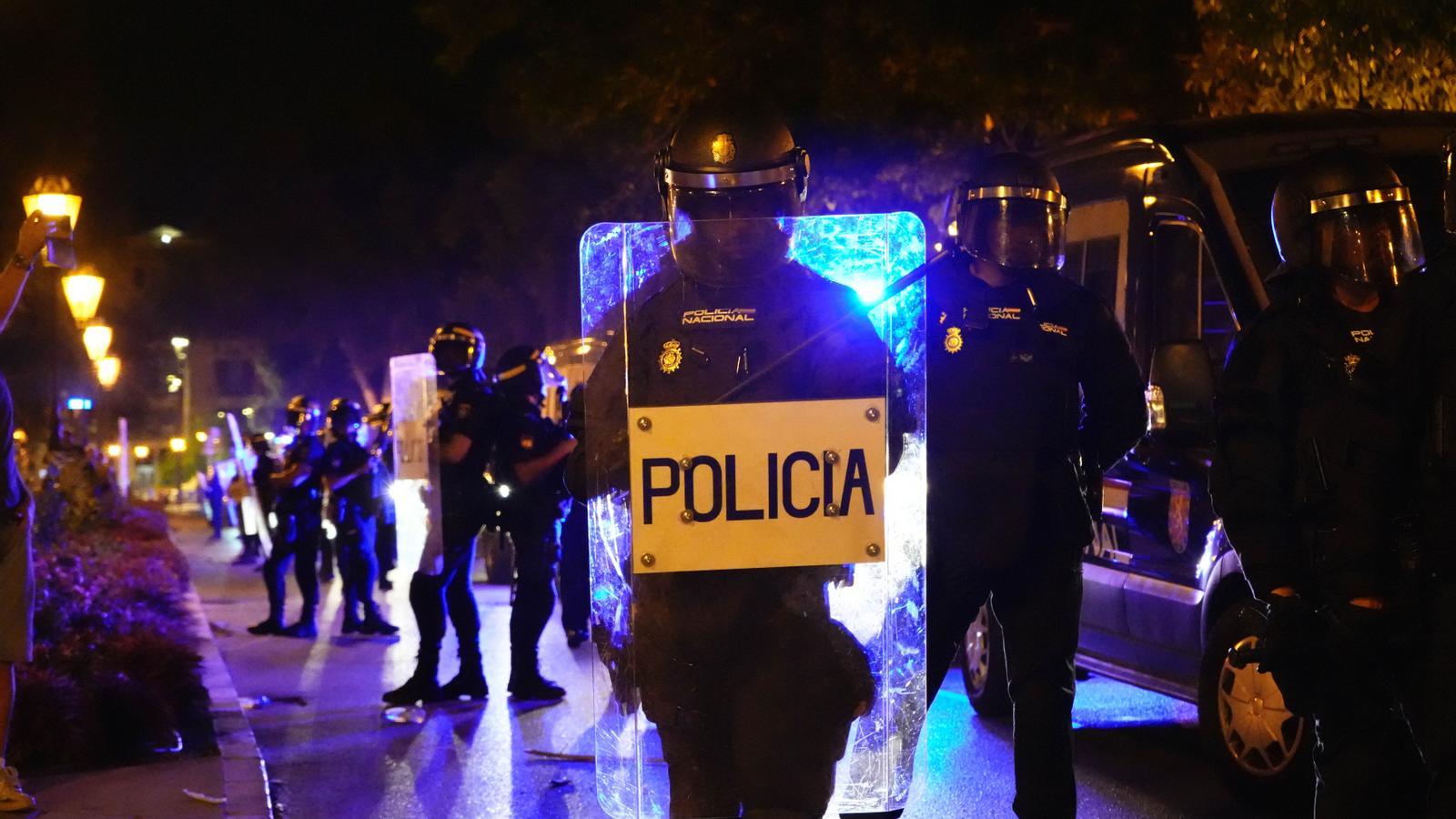
The situation only began to tense up when the head of the march had already reached Les Voltes and thousands of people continued down Passeig d'Antoni Maura and through the city streets to attend the reading of the manifesto. The National Police prevented access to the venue, arguing that the capacity limit had been reached. Two police cordons were deployed: one on top of the wall and another at the access that connects the Parc de la Mar, at the height of Hort del Rei, with Les Voltes.
For several minutes, the demonstrators demanded to be able to complete the route. Shortly after, the National Police charged against the concentrated crowd with batons. Several videos recorded by attendees also show detonations during the police intervention. According to the count compiled by ARA Balears, at least six people suffered head injuries. Among them is a photojournalist covering the mobilization who had to be hospitalized with a head wound, as well as a young man who was diagnosed with a traumatic brain injury.
These injuries have reopened the debate on police action protocols. In fact, the National Police's internal protocol establishes that officers must avoid striking with the baton in a vertical direction – from top to bottom – and expressly prohibits impacting the head, neck, collarbones, or spine due to the risk of causing serious injuries.
Irídia calls for an investigation
The charges have also provoked the reaction of Irídia, the center for the defense of human rights specializing in institutional violence, which has denounced the "disproportion" of the operation deployed by the National Police.
The entity assures that the intervention left more than a dozen people injured, including a photojournalist who was doing his job and who suffered injuries to the head, abdomen, and extremities. Irídia also denounces the use of baton blows "from top to bottom" and rubber bullets, a material that it considers "potentially lethal" and for which it demands definitive prohibition.
The organization also points to an alleged non-compliance with the regulations on the visible identification of agents, which, according to it, hinders the accountability and investigation of possible police abuses. Furthermore, it calls for an "urgent and exhaustive" investigation of the facts and expresses concern about the "criminalization" that, it claims, the Menys Turisme, Més Vida movement has suffered in the days leading up to the mobilization.
"The Gag Law discourages the right to protest"
The lawyer specialized in the Citizen Security Law, Celia Ballester, who is part of Irídia, considers that the regulation, in force since 2015, "has become another tool to repress and criminalize the right to protest".
According to Ballester, the norm has meant a "clear setback in terms of rights and freedoms" because it allows administrative sanctions of between 100 and 600,000 euros to be imposed without the need for criminal proceedings. The lawyer also maintains that one of the main problems of the law is the use of "ambiguous and generic" legal concepts, especially in the articles related to disobedience and disrespect to authority.
Between the entry into force of the norm and 2023, more than 429,000 sanctions have been imposed for infractions related to citizen security – not counting drugs, weapons and explosives – and more than 76% correspond to articles 36.6 and 37.4.
Following the numerous images recorded during the charges, Ballester recalls that there is a widespread mistaken belief. The lawyer regrets that some officers continue to use this argument to prevent recordings that may later be decisive in an investigation. She also recalls that many investigations do not progress because it is not possible to identify the officers who intervened.
What to do if you believe you have suffered police aggression
Ballester insists that the first hours are decisive for preserving evidence. The lawyer recommends explaining in detail to healthcare professionals how the events occurred, what physical and psychological injuries were suffered and, if possible, which police force intervened. If symptoms worsen or appear days later, she advises returning to the doctor so that they are reflected in a new report.
She also recommends photographing the injuries, keeping the videos and photographs on the original device on which they were recorded, identifying possible witnesses and checking if there were surveillance cameras that could have captured the events. Regarding the complaint, she considers it preferable to file it with the duty court, providing all available documentation and, if necessary, requesting that the judge require camera recordings or the identification of the officers.
Finally, she recalls that the consequences of police aggression are not only physical, but also affect the psychosocial context. "Faced with a situation of violence, it is normal to react in a way we do not expect, we must take into account that these are normal reactions to abnormal situations," she pointed out. For this reason, the lawyer pointed out that during the first month it is possible to have acute stress reactions that can lead to a feeling of unreality of the events, sudden mood swings, insomnia or attempts to avoid situations or places that remind us in some way of the lived events. Regarding anti-riot material, Ballester recalls that the last proposal to reform the Gag Law, currently blocked in Congress, provided for the elimination of rubber bullets. However, in September she pointed out that there may be news about the reform.
