Menorca puts the barriers in the countryside
The rise of the traditional enclosure of estates and villas on the island resurrects the artisan craft of the wheelwright and makes the typical wild olive gates cross borders

-
CAT -
CAST -
DE
CitadelMore than 11,000 kilometers of dry stone walls delimit and enclose farms throughout the Menorcan countryside, most of which have a wild olive wood gate as their entrance. The same applies to the gates that any hiker might encounter when traveling the 220-kilometer route of the Camí de Cavalls.
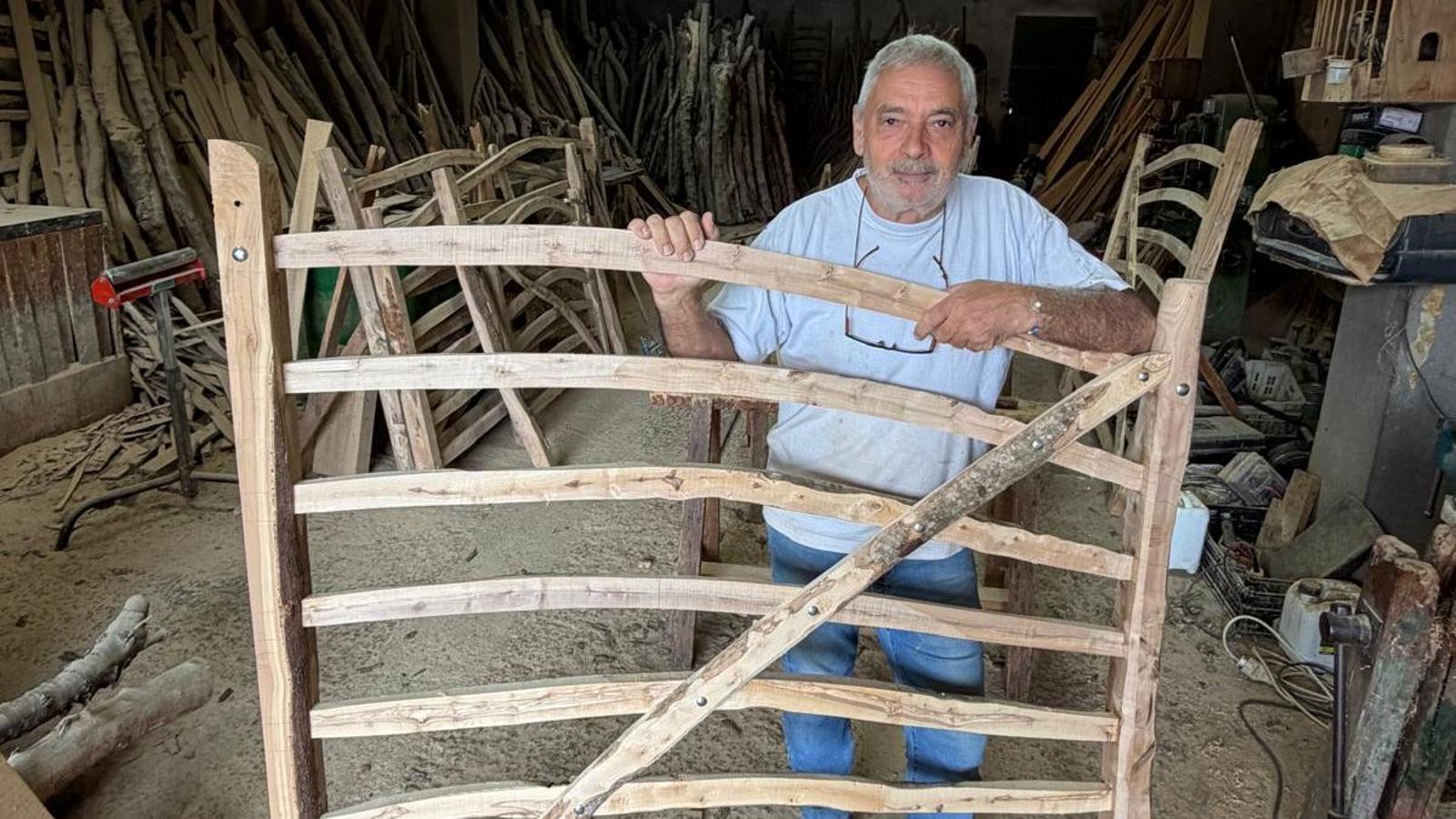
These types of traditional gates, with horizontal slats and a diagonal one that crosses from top to bottom, have recently become very popular again due to the growing process of tourism and the purchase and replacement of land ownership on the island. But, curiously, in the middle of the 21st century, there are almost no dry stone wallers left who want to build dry stone walls in the countryside, nor gate makers who are dedicated to meeting the significant demand for wild olive wood gates currently on the market.
Miquel Gomila cannot keep up. He is one of the only four gate makers still remaining in Menorca and he never stops receiving orders to make wild olive wood gates to enclose farms and villas surrounded by dry stone walls. Although he is already 66 years old, the high demand he receives forces him to maintain a very active retirement. "I am so full of work that I sometimes say no, but I cannot say it to my lifelong clients. And even though I have my grandchildren in Zaragoza and the boat in Ses Salines waiting for me, I have barely had time to take it out all summer," he complains.
The rise of the traditional Menorcan gate, clearly perceptible over the last decade, has led him to export them to farmhouses in the Catalan Pyrenees, to Mallorca, and even to Europe. "Just recently I sent a few to France," he says, "but the true market remains here, in Menorca."
From his workshop on Carrer Tramuntana in Es Mercadal, he manufactures them in all sizes, and always upon request. The smallest ones, which he sells for about 300 euros, he can make in a single day, but the largest ones, which reach 900 euros, "easily represent two days of work."
Gomila says that theboom of wild olive wood gates began between the late 90s and the beginning of this century, with the public recovery of the Camí de Cavalls, and has been boosted especially throughout the last ten years.
The production still provides a living for four artisans located in Ferreries, Sant Climent, Alaior, and Es Mercadal. Miquel works alone and, although he has tried to encourage his son to continue the business, he finds it difficult to see him eventually taking over. "When the kids go away to study, they already look at these trades from a bit of a distance," he comments. So, if nothing remedies this, the trade that has provided a living for four generations of his family, from Miquel to his great-grandfather, will end with him.
"The trade of the wheelwright has changed a lot over time," he recalls. "With my father, we used to make any of the tools used by people in the countryside, from carts to plows. It was a trade of many trades, but now practically only the gate remains." However, he still makes it the same way: "just as my father used to make it. In this sense, the system has not changed."
Generational relief
Llorenç Coll Casasnovas, son of the last wheelwright of Ciutadella, also provided continuity until recently to a family lineage that dates back to the 19th century. He even tried to get his son to try it too, but the dust of the workshop, allergies, and the decline of artisanal activity frustrated the generational handover. “The trade has been dying over time. The type of wood is hard to find and everything is being mechanized,” comments Llorenç, who started helping his father in the carpentry shop at the age of two. “Since the beginning of the century, farmers stopped ordering gates from us, but, after the 2008 crisis, there was aboom significant. The Council promoted it and private individuals began to order them to fence their estates and villas. But, since then, the trade has been declining. In fact, nowadays it is hard to find any carpenter under 45 years of age who is active,” he laments.
The success of the traditional Menorcan wild olive gates has crossed the Mediterranean and has already reached Mallorca at the hands of Alan Kennedy. He is a carpenter established on the island who, after receiving an order from a client who wanted to put a Menorcan gate at his entrance, contacted a wheelwright from Menorca and delved into this world.
Not only does he personally collect the gates made in Menorca and assemble them at the estate where they are requested, but he also offers to do the same with the incipient market that is opening on the Peninsula. In order to encourage this, he has created a website as an informative guide. In this portal, written in Spanish, English, and German, he reviews the relationship between the wild olive gates with the fences and the dry stone walls, equally traditional in Menorca. He also recalls the wheelwright trade and how this type of estate closure is present along the route of the Camí de Cavalls.
The wheelwright trade is listed in the inventory of the Intangible Cultural Heritage of Menorca and has had its own informative space for 20 years at the island's Artisan Center, located in Es Mercadal. The Official College of Forestry Engineers and Technicians has recognized the professionals of this traditional art with its Diploma of Honor.
