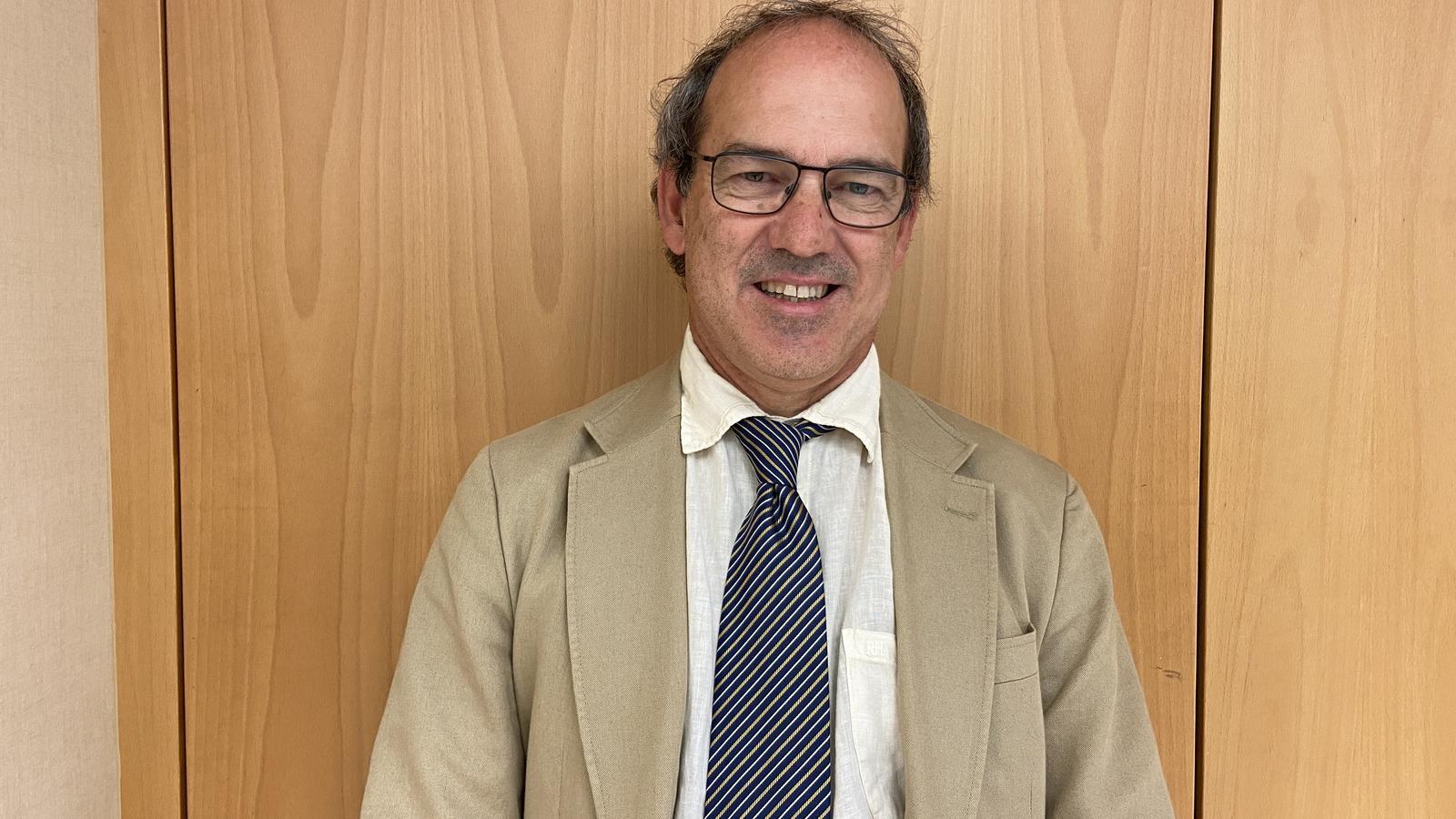
Sergi Querol: "No patient should be left without a transplant"
Director of the Bone Marrow Donors Registry (REDMO)
-
CAT -
CAST -
DE
PalmaEvery time a hospital needs a bone marrow donor, the REDMO initiates a search that crosses registries, hospitals, and borders. At the helm is Sergi Querol, a hematologist specializing in transplants and cell therapy. Before directing the Bone Marrow Donors Registry, managed by the Josep Carreras Foundation, he spent more than twenty years leading the Barcelona Cord Blood Bank and participated in the development of the British Anthony Nolan bank. Querol explains why 44 million registered people do not guarantee finding a compatible donor, how this international network works, and why the challenge now is to incorporate more young people into it.
There are more than 44 million donors registered worldwide. How is it explained that there are still patients for whom no compatible person appears?
— Fortunately, there are few. These are people with a histocompatibility system—the genetic marker we have—that is poorly represented in the registries. These 44 million donors mostly come from populations of European descent. For this reason, patients of African, Latin American, or mixed origin have more difficulties. In some cases, we have had to turn to registries in China to find a donor for a patient of Chinese origin. With people of African descent, we sometimes search the registries of the United States, Canada, or the United Kingdom, where there is a larger population of this origin. In Africa, there are very few registries. Even so, approximately 90% of patients in Spain find a donor. And not finding an almost perfect match does not mean that the transplant cannot be performed. We have alternatives: haploidentical family donors, unrelated donors with a lower degree of compatibility, or umbilical cord blood. Spain has more than 60,000 cord blood units. No patient should be left without a transplant if it is truly the best therapeutic option.
The median search time has been reduced to 26 days. What happens during this period?
— When we receive a request from a hospital, the patient team at the Josep Carreras Foundation consults the databases of the REDMO and the World Marrow Donor Association. Through compatibility programs, up to three possible donors are identified based on the degree of compatibility and the most suitable profile for the patient. We contact these individuals to find out if they still wish to donate, and they are surveyed about their health status and availability. Then, a blood sample is drawn from them, which is sent to the transplant center to confirm compatibility. If the center gives the approval, the donor is reserved for two months while the patient is being prepared. It is difficult for new donors to appear after three or four months, although we keep the search active for up to a year. Having reduced the median to 26 days places us very well compared to other countries.
What happens if the best possible donor has changed their mind, cannot donate, or it proves impossible to locate them?
— It can happen. The probability of a registered person being contacted is one in 250 each year, and that of making an effective donation, one in 1,000. It is most common for two or three years to pass between registration and the first call. During this time, the person may have developed an illness, changed their address, or be in a situation that prevents them from donating. In Spain, practically 80% of donors are still available when we call them. In countries like the United Kingdom, the United States, or Canada, this proportion can be reduced by half. That is why we study up to three donors in parallel: if one is not available, we have alternatives.
Which donors does the registry especially need?
— We need more young and diverse profiles, but also to increase the total number of donors. At REDMO we have more than 530,000 registered people, of whom a little over 100,000 are under 30 years old. We want to double this last figure until reaching 200,000. All donors are useful up to 60 years of age and I believe that over the next few years we will reach one million registrants. We must also balance the presence of women and men. Women represent between 64% and 65% of those registered in Spain, and men, approximately 35%.
Why is it difficult to reach young people?
— Sociological studies indicate that they do not have sufficiently clear information and that we do not address them in their own language. The culture of donation is also not part of secondary and high school curricula. We continue to have very institutional communication and many young people arrive at bone marrow donation through blood donation, but this is a small group. We must update the way we communicate, use social networks, turn to people who have influence, and show examples of donations. We are convinced that young people are as supportive as older people and we know that they offer better results in transplants.
A portion of the population still thinks that to donate marrow you have to have your spine punctured. What does the donation actually consist of?
— It is a very common confusion. The population tends to confuse bone marrow with the spinal cord, but they have nothing to do with each other. Bone marrow is the tissue found inside bones and produces blood cells. Perhaps we should talk more about blood stem cells. After administering medications called growth factors for a few days, these cells move into the peripheral blood. The donor's blood passes through a machine that selects the cells we need and returns the rest of the components to them. It is the procedure known as apheresis, it is done through the veins of the arms and has very few side effects. Extractions are still performed through punctures, but in the hip bones, very far from the spine. It is also a very safe procedure. In any case, 90% of our donors do it through peripheral blood.
Does sex affect compatibility? Can a woman only receive cells from another woman?
— No. Sex is not a main factor of compatibility. The histocompatibility system and other elements are, such as blood type or cytomegalovirus infection status. In some cases, there is a slight preference for men because women who have had pregnancies may present slightly more reactivity after the transplant. If two donors have similar characteristics, the one who has not experienced this phenomenon related to motherhood may be preferred.
Under what circumstances can a person who has already donated be called again?
— In Spain, the REDMO sets a maximum of two donations per person. The second is reserved for the same patient who received the first. It is a protective measure for both the donor and the recipient. It may be necessary if the transplant does not fully succeed or if the patient needs a new product, but it happens in very few cases.
No country is self-sufficient. How does this international network work?
— Compatibility is so complex that we all depend on an international solidarity system coordinated by the World Marrow Donor Association. Spain covers approximately one third of the transplants that need an unrelated donor with its own donors. We are the fifth registry in Europe by total number of donors and the thirteenth in the world. Germany is the country with the most registered donors, followed by the United States. When the patient already has a date for the transplant, transport is organized so that the cells arrive at the hospital on time. There are specialized couriers who take the donation door-to-door and flights, customs, and permits are coordinated. We always have alternative systems in case any difficulty arises. Every day, dozens of samples and donations circulate around the world.
After managing so many searches, what impresses you most: the difficulty of finding two compatible people or that a stranger agrees to donate to save another?
— The human part, without a doubt. Finding a match is like finding a needle in a haystack and, when it appears, you experience a kind of "eureka". But what is truly moving is knowing that a person performs a selfless act of altruism and love towards others. That is what continues to be impressive.
