“Officially, I do not live here”: the residential emergency also extends to rustic land
The housing crisis pushes families and workers to live in caravans, trailers and tool sheds on rustic land, outside of urban legality.
-
CAT -
CAST -
GER
Palma‘If you don’t have a house, nor the money to build one (...) put a caravan / in the middle of a plot / or expand a small shed / without permission to do so’, sing Ànimos Parrec. The song Veniu a es Pla, has already become an anthem for a land that never stops accumulating transformations on the margins of legality. With these lyrics, Julià Picornell ironizes about the proliferation of irregular dwellings and settlements on rustic land in the Pla de Mallorca.
In a relatively short stretch of one of the roads surrounding Petra, one can find caravans, tool sheds, and other structures converted into dwellings. The residential emergency extends beyond the metropolitan area of Palma and the main population centers of Mallorca and reaches, implacably, the rustic land in the interior of the island.
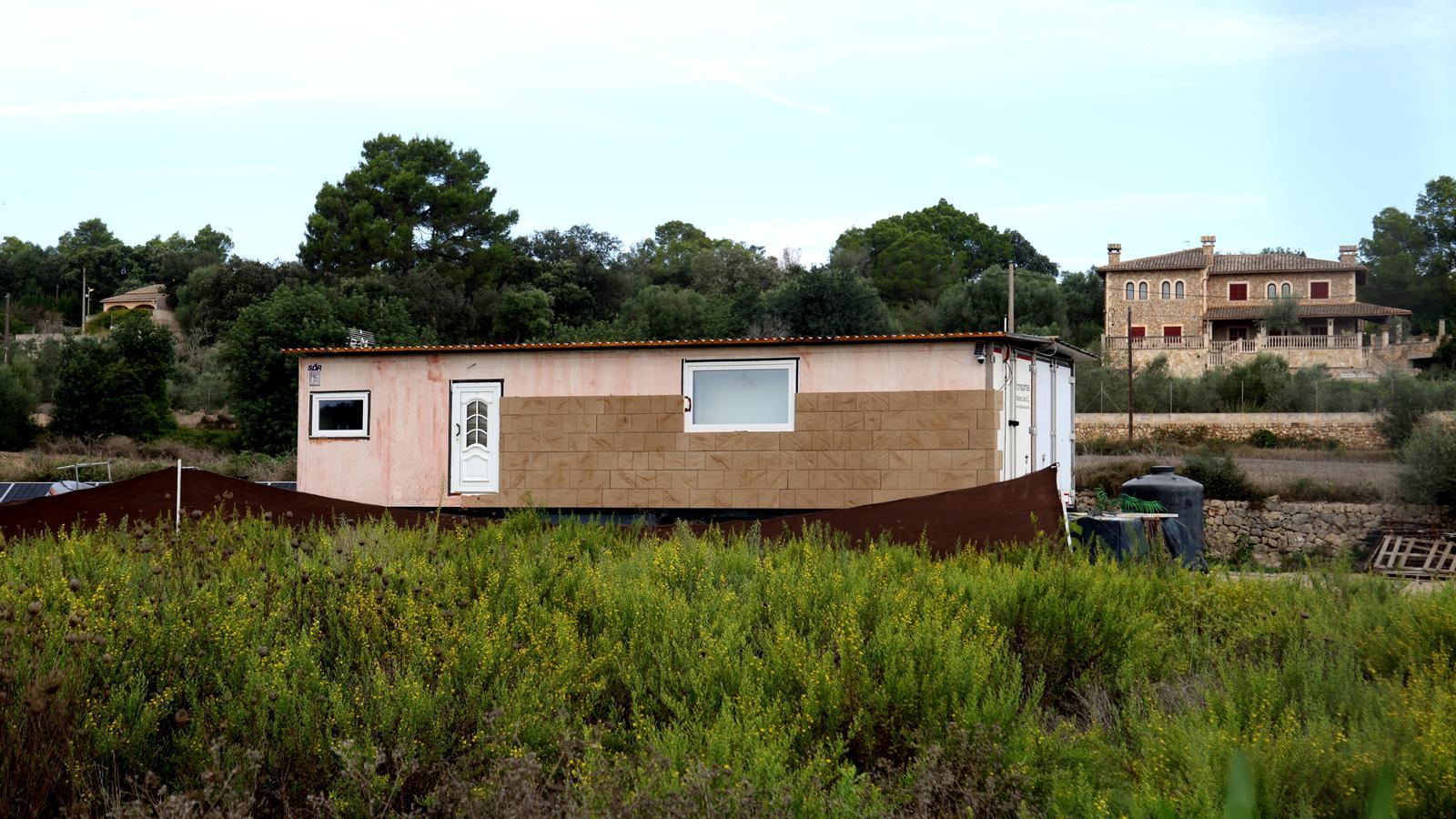
Francisco Lorca is from Murcia and works doing small renovations. After spending time in Germany and other northern European countries, he settled in Mallorca with his partner and their two daughters, aged four and eight. Now they live in the nearly 70 square meters he obtained by joining two trailer trucks. “They are not containers: they are trailers and they have wheels,” he remarks. He bought a property divided into three plots of 4,000 square meters for 7,200 euros while he was still abroad and decided to settle there with his family. “My wife went to a campsite that cost eleven euros a day and I came to sleep here,” he explains.

He turned the two truck trailers into a home, connected from the inside and covered with a facade featuring a door and windows. He installed solar panels, a water tank, and a purification system. He claims that the trailers are not anchored to the ground and that he has not laid any foundation. "Everything can be dismantled," he insists. Between the purchase of the land, the two vehicles which, according to him, cost him 6,000 euros each, and the labor, he calculates that he has invested between 35,000 and 40,000 euros.
Legality, however, does not depend solely on whether a structure has wheels. The Petra City Council sealed the construction in May. The action began following a citizen complaint. After a visual inspection, the Local Police confirmed that it was being used as a dwelling without a planning license or a certificate of occupancy. The City Council transferred the file to the Council of Mallorca and the Territory Defense Agency has already opened a file to determine the necessary measures to restore the altered physical reality, which may involve the removal of the construction and the restoration of the land.
Francisco states that the officers ordered him to stop work when he had just finished installing the exterior cladding and that he has left the rest of the material uninstalled. Faced with the seal, he defends himself with a phrase that summarizes the contradiction in which he lives: "Officially, I do not live here." Legally, no one can reside in a space without a certificate of occupancy; materially, however, it is the place where he, his partner, and his daughters have built their daily life.

He did not arrive there, he assures, by choice. Before that, he had had to live at his brother's house and had tried his luck off the island. With the land purchased and the trailers installed, he and his partner completed the space with a sandstone and wire mesh fence that has also been reported. "There is nothing here to rent. We have been looking for three years," he laments. He says that he has even offered to finish empty houses in the village in exchange for being able to live in them: "There are so many houses in Petra that don't even have windows. I have told them: 'I will finish it for you and you let me stay there,' but they won't listen to reason. Neither rent, nor anything." And he adds: "It makes me want to cry."
With the procedure open, he fears that at any moment he could be left with nothing. "I don't want my daughters to end up on the street," he says. That is why he is already thinking about selling what he can and heading towards Asturias, where he has heard there are villages that need inhabitants. The shadow of withdrawal and eviction hangs over what he now considers his home. If the file ends with a restoration order, he may lose a large part of the money invested. "I only ask to live, nothing more. If I don't have half a million euros, is it my fault? I have been working my whole life," he insists.
Prohibited, by law
Law 6/1997 on rustic land of the Balearic Islands establishes that outside the areas expressly enabled by general planning, caravans, trailers, and other mobile elements susceptible to being inhabited cannot be placed. That is to say, they can only be implemented in spaces delimited for this purpose, such as campsites recognized by the planning. In the rest of the rustic land, it is not a use that can obtain ordinary authorization, but rather an action subject to urban discipline.
Jaume Munar's doctoral thesis on the urban regime of Balearic rustic land reinforces the legal argument: outside of expressly delimited zones, these habitable elements cannot be authorized, not even on a provisional basis. The legal provision aims to prevent a temporary license from being used to circumvent the general prohibition. Therefore, the fact that a caravan or a trailer retains mobility does not automatically make its permanent residential use legal.
The competence to act in these cases depends on each municipality. When the city council has delegated urban discipline on rustic land to the Council (Consell), it is up to the ADT to inspect, instruct the files, and order, if applicable, the restitution. If it has not delegated it, the responsibility lies with the town hall.
Administration sources knowledgeable about the regulations also warn that many of these implementations are not detected through official inspections, but rather after complaints from private individuals.
Cases throughout Mallorca
The one in Petra is by no means the only case of this type of precarious housing that is spreading across the rustic land of Mallorca. In Manacor, in September 2025, the Government's Housing Inspection Service detected 11 shacks being used as housing near the racetrack. According to the investigation, the owner charged illegal rents to vulnerable people and the living spaces shared only two bathrooms and two kitchens.
In Sencelles, the ADT had an advanced file in 2025 against a caravan settlement on a rustic estate. In these cases, the penalty can reach 175% of the value of the facilities and coercive fines can be added as long as legality is not restored. If the offender does not comply, the Administration can remove them subsidiarily, but sources from the Council warn that the procedure can take years. Furthermore, everything is complicated when the owner of the land and the owners of the vehicles are not the same person.
In Santa Eugènia, about fifteen caravans allegedly intended for residential rental for about 250 euros per month have also been documented. Families and workers who had not been able to access conventional housing lived there. The settlement, with caravans, prefabricated huts, and makeshift facilities, did not have running water. The Administration took action there due to residential use on non-developable land.
The proliferation of sub-housing adds to decades of irregular buildings and territorial consumption in the Majorcan countryside. Urban planning discipline can sanction and order the removal of what the law does not allow, but it does not solve why a family ends up living in two trailers.
The sealing in Petra exposes the collision: the Administration must restore legality while the residents do not find an affordable alternative. Between a rule that prohibits the settlement and a market that expels them, Francisco and his family continue to say that that is their home, even if, officially, they do not live there. “If I found a house for 50,000 euros I would stay, because I love Mallorca and my daughters need stability, but there is nothing.”
