The drama of the 0-3 teachers: "We survive on what the families give us"
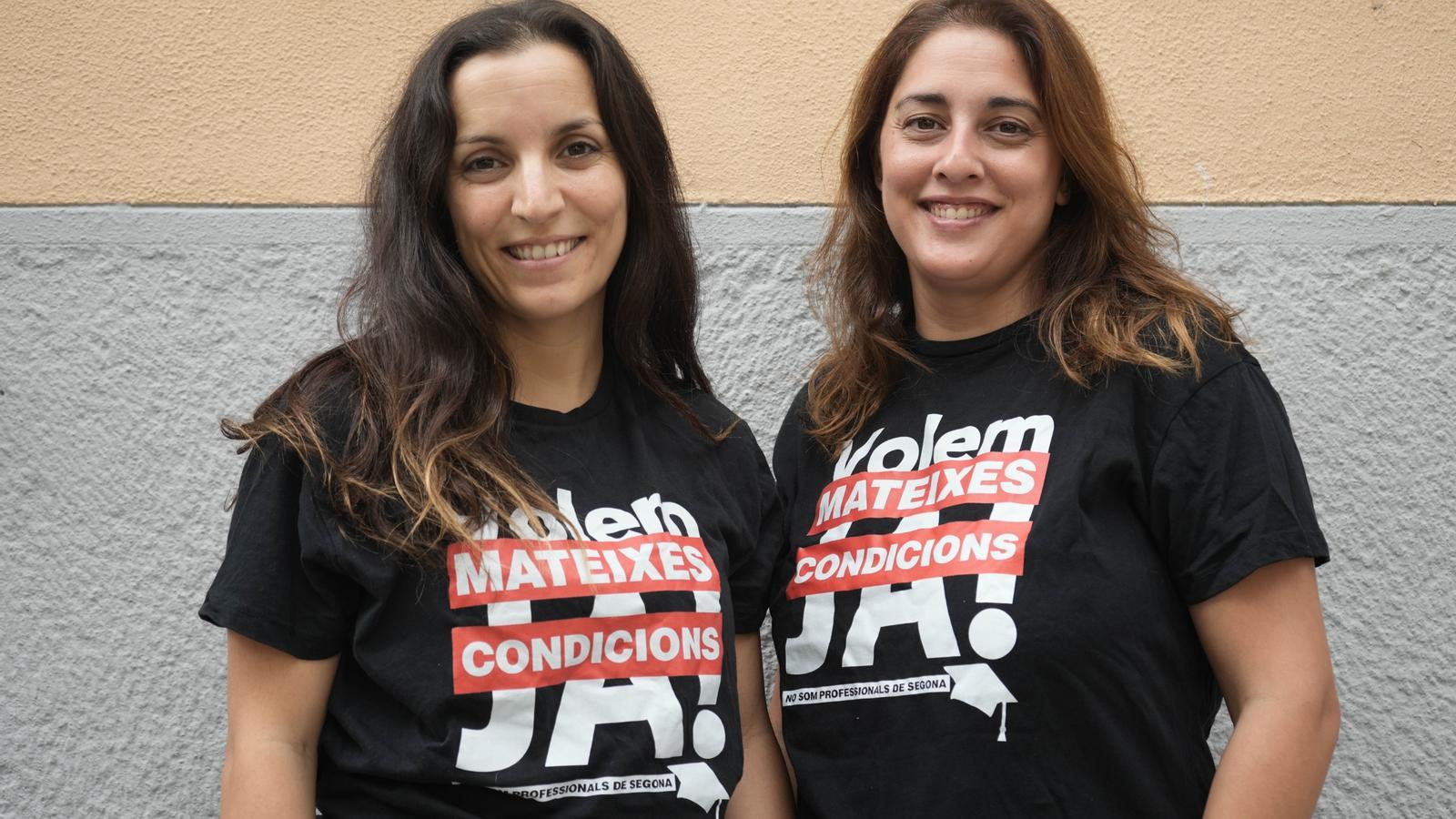
Clara and Marga, 0-3 teachers at the Ciutat Antiga school in Palma, explain how job insecurity and the lack of resources condition their lives inside and outside the classroom

-
CAT -
CAST -
GER
PalmaClara Ruiz begins her day while it is still dark. She wakes up at 6 a.m., gets ready, leaves home, and walks for half an hour to Ciutat Antiga, an outsourced municipal nursery school in Palma, where she works as a 0-3 year old teacher. At 7:30 a.m., the early morning service begins: she organizes the day, monitors the children's arrival, and assists families if there is any problem that requires help.
The day passes among children, meetings, office tasks, coordination with colleagues, and problems that must be solved on the fly. Above all this, the unfulfilled promises of the Administration hover. The feeling is that "every day it is a little harder to get to everything," she says.

In January of this year, the new contract for the outsourced nursery schools of Palma was announced with great fanfare, which included a salary increase—currently they earn about 1,200 euros—and a budgetary increase of two million euros. Nine months later, the improvements that, in fact, had been agreed upon in 2024, after a strike lasting several weeks, still have not taken place. "It has been many months in which one thing is promised and new problems always arise," explains Clara, who laments how "the passage of time takes its toll on energy, effort, and positivity."
Marga Isern, a colleague of Clara, has a young daughter. They began their demands when she was still pregnant. Now the child is 16 months old. One of the moments she remembers with the most helplessness arrived just before the start of the school year, a few weeks ago. Throughout the summer, just as had been agreed, they had prepared for the arrival of the educational partner—an extra teacher to teach simultaneously.
"The teams were already organized and some colleagues had left other jobs because they were expecting to join the preschools," she explains. But on September 3rd, just one day before starting the school year, around three in the afternoon, the message arrived. "I arrived home and said goodbye to my colleagues: 'How great, tomorrow everything begins, we will all meet up.' And boom: it turns out not," recalls Clara. At that moment, Marga was at home waiting for her husband with her daughter. "I was very excited and I froze," she explains.
Uncertainty also reached the families. When it was announced that the additions would not take place, there were still no children in the classrooms, and the teachers took on the content of the message with the mothers and fathers. "The families were freaking out," explains Marga. "Weren't there supposed to be two of you in the classroom?" was the most repeated question.
For Clara and Marga, the labor conflict has a direct consequence on what worries them most: the care of the children. "Politicians could come one day to see the situation. They would verify what the precariousness of Palma's schools is like. They have no idea," says Marga.
"How do you play with 18 children with a little kitchen?"
The material is one of the examples that best explains this situation. Marga remembers that the last significant endowment they received at the center was approximately five years ago. Among the material were eight dolls, two animal sets, two construction sets, and a play kitchen. "How do you play with 18 children and one play kitchen?", she asks. Clara adds: "Eight dolls for ten classrooms of 18 children... The numbers don't add up".
For this reason, the teachers try to complete the classrooms with material they buy themselves or with donations from families. In the case of Ciutat Antiga, they explain, many families also find themselves in a situation of vulnerability. "Many times we buy material that we like ourselves to fill our classroom", says Clara. "We survive on what the families give us or what we buy out of our own pocket", reiterates Marga.
Marga also explains that this situation has led some workers to decide to change sectors. "No matter how much vocation you have, if the balance doesn't pay off, you choose to be able to pay the bills," she says. She gives the example of a colleague who ended up working as a taxi driver. Clara explains that another has opted for Social Work with users with special needs, with a different collective agreement and a better salary.
In Clara's case, the economic situation has also forced her to make personal decisions. When she got married, she explains, she had imagined a wedding with all her friends. Finally, she opted for a "super intimate, family, homemade" celebration.
Clara explains that there are also part-time workers who have tried to apply for a mortgage and it has been denied. "These are salaries of 600 euros for part-time work," adds Marga.
6,000 signatures at the Department
Recently, the 0-3 Network of the Balearic Islands, together with the sector's trade union representation –CCOO, UGT and STEI–, delivered 6,000 signatures to the Ministry of Education to demand solutions. The group considers the Administration's management an "absolute nonsense" and insists that the creation of a specific 0-3 Board is an urgent necessity to bring to the table the reality of the more than 900 workers in outsourced municipal nursery schools.
Furthermore, their two main demands are the start of negotiations for an Autonomous Collective Agreement for 0-3 Early Childhood Education and the revision and realistic application of a new Minimums Decree. The group has already reactivated protests across all the Islands, among others, at the plenary sessions of Cort and the Balearic Parliament, where they have denounced the delays in the tendering of the new contract and the impact they have on their salaries and the conditions of care for the children.
