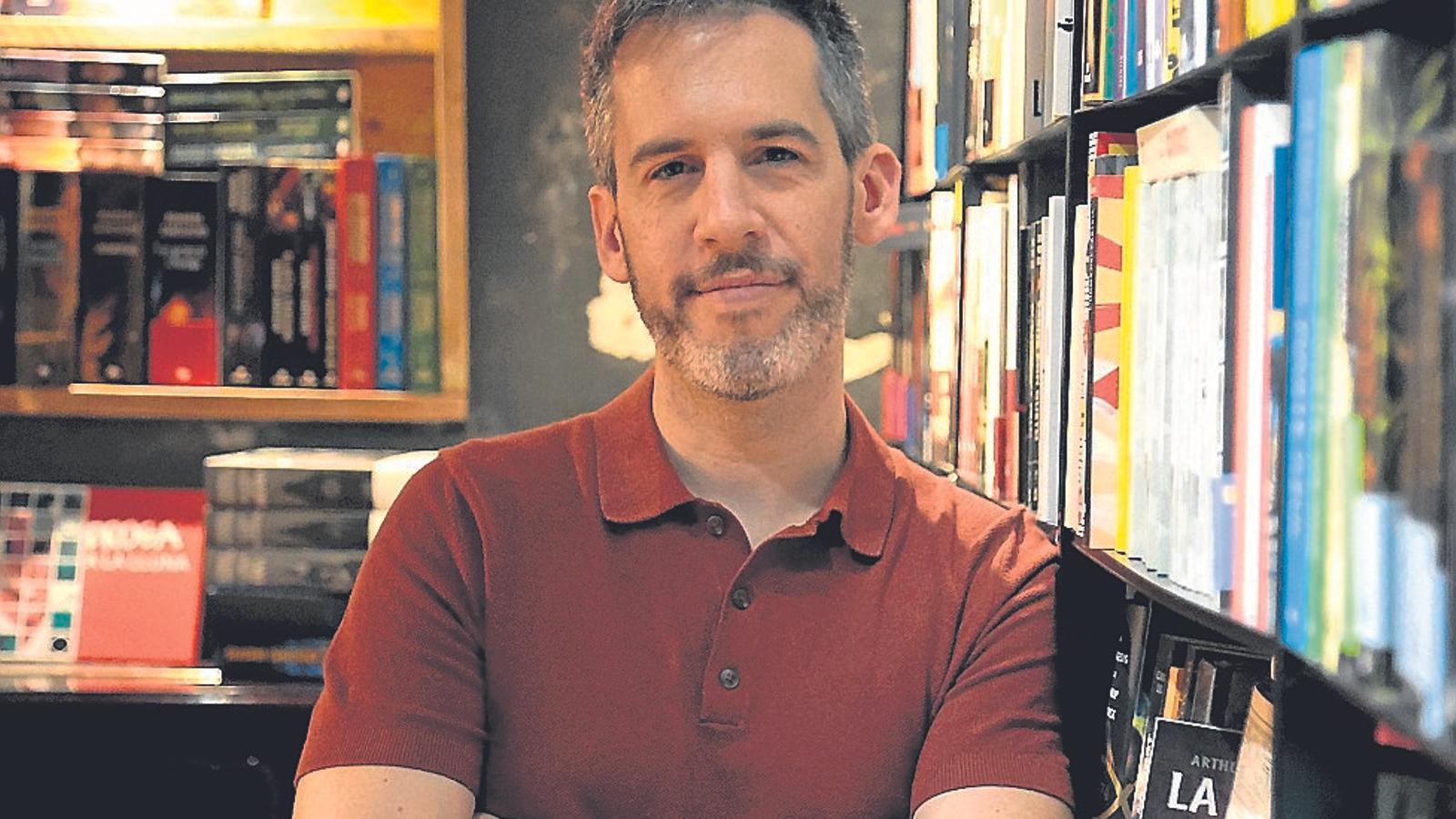
Jaime Palomera: "People who live from their work are increasingly out of the game"
Anthropologist, activist and housing expert

-
CAT -
CAST -
DE
PalmaJaime Palomera (Barcelona, 1983) is part of the Urban Research Institute of Barcelona (IDRA) and is one of the founders of the Tenants' Union. A year ago he published the book The Housing Heist (Pòrtic Editorial), which attempts to explain how the gap is widening between rich landlords, who are getting richer and richer, and tenants, who are getting poorer and poorer.
Who has hijacked housing?
— When I speak of hijacking, I am referring to a systemic problem, the result of political decisions over the years, which has led us to a hijacking of the primary function. A dwelling is a house, but this function is nullified and priority is given to the function of [financial] asset.
Since when has the current situation been brewing? In the second half of the 20th century, many people could buy an apartment.
— Throughout the 20th century, in Spain and other countries, there was a commitment to a society of owners and a democracy of rents. One could be an owner and benefit from the price of land and houses. Even if your salary didn't increase, the price of these assets in the hands of families did, and this generated a sense of wealth. The problem is that those who are not within the club of owners find it increasingly difficult. If your salary doesn't go up, how do you get in? This happened with the 2008 crisis and is not an anomaly. Since prices were rising from the early 2000s, families were getting more indebted. Because the model of a society of owners is unsustainable, as the price always goes up, those who acquire more and more houses are the rich. When you decide that houses enter the market and behave as assets, those who already owned properties and can buy new ones win.
Does homeownership change the axis of class society?
— People who have a home to live in are not so different from those who don't. For these families, it is increasingly difficult to maintain their property, because the welfare state is being dismantled in Spain and Europe. When working people get old, they often have to sell their homes to secure a retirement, and it is very difficult to pass them on to their children. And those who own properties, plural, are accumulating more and more. There is so much accumulated wealth that there is no choice but to reinvest it, also in houses. In this way, those who own properties compete for the most basic resources with those who do not have a guaranteed home. Inequality is growing, because wealth is increasing very aggressively compared to the population's wages. People who live off their work are increasingly out of the game. The underlying problem is that hoarding must be curbed, and taxes are the tool of governments. If not, it is an irreversible process. Those who buy homes to enrich themselves must be heavily taxed, so that those who need a home do not have to compete. Inequality scholars like Piketty and Zucman have analyzed the process: a small part of society is increasing its wealth at a frenetic pace, hoarding more essential goods and resources. Therefore, the possibility of getting rich from housing must be made zero. Wealth inequality is a problem that will not disappear, but will only grow.
Why has there not been a strong social outburst regarding housing?
— The last 50 or 60 years are a parenthesis in the history of Europe. Everything before it is extreme inequality, with a minority accumulating wealth and a dispossessed part. The question is to what extent people are willing to accept that they will live much worse than their parents and grandparents. The situation can always get worse from a material point of view. What do people consider intolerable? In 2024 and 2025 there were mobilizations, and they will increase. Half of the population will inherit nothing and the division is very severe in Spain. But it is not just a matter of partisan politics. Certain conservative and centrist sectors must understand that, if they do not curb inequality, society will be increasingly broken. A middle-class society is being dismantled where a large part of the population owned property, could go on vacation and leave assets to their children. Now, the baby boomers live with anguish the situation of their children and grandchildren. Some are returning to work and accelerating donation processes.
An argument used in the Balearic Islands is that more construction is needed.
— If the population increases, as in the Islands, you will need more available housing. But if you don't change the rules of the game, no matter how many homes you build, many will be acquired by those who want to use them as an asset. There will be fewer owners with more houses, more people without, and the price will increase.
The real estate lobby has more power than institutions?
— There is a party we could call real estate, which does not run in elections and has a lot of influence. It ensures that the profitability of housing, these assets, increases and that those who have capital have no problems at all. Money has two ways to invest in housing: buy directly or help others to buy with a mortgage. In the second case, instead of charging a tenant, interest is charged. Mortgages are another form of income, passive income, and the mortgage system is interested in the price never falling. But both ways inflate prices, generate income for those who already have many assets, and impoverish those who do not have a home.
Is there any point in setting a cap on housing? The Government assures that it is a failed measure.
— In addition to curbing wealth hoarding, you must also protect the population within the rental system. When they say the solution is to build, I agree that affordable housing needs to be built. But things should not be presented as a dilemma, because an entire generation that needs housing now is left without an answer. European countries that have bet heavily on public housing have also regulated the rental market to protect the population from abusive price increases.Strategies are needed in the short, medium, and long term. Taxation and market regulations that protect the population are short-term. Presenting construction as an alternative is a false dilemma, because you are not proposing a solution for now. The right of first refusal for institutions is another way [the power that allows administrations to purchase properties as a priority, before they are sold to a third party]. But the real estate lobby does not want it because of the signal it sends to economic operators: these are homes that become public at a lower price, and what is of interest is the opposite, that they increase more and more.
