From the first train to the current network: 150 years of railway in Mallorca in a book
Carlos Olmo reviews the evolution of a service that began in 1875 with the line between Palma and Inca and that the Government has managed since 1994
-
CAT -
CAST -
DE
PalmaThe project that Eusebi Estada conceived in the 19th century laid the foundation for Mallorca's current railway network. From that first line between Palma and Inca, inaugurated in 1875, to the expansion of the metro to ParcBit, 150 years of expansions, setbacks, and railway recovery have passed. Serveis Ferroviaris de Mallorca (SFM) now captures this history in the book 1875-2025. 150 years of railway in Mallorca.
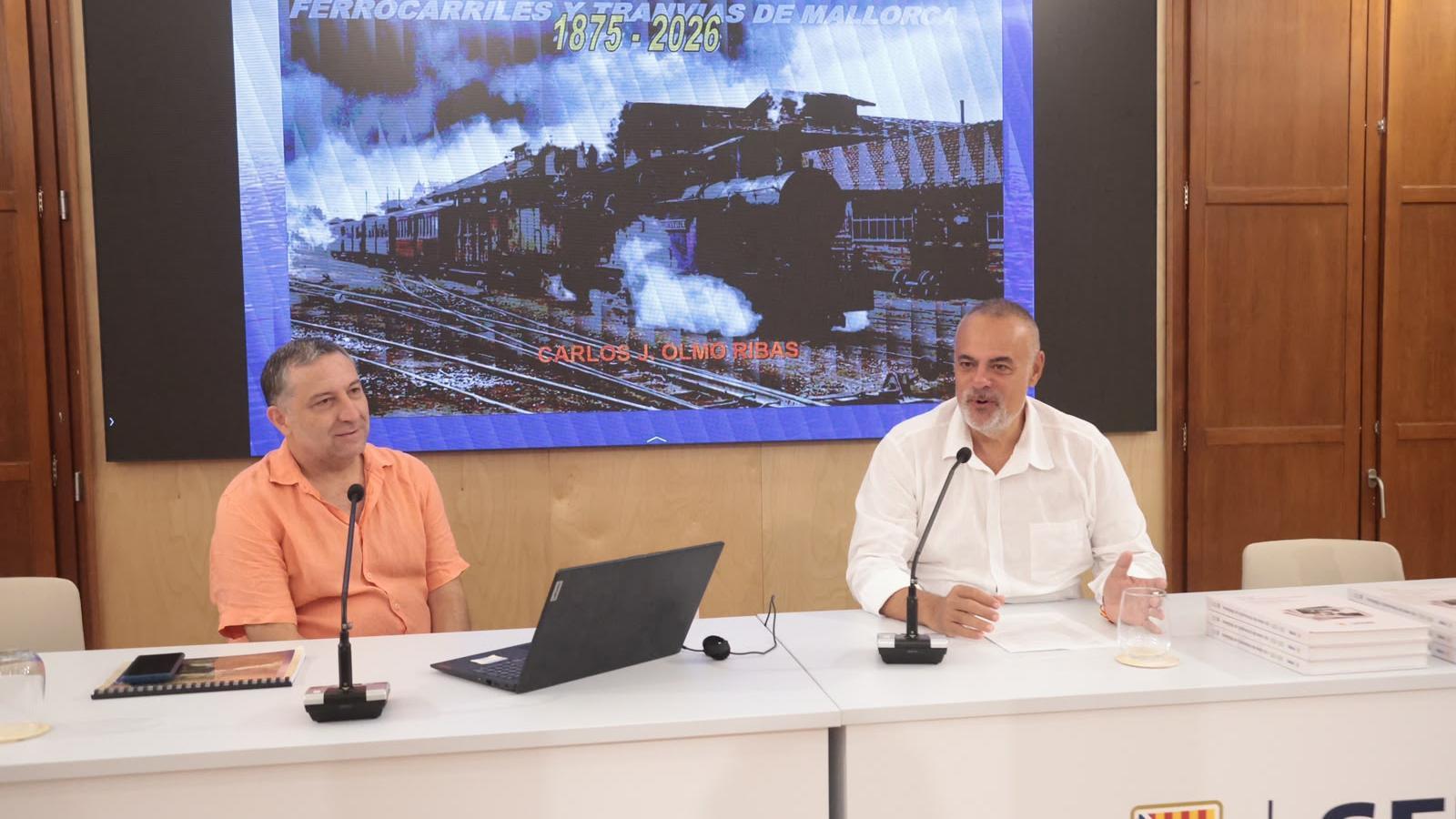
The publication was presented this Monday at the Términus building in Palma, the current institutional headquarters of SFM, in an event attended by the manager of the public company, José Ramón Orta, and the author of the book, Carlos Olmo. An active driver and a researcher specializing in Mallorcan railway history, Olmo has spent years documenting the evolution of an infrastructure that has played a decisive role in the island's economic, social, and territorial development.
Eusebi Estada was the main ideologue and promoter of the Mallorcan railway. After publishing Studies on the economic feasibility of establishing a railway between Palma and Inca, he promoted an initiative with local capital and financed with island funds. The promoters even renounced state subsidies to avoid state control over the railway company.
The project aimed to connect Palma, Inca, and Manacor, as well as extend the network to the Port of Alcúdia. The Palma station was built in 1875 in Plaça de la Porta Pintada, and that same year the first line to Inca was inaugurated. The train reached sa Pobla in 1878 and Manacor in 1879.
The implementation of the network transformed a predominantly agricultural society with very limited travel possibilities. The railway facilitated the movement of people and goods and contributed to the territorial articulation of Mallorca during the late 19th and early 20th centuries.
The book covers the different stages of this history but dedicates special attention to the period that began in 1994. That year, the Government assumed the railway competencies transferred by the State and created Serveis Ferroviaris de Mallorca, the public company that has managed the network ever since.
Modern infrastructures
This regional stage began after years of decline for the train and has been marked by the recovery of services and the modernization of infrastructure. Among the actions undertaken during these three decades are the reopening of lines, the remodeling of platforms, the restoration of railway buildings, and the renewal of tracks.
One of the most important works of this period has been the burying of the tracks and the construction of the Palma Intermodal station. The facility has ten railway tracks and five platforms, as well as thirty bays for interurban buses. To this transformation were added the commissioning of the metro to the University of the Balearic Islands and its extension to ParcBit, operational since July 2025.
The publication also addresses plans to continue expanding the network. Among the projects in progress are the line between Palma and Llucmajor, with planned stops at points such as Son Llàtzer, the airport, and El Arenal; the extension of the Sa Pobla train to Port d'Alcúdia, and the extension of the UIB metro to Son Espases.
SFM has published a thousand copies of the book: 600 in Spanish and 400 in Catalan. The presentation was held at the Términus building, a historic space linked to the train that has recently been recovered as the institutional headquarters of the public company.
