Ready for a "movie" eclipse: "We will see the stars and, then, the sunset"
Experts expect a "spectacular" and "unrepeatable" phenomenon, although it will have little "scientific appeal" because the Sun will be very low on the horizon
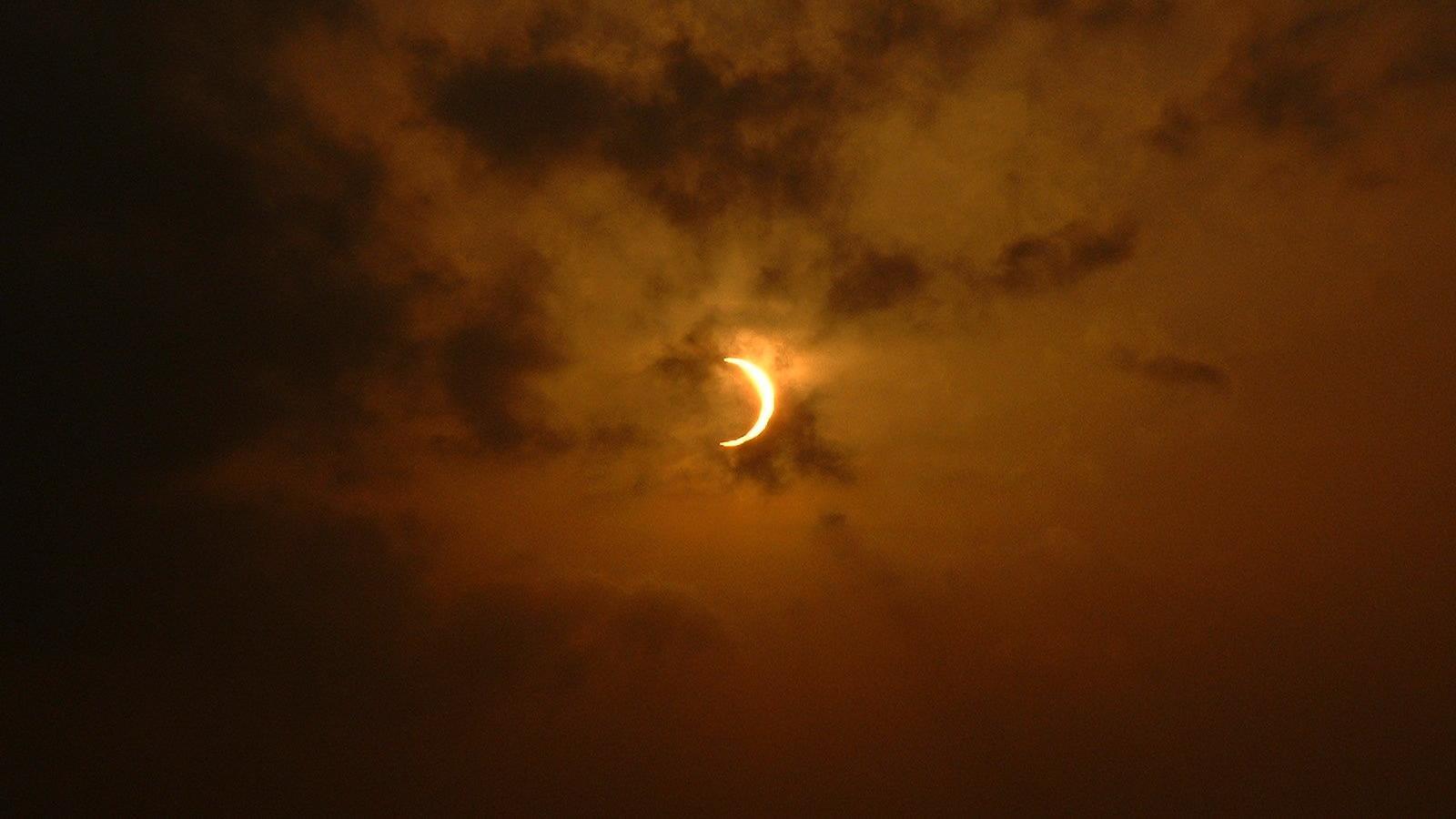
PalmaAstronomers and enthusiasts in the Balearic Islands are all set to observe the total solar eclipse that will occur this Wednesday afternoon. The phenomenon, which can be seen from the Islands in particularly unique conditions, promises to be an extraordinary visual spectacle, but it will have little "scientific appeal" due to the difficulties that will arise in taking precision measurements.
The Foundation of the Institute of Astronomy and Astronautics of Mallorca (Fiaam) has been one of the entities that has led the planning of the event, both in scientific aspects and in safety recommendations, outreach, and advice. Its scientific director, Salvador Sánchez, has been part of the team that in April 2025 presented a report to the Government with recommendations to address not only this eclipse, but also the two predicted for 2027 and 2028.
Initially, Sánchez explained in statements to Europa Press, the Executive "was stunned because they didn't know what was coming their way." A decision was made to create an interinstitutional commission in which, as he claimed, many of the decisions adopted bear Fiaam's signature.
The doctor in astrophysics and collaborating researcher at the University of the Balearic Islands (UIB), Sebastià Barceló, is another of the experts who has participated in the coordination commission promoted by the regional administration.
A movie-like scenario
All this with an eye on 7:35 PM this Wednesday, when the Moon will begin to cover the solar surface. The eclipse will advance progressively until 8:32 PM, when day will turn into night.
If the clouds do not prevent it, Sánchez explained, it could be "the most spectacular solar eclipse ever seen in centuries."
"We will see the stars and, when it ends, there will be a sunset. A movie-like scene," he assured.
This spectacularity contrasts with the little "scientific appeal" the phenomenon will have from the Balearic Islands. The reason is that it will occur when the Sun is only two and a half degrees above the sea, which will prevent "precision measurements."
Since there will be "little science involved," the objective of the Fiaam team, many of whose members have already observed other eclipses in Germany, Sweden, Iceland, or South Africa, will be to "obtain spectacular and unrepeatable images of the sequence."
And, as a cherry on top, they hope to obtain complete sequences of the green ray, the refraction of the last ray of light as the Sun sets over the sea. Any citizen, if they take a burst photograph, can capture this phenomenon, Sánchez pointed out.
It is more unlikely that, at the moment the Moon completely covers the Sun, any Perseid or Saint Lawrence tear, common at this time, can be observed. "They could be seen, but it is very difficult, because they are best seen from midnight onwards," noted the astronomer, who will nonetheless have his camera ready in case it happens.
Barceló, who has been waiting for an event of this caliber since deciding to dedicate himself to astrophysics, also agreed in pointing out the few scientific attractions that observing the eclipse from the Balearic Islands will have. "It is true that relativistic effects will not be well appreciated and that it will be difficult to measure the differences between stars due to this effect, but a reference can be obtained for future eclipses," he explained.
Nevertheless, from the measurement of the solar corona, a region that "is still to be studied and is very interesting," some elements of interest can be extracted. This is a matter on which the UIB conducts research, although they will not initially use the information for these studies.
In any case, both Fiaam members and university researchers will be deployed to various points in the Balearic Islands to try to obtain the best possible records of an eclipse that will probably not be repeated for more than a century.
Some will be in an area set up by the authorities of Estellencs, where Fiaam will install a hydrogen-alpha telescope that, among other things, will offer live signal. Others will be distributed at key points in the Serra de Tramuntana, such as Sóller and Formentor, but also in the Trenc Natural Park.

Menorca and Ibiza are also preparing
Although Mallorca will be the island where the eclipse can be observed in better conditions, astronomy enthusiasts from Menorca and Ibiza also did not want to be left behind.
At the Agrupació Astronòmica d’Eivissa, founded in 1956 and currently with around 180 members, they have been preparing themselves and the people of Ibiza for this Wednesday's total solar eclipse for almost a year. "We have been constantly talking about the subject in schools; these have been months of almost exaggerated outreach activity," its spokesperson, Pedro Pérez, one of those in charge of giving these talks, explained to Europa Press.
Some of the group's members will stay in Ibiza to capture a phenomenon "without astronomical novelties but fantastic on a social scale" and will try to record the atmospheric elements of the moment, one of the "appeals" of the eclipse. One of his colleagues, a Frenchman, will send data to Paris.
Others, considering that Ibiza is not one of the best places to observe the phenomenon and given the prediction that the island may collapse, have decided to travel to Galicia or León. "This, touristically, is one of the best places in the world to see the eclipse. But scientifically it is not so," Pérez stressed.
Javier Ares, founder of Polaris Menorca, a company dedicated to outreach and offering experiences related to astronomical observation, has also been preparing for this moment for a long time. For two years he has been traveling around Spain giving training on observing an eclipse that will be the first for many, but not for him. With his team and his clients, they will set up four telescopes on land on the coast of Ciutadella, the location of which he prefers not to reveal to avoid it becoming overcrowded. They will not extract much data, he pointed out in statements to Europa Press, but they will try to make the most of the visual aspect of the phenomenon.
If Galicia will be "the gateway" for the eclipse in Spain, the Balearic Islands will be the last territory from which it can be observed with clarity.
"It will be a sunset that you catch once in a lifetime or you don't catch it at all," he stated.
