The Balearic government orders the demolition of the illegal swimming pool of journalist Pedro J. Ramírez in Son Servera
The Executive enforces the sentence of the National Court after 20 years of litigation with activists who denounced private use in public domain

PalmaThe Balearic Minister of the Sea and Water Cycle, Juan Manuel Lafuente, has signed a resolution that some believed impossible: the definitive authorization to demolish the swimming pool, the pier, and the terrace of the villa owned by journalist Pedro J. Ramírez on the Costa dels Pins (Son Servera, Mallorca), which occupy public land without the corresponding authorization in force. In this way, a story that began 25 years ago and has involved a marathon lawsuit between Ramírez and a group of entities and citizens led by the Mallorcan activist and independentist Jaume Sastre is practically brought to an end.
The origin of the case dates back to January 23, 2001, when the Ministry of Environment granted Giuliana Arioli a concession to occupy approximately 350 square meters of maritime-terrestrial public domain (the coastal strip that cannot be occupied for private use) to access the sea directly, as well as to enjoy a private swimming pool. That decision was made during Jaume Matas's tenure as minister and included a key element: the facilities, especially the swimming pool, were only accepted under the premise that they would have public, general, and free use. In 2013, the State authorized the transfer of the concession to Pedro J. Ramírez, who had acquired the property a few years earlier.

The Coastal Law establishes that the maritime-terrestrial public domain can only be occupied for activities that, by their nature, cannot have any other location. “A swimming pool or a private terrace hardly fit this criterion, although it is true that throughout history there have been similar cases, always protected by supposed public uses”, explains a technician from Coastal Demarcation who requests anonymity.
In fact, in the Balearic Islands and the rest of Spain there are hundreds of cases of small irregular constructions, some with demolition orders and others involved in processes where owners try to prove that the historical value of the building (such as an old fishermen's slipway) justifies the non-compliance with the Coastal Law. At the moment, the Government is processing a coastal law that aims, as the Valencian Country has already done, to legalize some of these buildings. But the Ministry of Ecological Transition and the courts have carried out several actions, always in the same direction: the first few meters of the coast (20 or 100, depending on the situation) are untouchable and no construction for private use can be built there permanently.
Jaume Sastre and a group of activists requested the file from the Coastal Demarcation in 2004. It was not easy, but they combined public demonstrations and legal action to prove that it was not possible to build a swimming pool, a terrace, and a mooring for private use in the public domain strip.
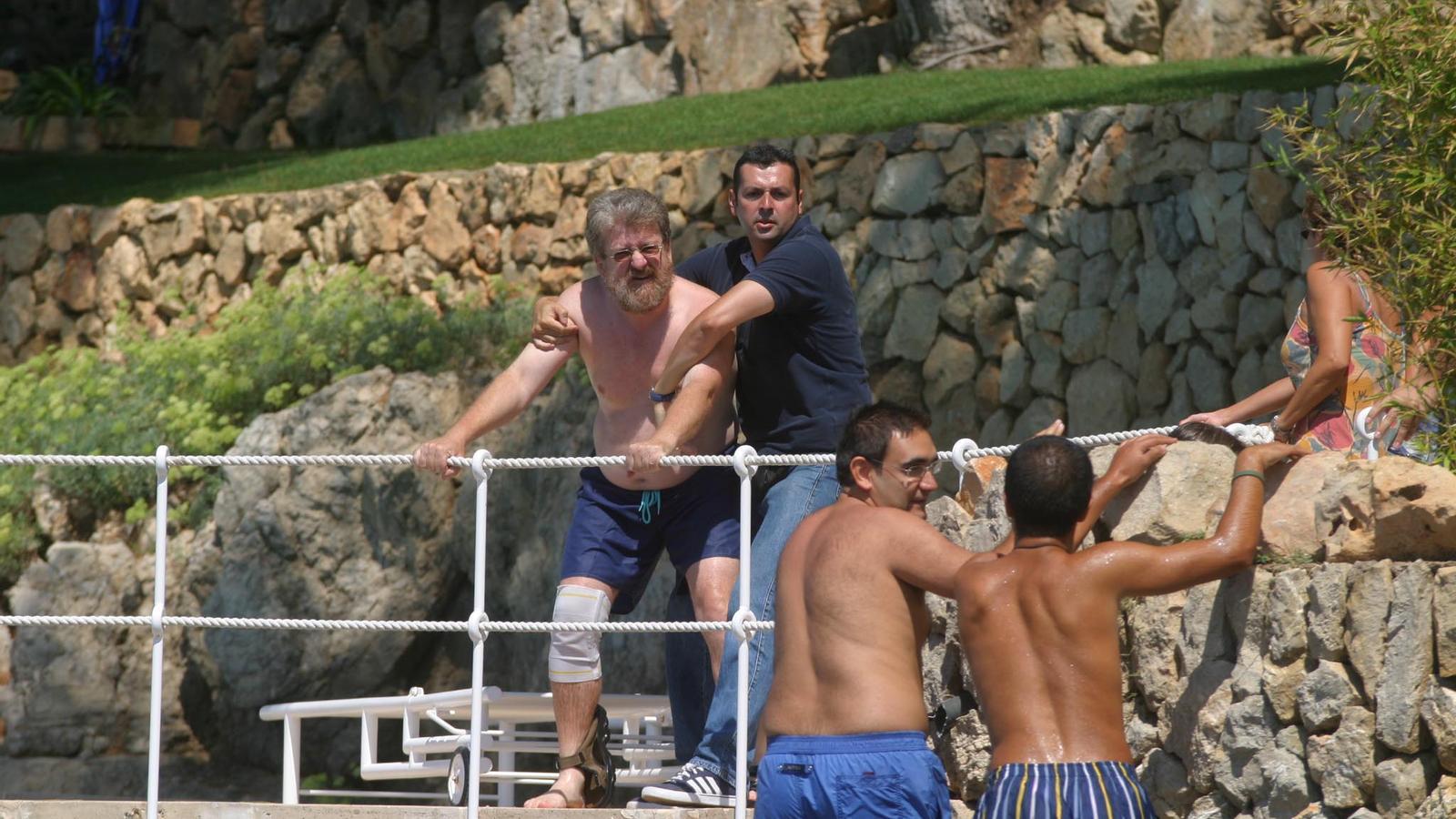
Some direct actions ended in a physical confrontation between the protesters, who wanted to enjoy the swimming pool by accessing it from the public strip, and the security guards hired by Pedro J. Ramírez. Those disturbances also ended up in court. For a few years, the classic Mallorcan summer was the landing of the protesters in the journalist's domain and scenes of the security team forcibly expelling them.

In 2006, with the Ministry of Environment in the hands of socialist Cristina Narbona, one of the most controversial justifications for the case was introduced: the possibility that students from Son Servera could visit the swimming pool to carry out environmental activities. It was a strategy to try to demonstrate that a villa's swimming pool could make sense even if it occupied public land. This proposal was based on a document signed by the then Minister of Education of the Balearic Government, Francesc 'Tito' Fiol, who, to the surprise of many, asserted that a swimming pool and a pier in a luxury villa area are an educational resource.
However, this use did not materialize: there were no stable programs or regular visits. In practice, the swimming pool functioned as a private space, while the public use coverage remained on paper.
Despite this background, the Ministry decided to extend the concession. In 2014, an extension was granted, and in 2016, the duration was set until February 27, 2074, a date that meant 60 more years of occupation of public land.
The decision was legally challenged by Jaume Sastre, which led to a key ruling by the National High Court. In its 2021 ruling, the court recalled that the extension of concessions is not automatic, but a discretionary power of the Administration, which must be duly justified and guided by the general interest and the protection of the coast. According to the Chamber, this was not the case. The ruling is particularly critical of the arguments of the state Administration, which had accepted theories such as that the facilities were integrated into the environment and that demolition could generate excessive impact.
Furthermore, the court highlights a key contradiction: the original concession was only accepted because the pool and terrace had public use. Essentially private use constitutes a substantial modification of the concession title. It also pointed out that the extension cannot serve to consolidate situations that violate the essence of the public maritime-terrestrial domain, which is inalienable and intended for free, public, and gratuitous use. In this regard, the ruling recalls that there are reasons of general interest to deny the extension and recover the space and guarantee its common use for activities such as walking, swimming, and accessing the coast.
With this reasoning, the National High Court declared the ministerial orders of 2014 and 2016 null in 2021, in addition to declaring the concession extinguished. It also imposed costs on the Administration and the holder. However, despite the victory of Jaume Sastre and environmental and citizen organizations such as GOB and OCB, and political parties such as PSM and Verds, who supported the cause from the beginning, there was still a long way to go. The appeals of the journalist's representatives attempted to prolong the procedure.
Some even took for granted that the Government of Marga Prohens would try, through the ongoing processing of the coastal law, to save the construction. But sources from the Ministry confirm to ARA Balears that "it was competently impossible." "The ruling of the National High Court is very clear and the Balearic Islands do not have enough powers to impose other uses on the public maritime-terrestrial domain," they point out.
Now, with the execution of the sentence confirmed by the autonomous administration, there is still one step left: obtaining a municipal building permit to carry out the demolition. According to sources familiar with the procedure, "there is nothing to be done: the pool and the rest of the irregular facilities are condemned and will be demolished." "The Son Servera City Council cannot refuse it," they conclude.
