The minute and a half that transformed the Platja de Palma
The Arenal has erupted in applause as the Moon has covered the Sun and turned the city's coast into an immense open-air observatory

-
CAT -
CAST -
DE
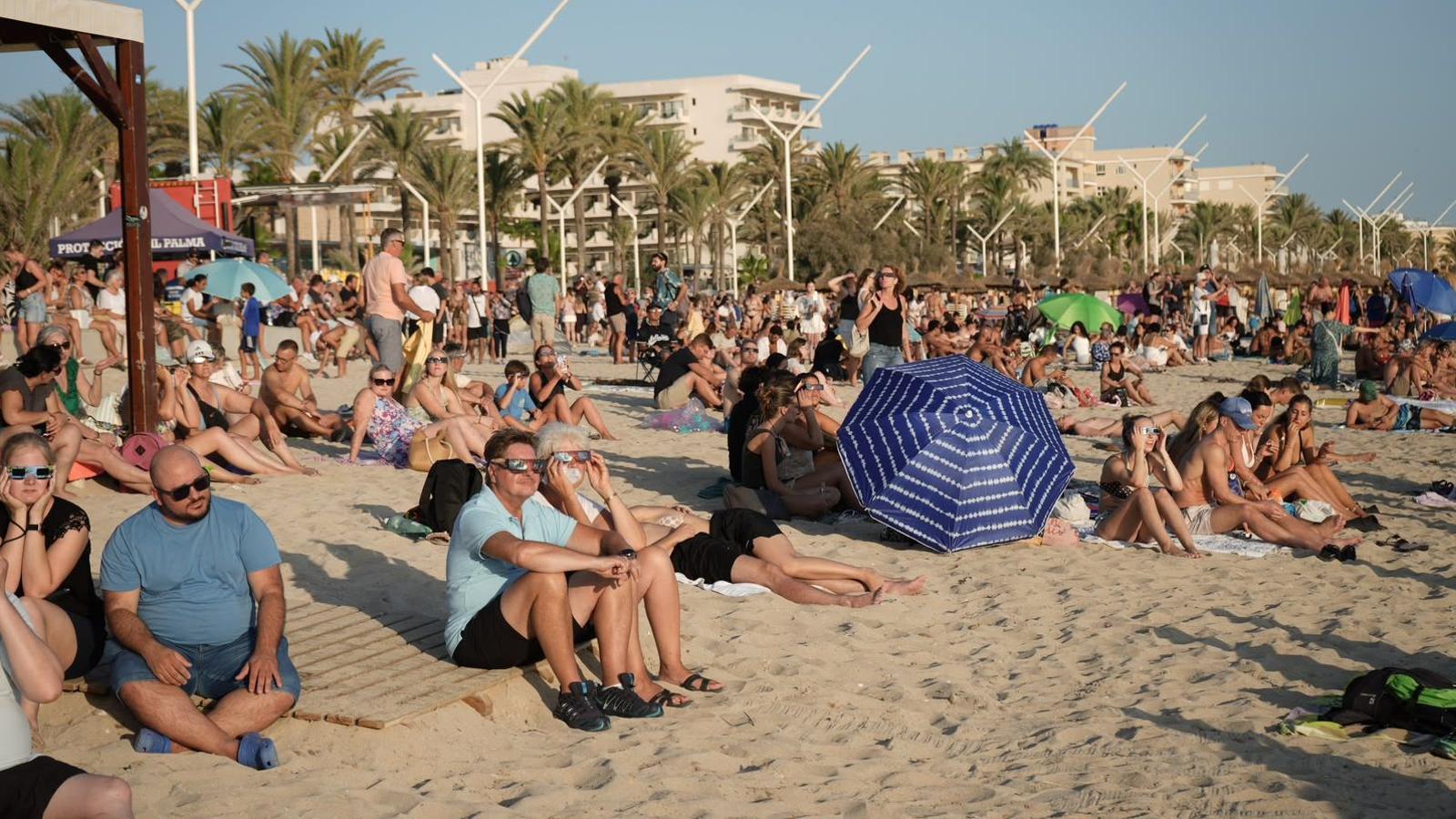
Palma“Ohhhh!”. The exclamation echoed across Playa de Palma as the Moon finished covering the Sun. And then came the applause. For a moment, the noise of the terraces, the alcohol, and the madness disappeared from this enclave of binge tourism. For one minute and 36 seconds, thousands of people (mostly foreigners) stopped looking at the sea, the sand, and their mobile phone screens to focus all their attention on a single point in the sky: the Sun. The Palma City Council had spent the day with a dance of figures: out of the 70,000 predicted, it ended up correcting itself saying it expected 30,000 attendees and finally said there were 60,000.
Above the horizon of Arenal, the sun disappeared behind the black disk of the Moon and was reduced to a ring of white light, a corona that illuminated a coast that, suddenly, seemed different. Darkness arrived in the middle of the afternoon and the beach reacted with shouts, applause, and hugs, as if it had just witnessed an unrepeatable experience.

The image has been especially extraordinary for the place where it happened. The Platja de Palma, accustomed to the summer crowds, to the bathers entering and leaving the sea and to the constant movement of the promenade, has been transformed for a few moments into an immense open-air observatory. The special glasses have disappeared from faces because during the totality they were no longer necessary, mobile phones have been raised to try to capture the ring of light and telescopes have pointed towards the sky. Those who had arrived hours before to secure a good spot and those who had discovered the eclipse almost by chance ended up doing exactly the same thing: looking up.
A long wait under the Sun
To reach that moment, however, some have had to do much more work than others. The Machaca family has arrived at El Arenal prepared to endure a long wait under the sun. They brought camping chairs, food, and buckets full of ice, and before thinking about the eclipse, they had to resolve a much more immediate issue: finding shade. They located one of the few trees left near the sand and there they set up the chairs, left the provisions, and prepared to spend the afternoon. They knew that the heat would be intense and that there were still hours to go, but they were also aware that leaving that spot could mean losing the position they had achieved. "We won't move from here until this heat stops," they explained under the tree. For them, the wait was part of the experience: it was the first total eclipse they would see live and they were not willing to let it escape for a few hours of heat.

A few meters away, the situation was completely different. Lukas, Niklas, and Maximilian, three German friends aged 27, 23, and 30, have arrived at the beach without any special preparation and with a much simpler plan: sunbathe, swim, and drink beer. They haven't brought approved glasses, cameras, or telescopes, and above all, they haven't brought any special expectations. In fact, they didn't even know there was an eclipse that afternoon. “We just found out from you, but the truth is, we don't really care; we came here to disconnect, to swim, and to enjoy a nice cold beer,” Lukas explained with a laugh while giving a thumbs-up. The Machacas had made the eclipse the focus of their entire afternoon; the three young Germans had arrived in Mallorca without knowing the Sun was about to disappear.

Between these two ways of experiencing the day, the Arenal has been filling up and transforming. Families laden with chairs and portable coolers have shared the sand with bathers who have continued their normal lives, while astronomy enthusiasts have set up telescopes and cameras in spots from which to get a good view of the phenomenon. The magnitude of the influx has become visible as the afternoon progressed. The beach, the promenade, and the surrounding streets have been receiving people looking for a place from which to contemplate the sky, in an extraordinary concentration in one of the most touristy areas of Mallorca.
The crowd has also forced the space to be reorganized on the fly. Several Mallorcan couples who had already found a spot on the beach had to move, very angry, at the indication of Civil Protection, which was placing barriers and delimiting areas so that the tent reserved for the authorities could maintain visibility over the horizon.
Those who had arrived in time to secure a good spot found that the patch of sand they had chosen was no longer exactly theirs: they had to step back, move a few meters, and look again for the best possible angle to see the eclipse. Between the fences, the directions of the volunteers, and the constant movement of people, the logistics of the event have become as visible as the anticipation for the astronomical phenomenon.
The eclipse also does business
The crowds have also generated business. On the front line, restaurants have tried to take advantage of the concentration of people with refreshing drinks and all kinds of offers, while street vendors have spread their goods on the sand. Amidst the usual merchandise, pots and kitchen utensils have even appeared, but there has been a product that has had special prominence: glasses for observing the eclipse. Those who had not bought them in advance have had to look for them at the last minute and, in some cases, pay more for them. While they cost around three euros in pharmacies, they have been sold for double in informal sales. The Sun and the Moon have done their thing and helped to create a small market on the beach, with vendors trying to take advantage of every minute before the most anticipated moment arrived. However, even so, at 7:40 p.m. there were still some absent-minded people desperately seeking protection and asking Civil Protection where they could find them.
And the moment arrived after an wait that, for some, seemed long under an relentless sun. First it was almost imperceptible: the light began to change, the heat lessened, and the shadows took on a strange appearance. Then, people's attention became increasingly focused on the sky. The glasses came out of bags, mobile phones began to point upwards, and telescopes were fixed in the direction of the Sun. Conversations about holidays, food, and the sea gradually disappeared. Even those who, like the three German friends, had not come to see the eclipse ended up getting caught up in the crowd's dynamic. Playa de Palma was no longer waiting for anything in particular: it was waiting for the Moon to finish covering the Sun.
When totality arrived, the transformation was complete. The disc of the Moon covered the Sun and, around it, the ring of light that had been the focus of all eyes for months appeared. The light disappeared almost suddenly and the coast was left under an unexpected darkness, a kind of brief night that arrived before dusk. During that minute and a half, the hotels, the promenade, the sea, and the crowd were under a strange light. The shouts gave way to applause and many people hugged each other as they tried to capture with their mobile phones an image that they probably knew no photograph could reproduce exactly. There were those who laughed, those who shouted, and those who simply remained in silence looking at that white crown that surrounded the moon. There were also those who gave up their mobile phones, aware that no screen could reproduce that image exactly. The eclipse lasted a little more than a minute, but the wait of the entire afternoon culminated in a unique moment.

But the eclipse has been as brief as it was intense. As the moon began to move away from the Sun, the light returned progressively and, with it, Platja de Palma regained its usual rhythm. Mobile phones were put away, approved glasses were returned to backpacks, and telescopes began to be dismantled, while people reviewed photos and still commented with surprise on what they had just seen. Internet connection also returned little by little, which had been collapsed by the avalanche of people concentrated in the area. Terraces regained their usual noise, bathers looked towards the sea again, and the beach began to empty slowly, undoing that enormous human concentration that, for a few minutes, had stopped looking at the sand to look towards the Sun.
The Machaca finally had their reward after enduring the heat and waiting for hours. Between some and others, between those who had planned every detail and those who had simply gone to the beach, Arenal shared for a few moments an experience that made the usual differences between residents and tourists disappear. Everyone looked at the same sky, saw the same ring of light, and applauded the same moment.
Return to alcohol
Afterwards, Playa de Palma has returned to its usual self. The terraces have resumed conversations, alcohol has gained prominence, and drunken foreigners have come out of their 'caves' or entered Megapark. A minute and a half of history in the middle of August in front of a captivated crowd. For the first time in at least 121 years, Arenal has stopped looking at the sea and the sand to fix its gaze firmly on the Sun.
