The Council's recipe against Palma's traffic jams: a new 350 million road
The new first section of the second beltway will begin to be executed between the end of the year and 2027, with an accumulated execution period of six years and two months in two phases
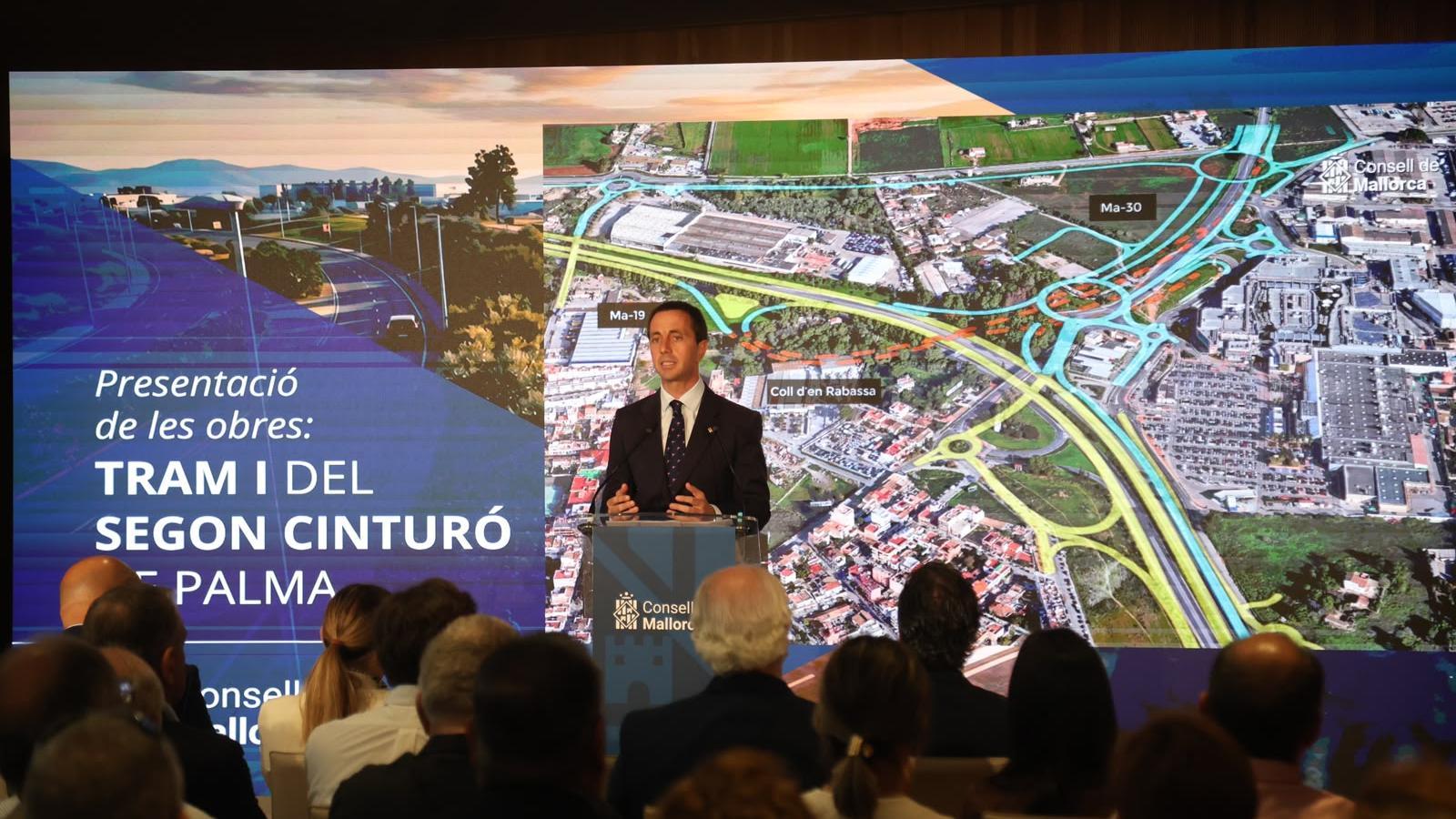
PalmaA new road –the first section of the second ring road– is the Mallorca Council's recipe to alleviate the traffic collapse suffered by the access routes to Palma. It is an action “of great social consensus”, according to the island institution, with a projected cost of 350 million euros that must continue the dual carriageway of the Ma-30 between the Manacor road and the Llucmajor motorway. The project has gained in ambition, budget, and execution time compared to what Galmés himself presented in the year 2024. The works will be divided into two phases, valued respectively at 90 and 260 million euros, and the Council plans to execute them partially simultaneously to reduce their total duration, which between the two phases adds up to six years and two months of work. The president of the Council, Llorenç Galmés, announced this Wednesday that the first phase will begin to be executed before the end of the year, while the technical managers have set the start of the works in 2027, once the processing and the public information period have been completed.
For the Council, the main objective of the project is to decongest the access routes to Palma and the ring road, where more than 185,000 vehicles circulate daily and which, as Galmés has assured, is one of the most saturated urban beltways in the country. The island institution presents the action as a “strategic infrastructure for the whole of Mallorca”, given the concentration of traffic coming from the airport, the industrial estates, the areas with large shopping centers and the main access roads to the City.
First phase, two years and ten months of workThe first phase, with an investment of 90 million euros and an estimated execution period of two years and ten months, will focus on the area between El Molinar, Es Coll d'en Rabassa, and the airport. It will include new overpasses, the improvement of the exit branch towards Es Coll d'en Rabassa, and the widening of the Ma-19 with an additional lane in each direction between kilometers 4 and 7.
The project will also allow moving the road further away from the homes in Es Coll d'en Rabassa, where it currently passes very close to the houses, and reforming the roundabout that distributes traffic to the commercial and industrial areas. In addition, new access branches will be created and the necessary space will be reserved to build a future railway stop for the future Migjorn train, which still only has the informative study approved.
Second phase, three years and four monthsThe second phase, valued at 260 million euros and with an estimated timeframe of 40 months, will act on the connection of the Ma-30 with the Ma-19. The most prominent part will be the burying of approximately one kilometer of road “to reduce its landscape impact” and allow for the development of a boulevard on the surface. This new space will incorporate pedestrian zones and civic pathways intended to connect Coll d’en Rabassa, Son Ferriol, and the commercial and industrial areas with Palma.
According to the head of the Planning and Projects Service of the Department of Roads, Laura Montaner, the project will allow for the combination of two vehicle itineraries: the underground circulation of vehicles continuing their journey and the surface routes to access the different areas of the surroundings.
The project also includes drainage basins and the installation of photovoltaic panels to supply lighting for the tunnel. Montaner has defended that a “global and comprehensive solution” has been chosen, which aims to improve traffic fluidity and, at the same time, “territorially and environmentally integrate” the infrastructure.
The Council has not specified how many vehicles could be removed from the ring road once the new section comes into operation. Technical managers have explained that they have simulations that allow for predicting “optimal service levels,” but they have not provided an estimate regarding the effective reduction of traffic.
The two projects that make up the first section of the second ring road will soon be released for public information. The will of the Department of Roads, said Montaner, is to partially overlap their execution so that the set of works does not drag on for six years and two months, but rather can be completed in a shorter timeframe.
Galmés attacks previous governments“Today we come to keep our word and provide solutions to people’s real problems,” stated Galmés during the presentation. The island president described the second ring road as a “long-awaited and demanded” project and assured that it has a “broad consensus within Mallorcan society.”
Criticisms of previous municipal, island, and regional executives dominated much of the presentation of this infrastructure. Galmés attributed the delays to the discrepancies of previous governments and stated that the project had been “in a drawer for more than ten years because the previous leaders only argued.” The president of the Council also defended the new road as a sign of his executive’s will to put “Mallorcans at the center of policies” and improve their quality of life.
The mayor of Palma, Jaime Martínez, described the project as “vital” for the city. Martínez recalled that thousands of people enter and leave Palma daily and that the strong population growth over the last decades has turned mobility into an “absolute priority.” According to the mayor, the intervention will not only decongest the beltway but will also allow for “cohesion” between different neighborhoods and offer mobility alternatives.
The President of the Government, Margalida Prohens, framed the action within a broader mobility policy and highlighted the coordination between the Government, the Council, and the Palma City Council. “We cannot normalize traffic jams or fall into resignation,” defended Prohens, who assured that the project “is about the time” that citizens lose every day in traffic.
The claim for 350 million from the StateBoth Galmés and Prohens have used the presentation to once again demand from the Spanish government the 350 million euros from the old road agreement, an amount equivalent to the cost announced to execute the two phases of the project.
Galmés has accused the state executive of having "stolen" these resources from Mallorca during the previous term and of not having met with the Council during the current mandate. The President of the Government has reproached Francina Armengol's executive for having renounced this amount "in exchange for a photo at Raixa".
The President has assured that the Government maintains the claim, but that it will not remain "resigned" while waiting for resources that do not arrive. In this sense, she has recalled that the Government and the Council signed a 30 million euro agreement and has showcased the flagship project of Galmés's mandate regarding roads, presented this Tuesday at the Palma Congress Centre.
